

How Informational Intent Dictates Organic Growth in the AI Era
Search engines process billions of unique queries every single day. Users do not just search the web to buy products immediately; instead, they hunt for knowledge, clarity, and solutions to their daily challenges. In the current era of search marketing, artificial intelligence and large language models completely reshape how platforms serve results. Google AI Overviews, Perplexity, and ChatGPT synthesize content directly from web pages to provide instant answers to user queries. If you want your website to survive and thrive in this shifting digital ecosystem, you must understand the exact psychological triggers behind user searches.
Search intent represents the foundational pillar of any successful digital marketing strategy. When a user opens a browser, they carry a specific goal in their mind. Content creators who successfully identify and satisfy this underlying goal win the organic visibility race. Among the various classifications of search intent, informational queries command the largest share of overall web traffic. Brands that ignore these educational search terms miss a massive opportunity to connect with potential clients at the very beginning of their buying journeys. By creating comprehensive, value-driven resources, you establish immediate authority and build deep trust with your target market.
Ready to scale your organic reach? Explore our tailored SEO services to dominate search rankings and attract qualified buyers today.
Decoding Search Intent: What Are Informational Keywords?
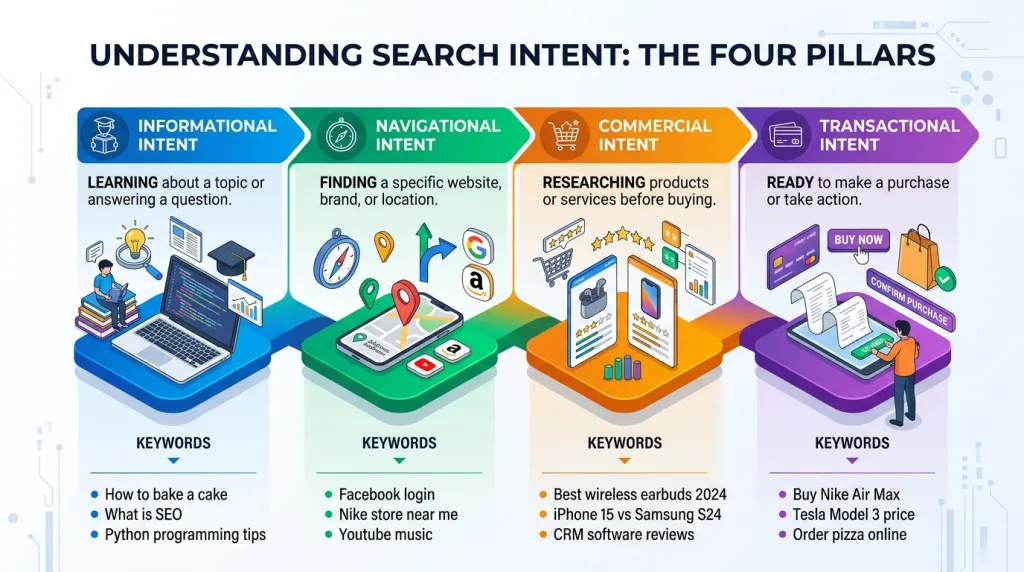
Informational keywords are specific search phrases that users enter into search engines when they want to discover facts, learn concepts, find tutorials, or gather background data on a topic. Unlike buyers who look for a discount code or a specific checkout page, information seekers look for education. They want to expand their understanding of a particular subject, troubleshoot a technical issue, or gather ideas for an upcoming project.
To build a robust content blueprint, you must distinguish informational phrases from other core categories of search intent:
- Informational Intent: The user seeks answers to specific questions or wants to learn more about a general concept (e.g., “how does machine learning work”).
- Navigational Intent: The searcher wants to find a specific website or portal (e.g., “Facebook login” or “Vastcope blog”).
- Commercial Intent: The consumer investigates options, compares brands, and reads reviews before making a final purchase choice (e.g., “best project management software 2026”).
- Transactional Intent: The buyer has their credit card ready and searches for the absolute fastest way to complete a purchase (e.g., “buy iPhone 15 pro max online”).
Informational searches dominate the top of your marketing funnel. When people experience a new challenge, they do not immediately search for a vendor. They search for definitions, symptoms, causes, and step-by-step remedies. If your website provides the most lucid, accurate, and comprehensive answer, you anchor your brand into the reader’s consciousness long before they look at a pricing page.
The True Value of Informational Keywords for Your Website
Many business owners make the critical mistake of targeting only high-transaction keywords. They pour their entire marketing budget into short-tail phrases like “hire web developer” or “SEO agency.” While these transactional terms boast high conversion rates, they also carry extreme competition and high cost-per-click rates. Conversely, informational keywords offer a massive, cost-effective stream of recurring organic traffic that compounds in value over time.
When you create content around educational terms, you establish your business as a genuine thought leader in your industry. Users naturally gravitate toward companies that freely share valuable insights without demanding an immediate financial transaction. This open exchange builds brand equity. Ranking in the top organic spots requires exceptional user satisfaction signals, which educational blog posts naturally generate through high dwell times and low bounce rates.
Furthermore, informational content fuels your entire digital ecosystem. You can repurpose a single comprehensive guide into a dozen social media snippets, email newsletters, and downloadable lead magnets.
The Linguistic Anatomy of Informational Queries
Informational keywords possess distinct linguistic markers that make them exceptionally easy to spot during your keyword research process. Searchers structure these queries around curiosity, exploration, and problem-solving.
Most informational phrases begin with interrogative adverbs or question-based triggers:
- Who: Seeks individuals, brands, or responsible entities (e.g., “who creates custom CMS platforms”).
- What: Seeks definitions, conceptual clarity, or explanations (e.g., “what is generative engine optimization”).
- Where: Seeks locations, sources, or platforms (e.g., “where do find high-quality stock photography”).
- Why: Seeks causes, motivations, or underlying logic (e.g., “why does my website load slowly”).
- How: Seeks step-by-step guidance, tutorials, or methodologies (e.g., “how to build high-quality backlinks”).
Beyond basic questions, informational queries heavily utilize guide-based terminology. Phrases containing words like “tutorial,” “guide,” “tips,” “ideas,” “examples,” “framework,” or “case study” automatically fall into the informational bucket.
Advanced Keyword Research Strategies for Informational Terms
Finding lucrative informational keywords requires a strategic blend of professional software analytics and real-world user observations. Follow this step-by-step framework to build an exhaustive list of traffic-driving informational keywords:
- Filter by Intent in Professional SEO Tools: Open your preferred search analytics suite (Semrush, Ahrefs, Moz). Enter your broad industry seed keywords. Use the built-in keyword intent filters to isolate “Informational” queries exclusively. Look for terms that display a moderate-to-high search volume combined with a manageable keyword difficulty score.
- Extract Insights from People Also Ask (PAA) Boxes: Google’s live search results pages offer a goldmine of real-time user intent data. Search for a primary topic in your niche and examine the “People Also Ask” section. Every single question in a PAA box represents an excellent subhead or a dedicated standalone blog post for your website.
- Conduct Comprehensive SERP Inspections: Never write a single sentence without performing a deep Google SERP analysis first. Look closely at the top three ranking results for your target informational phrase. Analyze their content depth, formatting choices, and media inclusions.
- Mine Community Forums and Social Media: Spend time inside subreddits, Quora spaces, and industry-specific LinkedIn groups. Pay close attention to repetitive questions, frustrating software experiences, and conceptual confusions. When a user writes a detailed post asking for help, write a definitive, long-form blog article that provides the exact solution.
Generative Engine Optimization (GEO): The New Frontier
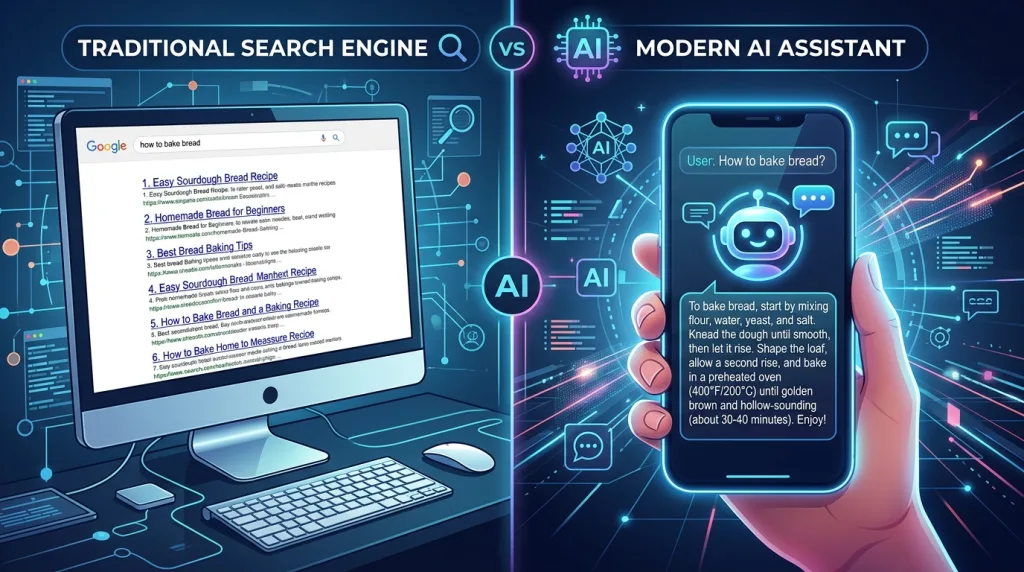
The traditional rules of SEO no longer suffice in an environment dominated by artificial intelligence. Today, you must master Generative Engine Optimization (GEO) alongside standard search practices. Generative AI engines do not merely present a list of blue hyperlinks; they actively ingest web pages, summarize core facts, and present an aggregated answer directly inside the chat screen.
| Optimization Type | Primary Goal | Core Ranking Factors |
| Traditional SEO | Rank Blue Links | Backlinks, Keyword Density, Site Speed |
| Modern GEO | Earn AI Citations | Direct Answers, Bolded Entities, Factual Data |
AI engines prioritize content that displays extreme clarity, authority, and structural organization. To optimize your informational blog posts for GEO, execute these four tactical content upgrades:
- Provide Immediate, Direct Answers: Place a concise, 40-to-50-word summary statement immediately beneath your main question headings. AI engines can easily extract this text block to form their conversational responses.
- Bold Your Core Entities and Facts: Bold essential terms, statistics, names, and metrics. This visual and structural emphasis helps AI parsers identify key data points during their scraping routines.
- Incorporate Unique Statistics and Case Studies: Include proprietary statistics, original research, or highly specific case studies to make your page an irreplaceable source of truth.
- Cite High-Authority Sources Extensively: Back up your subjective claims with external references to established industry authorities.
Boost your AI search visibility with authority links. Partner with our experts for premium backlink acquisition strategies that drive results.
Mapping Informational Keywords to High-Value Content Formats
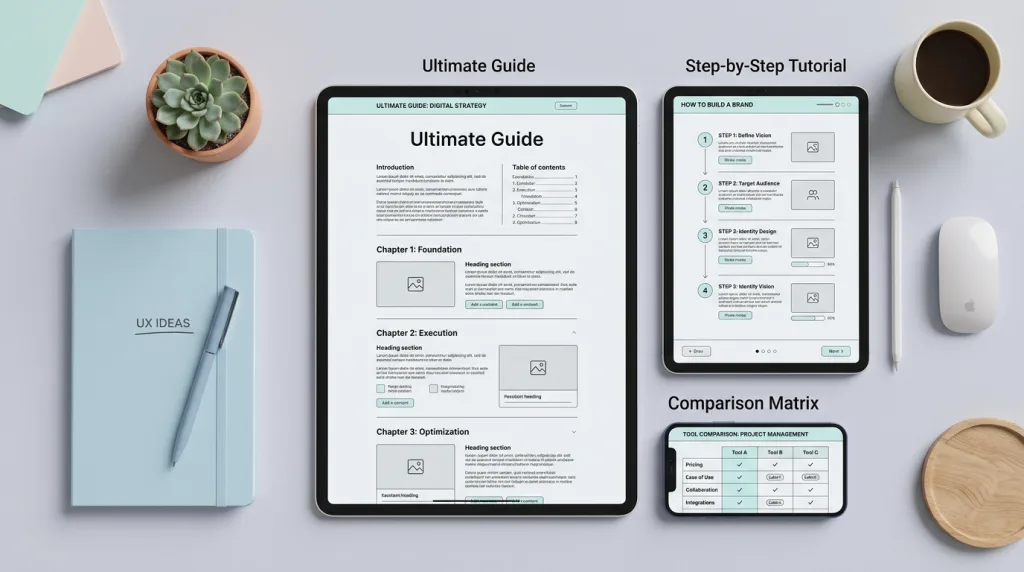
Different informational keywords require different content vehicles. You must carefully pair the keyword’s depth with the appropriate content architecture.
| Informational Content Format | Ideal Keyword Target | Core Structural Elements |
| Ultimate Guide | Broad, foundational concepts | Table of contents, H2/H3 chapters, internal links |
| Step-by-Step Tutorial | Process-oriented “how-to” queries | Numbered lists, action-oriented verbs, clear stages |
| Comparison Matrix | “X vs Y” or analytical queries | Bullet points, bold features, direct performance contrasts |
- Ultimate Guides: Break the guide into logical chapters using descriptive subheadings. Use a clear table of contents at the top of the page to help users navigate.
- Detailed Tutorials: Dive straight into the execution phase. Use ordered numbered lists to outline each individual step in chronological sequence.
- Structural Breakdown Matrix: Organize complex data using a structured matrix or standard vocabulary formats (like Schema.org) to make relationships easily understandable for both human readers and search bots.
Turn your informational blog traffic into high-paying clients. Discover how our professional lead generation services can maximize your revenue.
On-Page SEO and Formatting Rules for Educational Posts
Exceptional keyword research will fail if your website features poor on-page optimization. You must format your content so that search crawlers can parse it instantly, and human readers can scan it effortlessly.
Master the Hierarchy of Heading Tags
Always structure your article using a logical heading waterfall. Dedicate your H1 tag exclusively to your main title. Divide your main chapters using H2 tags, and break down sub-concepts using H3 and H4 tags. Never skip a heading level.
Keep Paragraphs Brief and Balanced
Limit your paragraphs to a maximum of three to four sentences. Dedicate each paragraph to a single, distinct idea. This breathing room lowers cognitive load and keeps users scrolling deeper down your page.
Maintain a Dominant Active Voice
Write your content using an active voice in more than 90% of your sentences. Instead of writing passive phrases like “The keyword research should be conducted by your team,” state directly: “Your team must conduct thorough keyword research.”
Keep your readers engaged with flawless design. Contact our team for bespoke UI/UX design solutions that boost user engagement.
The Soft Conversion Strategy: Moving Users Down the Funnel

Driving millions of organic visitors means absolutely nothing if that traffic leaves without interacting with your brand. You cannot treat informational traffic like transactional traffic. Instead, execute a strategic soft conversion plan.
The Informational Conversion Funnel:
Informational Search âž” Contextual Content Upgrade âž” Email Nurture Sequence âž” Commercial Client
The most effective way to capture an information seeker involves offering a contextually relevant content upgrade (e.g., a downloadable PDF checklist). Once you secure their email address, route them into an automated nurture sequence. Send them additional helpful resources over the coming weeks. When they eventually require professional corporate assistance, your agency will stand as the obvious, undisputed choice.
Crucial Metrics to Track for Informational Campaigns
To ensure your informational keyword campaign produces tangible business value, track these core metrics:
- Monitor Dwell Time and Scroll Depth: Dwell time measures the exact duration a searcher spends analyzing your page. Track your scroll depth metrics inside Google Analytics to see exactly where users lose interest.
- Audit Your Assisted Conversions: Informational blog posts rarely secure direct, last-click sales. Configure custom multi-channel funnel reports inside your analytics suite to monitor how often a customer first discovers your brand through an educational article and later returns to hire your company.
- Measure Generative AI Citation Counts: Manually track how often AI platforms (ChatGPT, Perplexity, Google AI Overviews) cite your content as reference footnotes.
Conclusion: The Future of Informational Search Strategy
Targeting informational keywords represents the single most reliable method for building a resilient, high-traffic web presence that withstands volatile search engine algorithm updates. By prioritizing user education, you align your business directly with the ultimate goal of search platforms: delivering instant, accurate, and deeply satisfying answers to human curiosity.
Ultimate success belongs to content creators who publish truly comprehensive, authoritative, and expertly structured resources. Analyze your target market’s deepest questions, format your articles for both human eyes and generative parsers, and maintain a clear funnel to transform raw educational traffic into profitable, long-term business relationships.
Frequently Asked Questions (FAQs)
What is the primary difference between informational and commercial keywords?
Informational keywords target users who want to learn a concept or solve a problem without spending money immediately (e.g., “what is causing my website slowdown”). Commercial keywords target users who actively compare specific brands, read reviews, and explore pricing options before purchasing a final service (e.g., “best managed WordPress hosting provider”).
Can informational blog posts generate actual business revenue?
Yes. Informational blog posts generate substantial revenue by capturing prospective buyers at the very beginning of their decision-making process. You can capture their contact details via lead magnets and guide them down your sales funnel until they buy.
How many words should a high-quality informational article contain?
An informational article should contain as many words as necessary to completely resolve the searcher’s query without adding fluff. While short topics require only 1,000 words, highly complex subjects or ultimate guides often require 2,500 to 3,500 words to comprehensively satisfy modern search engine crawlers and generative AI platforms.
What is Generative Engine Optimization (GEO) in search marketing?
Generative Engine Optimization (GEO) is the practice of structuring website content so that AI-powered search engines (like Google AI Overviews, Perplexity, and ChatGPT) can easily parse, summarize, and cite your text within their conversational search responses. GEO focuses on direct answers, bolded entities, and clean data-backed facts.
How often should I audit and update my informational blog posts?
You should audit and refresh your core informational blog content at least once every six to twelve months. Updating outdated statistics and adding answers to new relevant user questions signals to search engines that your resource remains accurate and fresh.
Why does long-tail informational keyword targeting convert better?
Long-tail informational keywords convert better because they possess extreme specificity. A user searching a broad term like “marketing” has unclear intent, whereas a user searching “how to configure goal tracking in Google Analytics 4” reveals an exact professional challenge.
Keep reading
All articles
How to Convert a Photo to a Line Drawing in Photoshop (Easy Guide)
Converting a photo to a line drawing opens up a world of artistic possibilities. You might want to create a coloring book…
Read article
Key Marketing Terms That Drive Search Results
Build stronger campaigns by mastering core search terminology. Packed with explanations, examples, and tips, this resource helps marketers make smarter decisions every…
Read article
How to Choose the Ideal Content Management System for 2026
What Is a Content Management System (CMS)? The Complete Master Guide Managing a modern website used to require hand-crafting HTML code, writing…
Read article