
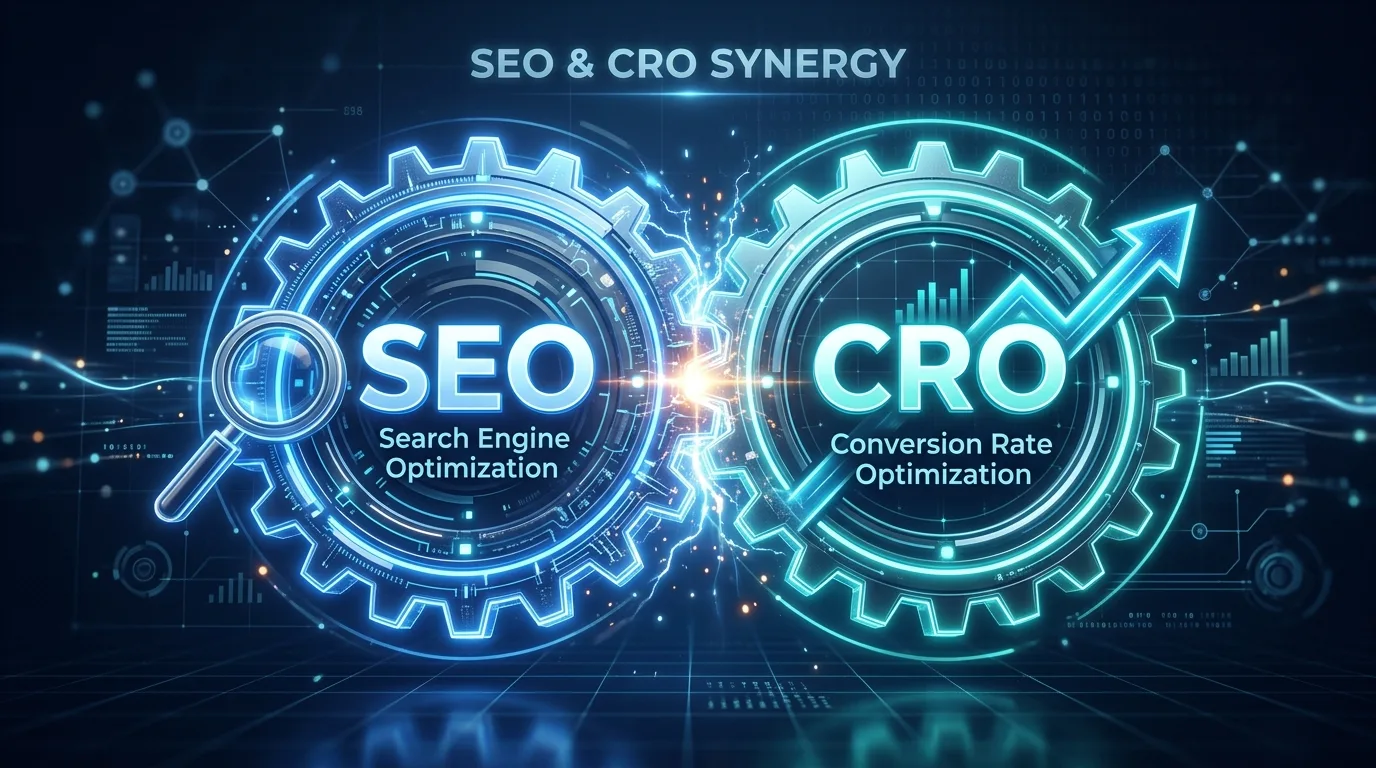
Digital marketing often forces businesses into artificial silos. Teams divide budgets, specialists work in isolation, and executives chase fragmented metrics. The most profound manifestation of this issue appears in the ongoing division between Search Engine Optimization (SEO) and Conversion Rate Optimization (CRO).
For years, marketers treated these two disciplines as independent paths. The SEO team focused exclusively on satisfying search engine algorithms to drive organic visibility. Meanwhile, the CRO team focused entirely on the user experience once visitors arrived on the page. This division creates a fundamental flaw in your digital ecosystem.
When you separate search optimization from conversion optimization, you compromise the efficiency of both strategies. SEO without CRO leaves your business with high traffic numbers that fail to generate revenue. CRO without SEO leaves you with a perfectly optimized sales funnel that contains no users. True digital growth happens when you align these two forces into a single, cohesive engine. This article unpacks the strategic synergy between SEO and CRO, demonstrating why they must work together to maximize your return on investment.
Boost your organic visibility and secure higher search engine rankings with our tailored SEO strategies.
Unpacking Search Engine Optimization (SEO)
The Mechanics of Attracting Organic Audiences
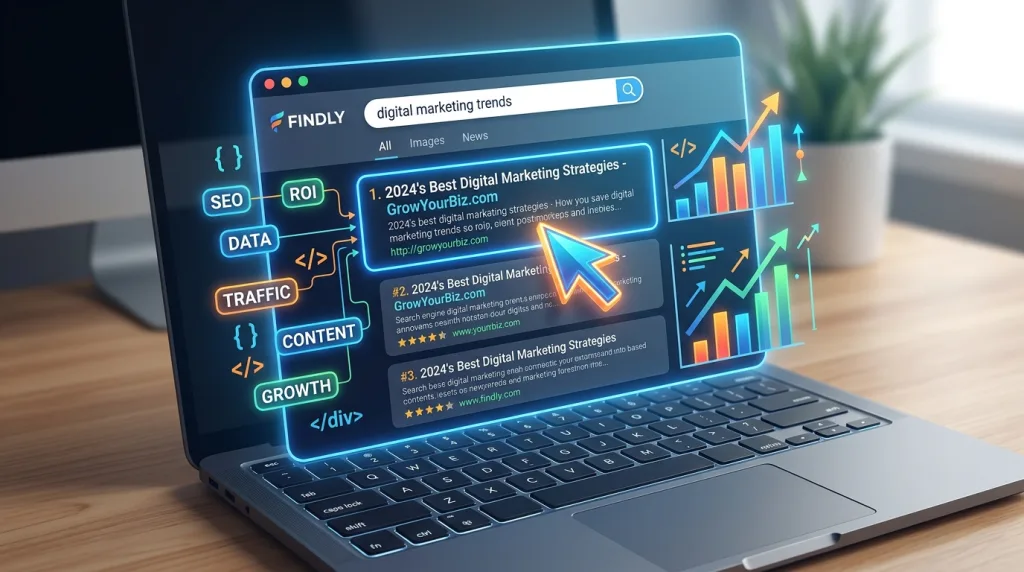
Search Engine Optimization represents the deliberate process of increasing your website’s visibility within organic search engine results pages (SERPs). At its core, SEO functions as an acquisition mechanism. It connects individuals who have specific questions, needs, or commercial intents with your digital platform.
To achieve high visibility, your website must satisfy hundreds of algorithmic ranking signals. These signals evaluate everything from your technical architecture to the contextual depth of your written material.
Core Metrics of Search Success
To evaluate the efficacy of your search campaigns, you must monitor specific performance indicators. These metrics show how effectively search engines discover, index, and favor your content:
- Organic Impressions: The total number of times your website appears in search results for user queries.
- Organic Traffic: The absolute number of unique visitors who arrive on your site via unpaid search listings.
- Keyword Rankings: The precise position your pages hold on search result pages for targeted phrases.
- Click-Through Rate (CTR): The percentage of searchers who click your organic listing after seeing it on a search engine result page.
Understanding how to source, evaluate, and implement correct search phrases remains central to this process. Businesses frequently struggle to connect with their target audience because they target keyword variants that lack clear intent. For a deep understanding of how keywords form the bedrock of your search visibility, review our comprehensive breakdown on understanding how to use SEO keywords effectively to structure your site’s content.
The Evolution of Modern Search Algorithms
Modern search algorithms no longer rely on simple keyword matching. Engines use advanced machine learning and semantic understanding to interpret the exact context behind a query. They reward websites that offer deep, comprehensive answers to specific questions rather than pages that repeat phrases excessively.
Consequently, search optimization now demands structural integrity, rapid load speeds, mobile responsiveness, and high-quality information. Your site must solve the user’s problem quickly to hold its rank.
Demystifying Conversion Rate Optimization (CRO)

The Art of Persuading On-Site Visitors
While search optimization focuses on the journey to your website, Conversion Rate Optimization governs the journey within your website. CRO represents the systemic process of enhancing your site’s user experience to increase the percentage of visitors who complete a specific, desired action. It turns passive browsers into active customers, leads, or subscribers.
CRO relies heavily on data-driven experimentation. Optimization specialists do not guess what works; they use continuous A/B testing, multivariate testing, heatmaps, and user feedback loops to reveal exact user preferences. According to industry tracking by Optimizely’s optimization glossary documentation, a successful conversion strategy relies fundamentally on deep user research, structured website analytics, and rigorous landing page refinement to remove friction points across the user journey.
Defining Key Conversion Objectives
Conversion goals vary depending on your business model, target industry, and specific marketing campaigns. They generally fall into two categories:
- Macro-Conversions: Primary revenue-driving actions, such as completing a product purchase, requesting a commercial service quote, or signing a long-term service contract.
- Micro-Conversions: Low-barrier actions that indicate interest, such as signing up for an email newsletter, downloading a whitepaper, creating an account, or adding an item to a digital shopping cart.
Essential Performance Metrics for CRO
To track your conversion optimization success, your analytics setup must isolate clear behavioral metrics. These figures help you pinpoint exactly where users lose interest or encounter friction:
- Conversion Rate: The percentage of total visitors who successfully complete a defined conversion goal.
- Bounce Rate: The percentage of users who exit your website after viewing only a single page without triggering any actions.
- Average Session Duration: The total time a user spends exploring your site during a single visit.
- Cart Abandonment Rate: The proportion of e-commerce users who add items to their digital carts but exit before paying.
The Danger of Siloed Strategies
The Vanity Trap of High Traffic and Zero Conversions
When digital teams operate in isolation, they prioritize narrow metrics over total business growth. An isolated SEO team often falls into the trap of pursuing raw traffic volume without assessing the commercial readiness of that traffic. They might optimize for high-volume keywords that bring hundreds of thousands of users to your site.
However, if those landing pages lack clear navigation, persuasive copy, or visible calls-to-action, those visitors will leave immediately. High traffic looks excellent on monthly performance reports, but it does not cover business expenses. It indicates that you are paying to attract an audience that you fail to monetize.
The Failure of High-Converting Funnels Without Traffic
Conversely, focusing entirely on conversion optimization while ignoring search visibility creates an equally destructive scenario. Imagine building the most intuitive, persuasive, and beautifully designed landing page in your industry. If that page is buried on the fifth page of search results, no one will ever see it.
CRO requires a steady stream of data to achieve statistical significance in A/B testing. Without consistent organic traffic, your conversion optimization efforts stagnate because you lack the sample size needed to make valid, data-backed design changes.
Aligning Team Priorities for Unified Success
Siloed operations also create internal conflict and redundant asset creation. The SEO team might add paragraphs of dense text to a page to satisfy search engine crawlers, while the CRO team tries to remove text to clear the user’s path to a checkout button.
Without collaboration, these teams constantly undo each other’s adjustments. You must establish a unified operational framework where both teams work toward a single overarching goal: maximizing profitable conversions from organic search channels.
Transform your digital platform into an intuitive, high-converting masterpiece with our professional UI/UX design services.
The Synergistic Intersection: Where SEO and CRO Collide
Navigating the Unified Landscape of Search Intent
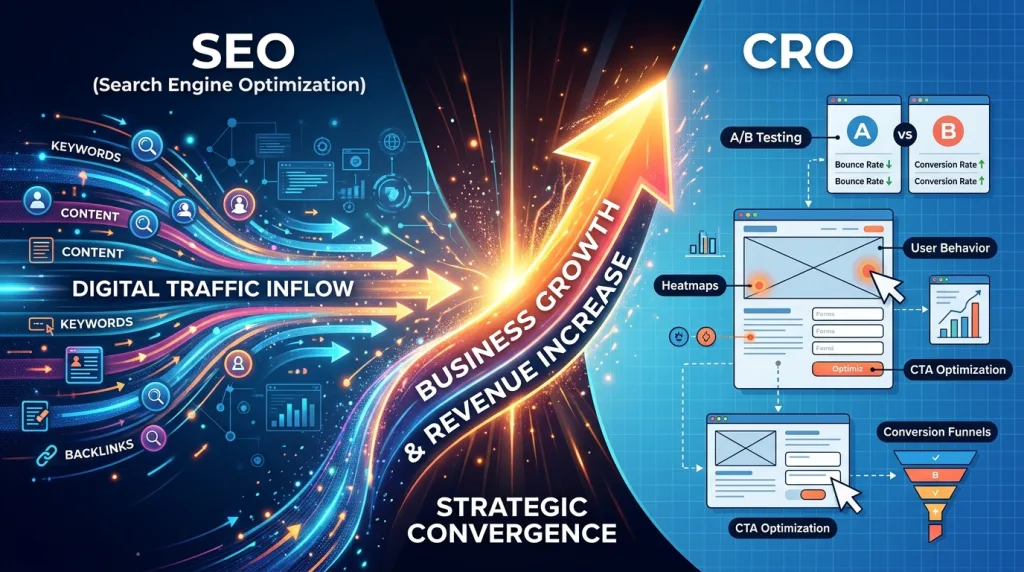
The intersection of SEO and CRO begins with a shared focus on search intent. Search intent represents the underlying reason why a user types a specific query into a search engine. To rank your content, search engines must believe your page provides the best answer to that intent.
To convert that visitor, your page must deliver that exact answer instantly. When you align your SEO keyword targeting with your CRO landing page structure, you ensure that the user finds exactly what they expected. This continuity lowers bounce rates and establishes immediate trust.
Mastering Shared Technical Foundations
Search engines and human users value many of the same technical performance metrics. Consider page load speed. Search engines use page speed as a primary ranking factor because slow websites frustrate users. At the same time, conversion data shows that slow websites destroy revenue. According to commercial data compiled within WordStream’s conversion optimization benchmark analysis, a page that loads in just one second achieves e-commerce conversion rates that are 2.5 times higher than a page taking five seconds to load.
By optimizing your images, cleaning your code, and utilizing fast hosting, you satisfy search engine algorithms while removing a primary point of user friction. The table below illustrates how primary optimization actions simultaneously improve both search and conversion metrics:
| Optimization Action | Search Engine Impact (SEO) | User Experience Impact (CRO) |
| Compressing Images & Media | Lowers page load times; improves Core Web Vitals rankings. | Prevents user abandonment; keeps visitors engaged on mobile devices. |
| Simplifying Site Architecture | Enables efficient crawling and indexing by search bots. | Helps users locate products or forms within three clicks. |
| Writing Clear Meta Assets | Improves organic CTR on search engine result pages. | Prepares the user’s expectations; brings qualified leads to the page. |
| Enhancing Mobile Layouts | Satisfies mobile-first indexing requirements. | Secures conversions from smartphone users, who drive over half of all traffic. |
Capitalizing on Shared Behavioral Data Insights
SEO and CRO strategies thrive on the same behavioral datasets. When an SEO analyst notices that a specific page has high organic rankings but a high bounce rate, they uncover a prime opportunity for CRO intervention.
The high rank proves that the keyword targeting is successful, while the high bounce rate indicates that the on-page experience fails the user. By analyzing heatmaps and session replays on that page, conversion specialists can reconfigure layouts, move call-to-action buttons, or clarify headlines to capture and retain that search traffic.
A Practical Blueprint to Integrate SEO and CRO
Mapping Keywords to the Complete Customer Journey
To integrate SEO and CRO effectively, you must map your keyword strategy to every phase of the customer journey. Avoid targeting generic, high-volume terms exclusively. Instead, build a balanced portfolio of informational, consideration-focused, and transactional keywords:
- Informational Queries: Users seek knowledge (e.g., “how does digital optimization work”). Optimize these blog pages for search visibility, and use soft CRO goals like email newsletter sign-ups to capture the lead.
- Consideration Queries: Users compare alternatives (e.g., “best optimization frameworks for business”). Use comparative content, detailed case studies, and clear downloadable resources to guide them forward.
- Transactional Queries: Users intend to buy immediately (e.g., “hire professional optimization agency”). Direct this traffic to streamlined, highly focused landing pages that minimize distractions and feature prominent contact forms.
Architecting High-Performing Landing Pages
An integrated landing page must serve two masters: the search engine crawler and the human reader. To achieve this dual optimization, place your most valuable, keyword-conscious information above the digital fold. This placement allows both search crawlers and human visitors to understand your topic instantly.
Structure your content using logical header tags (H1, H2, H3) to organize your points. Use bullet points and bold text to make your text highly skimmable for users who do not want to read long paragraphs. Keep your forms brief; asking for too much information upfront reduces your conversion rate.
Executing Risk-Free CRO Experiments
Marketers often fear that running CRO experiments will damage their search engine rankings. If you use split-testing software improperly, search engines might view identical pages as duplicate content and penalize your site. However, you can run rigorous A/B tests safely by following clear search compliance guidelines:
- Use Rel=”canonical” Tags: Point your alternate test variations back to the original primary URL to ensure search engines know which page to index.
- Employ 302 Redirects: Use temporary (302) redirects rather than permanent (301) redirects when sending traffic to test variations.
- Keep Tests Time-Bound: Conclude your experiments and implement the winning variation as soon as you achieve statistical significance.
- Avoid Cloaking: Never show one version of a page to search engine bots and a completely different version to human visitors.
Measuring Combined Success: Unified KPIs
Transitioning Beyond Fragmented Departmental Reporting
To unlock the full potential of your integrated marketing engine, you must stop evaluating SEO and CRO in separate monthly reports. Evaluating organic search traffic without looking at conversion data encourages teams to focus on raw traffic numbers.
Evaluating conversion rates without tracking traffic sources masks changes in your audience’s profile. You must view these metrics as connected parts of a single conversion pipeline.
The Power of Combined Conversion Optimization
To understand the financial value of this unified approach, look at how small improvements in traffic and conversion rates compound to transform your bottom line. Let’s analyze a clear scenario tracking a business that generates leads through organic search:
- The Baseline Scenario: Your website attracts 10,000 organic visitors every month. Your landing page converts those visitors at a standard 1% rate. This baseline generates 100 leads per month.
- The Isolated Search Approach: You focus exclusively on SEO for six months. You increase organic traffic by 50%, bringing your monthly audience to 15,000 visitors. However, because you ignored on-page optimization, your conversion rate drops slightly to 0.9% due to broader audience targeting. You now generate 135 leads.
- The Integrated Strategy: You split your focus equally between SEO and CRO. You grow your organic traffic by a modest 20%, reaching 12,000 visitors. Simultaneously, your CRO efforts clean up the user journey, increasing your conversion rate from 1% to 2%. Your business now generates 240 leads per month.
This model proves that combining minor improvements across both disciplines yields far better results than focusing heavily on just one. The integrated strategy increases your lead volume by 140% without requiring you to double your customer acquisition budget.
Generative Engine Optimization (GEO): The Next Frontier

Navigating the Landscape of AI-Driven Search
The digital optimization landscape is undergoing a massive shift. Traditional search engines are evolving into generative answer engines that use artificial intelligence to answer queries directly within the search interface. This shift gives rise to Generative Engine Optimization (GEO).
To remain visible in an AI-driven environment, your content must do more than match keywords. It must serve as an authoritative source that AI models trust enough to cite in their generated answers.
Core GEO Strategies for Future-Proofing Your Site
To optimize your platform for generative search engines, you must prioritize information density and clarity. AI models value structured data and direct answers. Implement these strategies to maintain your digital visibility:
- Maximize Information Density: Remove filler language. Provide clear, direct answers to complex user questions early in your text.
- Integrate Structured Schema Markup: Use detailed JSON-LD schema to help generative engines understand the relationships between your products, authors, and services.
- Incorporate Authoritative Data and Citations: Support your claims with verified industry data and links to trusted sources. This structure makes your platform highly citable for AI models.
- Focus on Conversational Search Alignment: Optimize for long-tail, conversational phrases that mirror how people speak to AI assistants.
Why CRO is Your Best Defense Against Search Fluctuations
As generative engines answer more queries directly on search pages, some informational search traffic will decline. This shift makes the traffic that does reach your website incredibly valuable.
You cannot afford to waste qualified visitors who click through to your site. A robust CRO strategy ensures that your platform extracts maximum value from every single organic visitor, protecting your revenue even during major search engine algorithm updates.
Conclusion: Developing an Integrated Framework
Breaking Down the Barriers to Digital Success
Siloed digital marketing strategies are no longer effective. The clear division between SEO and CRO creates fragmented user experiences, wasted marketing budgets, and lost revenue opportunities.
True digital growth requires a shift in perspective. You must view SEO and CRO as two sides of the same coin: one brings the audience to your door, and the other welcomes them inside and guides them to the checkout counter.
Your Action Plan for Unified Optimization
To build a sustainable digital marketing model, establish clear processes that encourage your search and conversion teams to work together:
- Share Data Repositories: Ensure both teams analyze the same analytics dashboards, heatmap reports, and search console accounts.
- Collaborate on Keyword Research: Involve your conversion specialists in keyword planning to ensure your SEO team targets phrases with high commercial intent.
- Conduct Joint Page Audits: Review underperforming pages together to find ways to improve both search visibility and user conversion rates.
- Align Performance Metrics: Reward your teams based on total business growth and revenue conversions rather than isolated traffic or bounce rate metrics.
When you merge these two disciplines into a single framework, you create a powerful digital ecosystem. Your search optimization efforts attract highly qualified leads, and your conversion optimization efforts convert those leads efficiently. Stop choosing between traffic and conversions; integrate your strategies today to build an enduring digital competitive advantage.
Attract more high-quality prospects and scale your sales pipeline efficiently with our results-driven lead generation strategies.
Frequently Asked Questions (FAQ)
Can I implement CRO strategies on my website without having organic traffic?
You can technically set up conversion rate optimization tools and refine your design layout without organic traffic, but your long-term success will stall. CRO relies on steady traffic data to run valid A/B tests and identify clear user behavior patterns.
Without consistent traffic from organic search or paid campaigns, you will struggle to gather large enough sample sizes to make accurate, data-backed decisions. Focus on building a reliable traffic foundation through search optimization first, then layer in rigorous conversion testing to maximize your results.
Will changing my web copy for CRO experiments hurt my search engine rankings?
Modifying your on-page copy can influence your search engine rankings if you remove essential target keywords or alter the core focus of the page. However, you can safely optimize your text by following proper integration guidelines.
Always keep your primary target keywords within your critical structural elements, such as your H1 titles and meta tags, while reconfiguring your body copy, headlines, and call-to-action buttons to improve readability and user engagement. When you run split tests, make sure to use correct canonical tags to prevent search engines from penalizing your site for duplicate content.
How do I figure out if my website needs help with search visibility or conversion rates?
You can find the answers by analyzing your primary analytics data. If your website ranks well and attracts high traffic volumes, but your sales or form submissions remain flat, you have a conversion problem that requires immediate CRO support.
Conversely, if your analytics show a high conversion rate but very low overall traffic numbers, your main bottleneck is visibility. In that scenario, you need to ramp up your SEO campaigns to bring more qualified prospects into your sales funnel.
How does mobile optimization influence both search engine rankings and conversions?
Mobile performance plays a critical role in both optimization disciplines. Search engines evaluate websites using mobile-first indexing, meaning they rank your platform based on how efficiently it loads and operates on smartphones.
From a conversion standpoint, a large portion of global web traffic comes from mobile devices. If your checkout processes are confusing, your text is too small, or your buttons are hard to click on a smartphone, mobile users will abandon your site immediately, damaging both your conversion metrics and your search visibility.
What is the average timeframe for seeing measurable results from an integrated campaign?
Search engine optimization is inherently a long-term investment that typically requires three to six months to show significant ranking gains and traffic growth. Conversion rate optimization can sometimes deliver quicker returns because a winning layout adjustment or a clearer headline can boost your conversion rates as soon as you launch the test.
When you combine both strategies, expect to see your overall lead and revenue metrics improve steadily over a three-to-six-month period as your growing traffic runs through an increasingly efficient sales funnel.
How does the rise of AI answer engines affect traditional search and conversion strategies?
AI-driven search engines are shifting the digital landscape toward Generative Engine Optimization (GEO). These systems answer simple questions directly on the search results page, which may reduce traffic to basic informational articles.
To stay competitive, your content must provide deep, authoritative analysis that AI models trust enough to cite. Because this shift makes on-site traffic scarcer and more valuable, you must use excellent CRO to convert a higher percentage of the users who click through to your website.
Keep reading
All articles
Lead Generation: A Complete Guide to Building a High-Converting Pipeline
The modern marketplace moves faster than ever before. Today, capturing consumer attention requires more than just flashing a generic advertisement or blasting…
Read article
What’s A Good CTR (Click-Through Rate) for Your Industry?
Decoding Click-Through Rate: The Ultimate Metric for Modern Search Visibility Digital marketers consistently chase higher performance across search engines and paid platforms.…
Read article
Marketing KPIs for Business Leaders: The Ultimate Growth Guide
Marketing often feels like a mix of creative intuition and financial risk. However, for business decision-makers, the difference between a high-growth brand…
Read article