
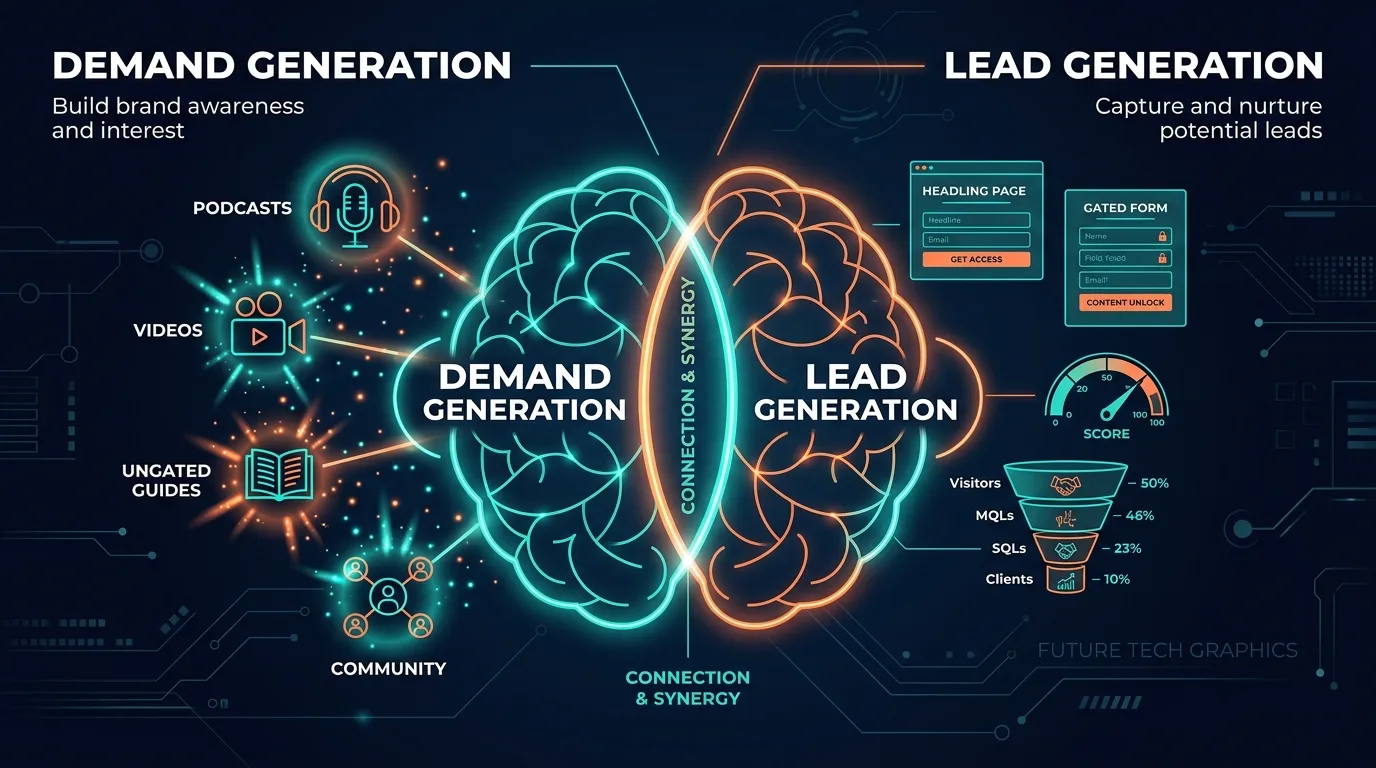
You pour thousands into marketing campaigns. Your team generates hundreds of leads every month. But when you check the sales pipeline, almost nothing moves.
This scenario plays out daily across B2B companies. Marketing celebrates high lead volume while sales complains about poor quality. Neither side wins. The root cause usually traces back to one fundamental confusion: teams treat demand generation and lead generation as interchangeable strategies.
They are not the same. Confusing them costs you pipeline velocity, marketing ROI, and sales efficiency.
In this guide, I will clarify exactly what each strategy does, show you how they work together, and give you a practical framework to implement both the right way. By the end, you will know how to build awareness that fills your funnel and capture leads that actually close.
Struggling to turn traffic into qualified leads? Learn how BANT qualification helps you identify high-intent prospects before wasting sales time.
What Is Demand Generation? (The Big Picture)
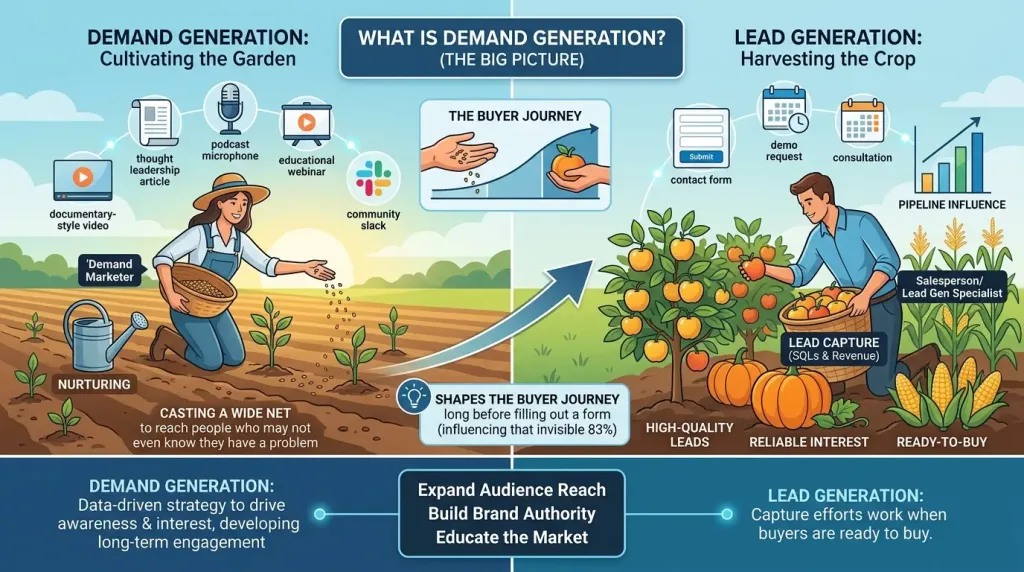
Demand generation is a data-driven marketing strategy focused on driving awareness and interest in your products or services, with the ultimate goal of developing long-term customer engagement.
Think of demand generation as planting seeds. You do not harvest immediately. You nurture the soil, water consistently, and trust that growth happens over time. Demand generation casts a wide net to reach people who may not even know they have a problem yet.
Gartner defines demand generation as a strategy that builds reliable brand awareness and interest, resulting in high-quality leads. The keyword here is reliable. You want steady, predictable interest, not one-time spikes.
Core Goals of Demand Generation
- Expand your audience reach beyond existing followers to attract new potential customers who fit your ideal profile
- Build brand authority by positioning your company as a trusted industry leader through thoughtful content and expertise
- Educate the market about problems customers may not realize they have, then show how your solution addresses those challenges
- Drive long-term engagement that keeps your brand top-of-mind when prospects eventually enter a buying cycle
- Create conditions for lead generation so your capture efforts actually work when buyers are ready
Real-World Demand Generation Examples
A cybersecurity software company creates a documentary-style video series exploring industry challenges. Visitors should be able to explore without interruption. Trust develops naturally when people can access valuable information before making a commitment. That approach often leads to stronger engagement and higher-quality conversions. Just pure value delivered consistently. Brand awareness increases 340% among target accounts. When those accounts enter buying cycles, the brand appears on 78% of vendor shortlists.
Another example: a sneaker brand gives its latest shoes to a popular athlete. The athlete posts videos wearing them. The videos go viral. Fans talk endlessly about the shoes. That is demand generation in action. You created desire before anyone asked for a sale.
Common Demand Generation Tactics
- Ungated thought leadership content on LinkedIn, YouTube, and industry publications
- Educational webinars that teach skills and frameworks without pushing product features
- Podcast appearances and hosting to build authority through authentic conversations
- Brand advertising focused on category awareness rather than direct response
- Social media education through short videos, carousels, and posts that answer buyer questions
- Community building in Slack groups, Reddit threads, or industry forums
- Original research reports that analyze market trends and buyer behavior
How to Measure Demand Generation Success
Traditional metrics like cost-per-lead do not work here. Demand generation requires different measurement approaches:
| Metric Type | What to Track | Why It Matters |
|---|---|---|
| Awareness | Brand mentions, share of voice, organic search impressions | Shows whether your message reaches new audiences |
| Engagement | Time on site, scroll depth, repeat visits, video completion rates | Indicates genuine interest, not accidental clicks |
| Consideration | Return visits, resource page views, comparison content consumption | Signals movement toward active evaluation |
| Pipeline influence | Multi-touch attribution, influenced opportunities, assisted conversions | Connects demand activity to eventual revenue |
According to Gartner research, 83% of a typical B2B purchase decision happens before a buyer directly engages with any provider. Demand generation influences that invisible 83%. It shapes the buyer journey long before anyone fills out a form.
What Is Lead Generation? (The Capture Mechanism)
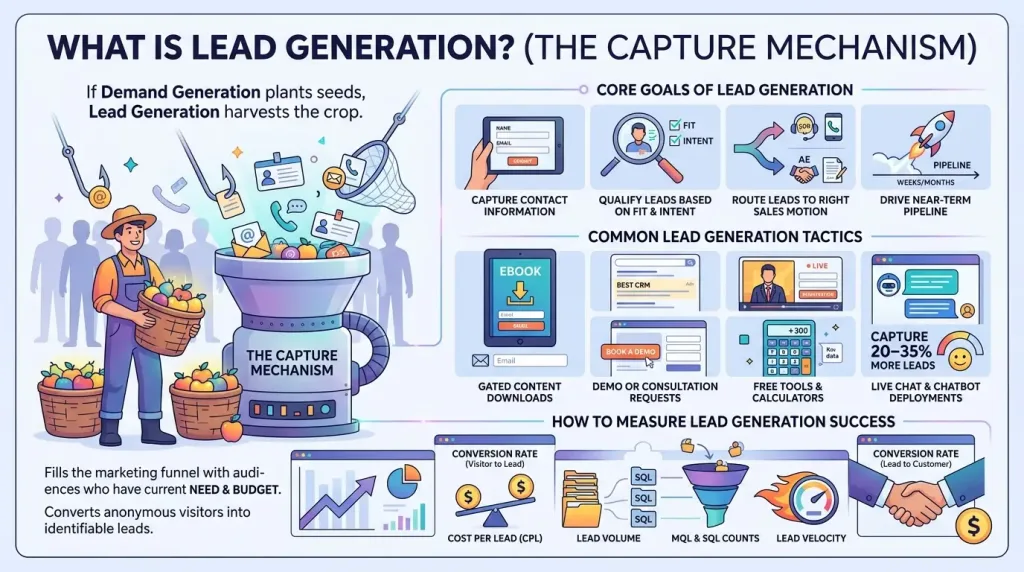
Lead generation focuses specifically on filling the marketing funnel with audiences who have a current need and budget to purchase your product or service. It captures contact information from prospects who have shown purchase interest and converts anonymous visitors into identifiable leads.
If demand generation plants seeds, lead generation harvests the crop. You identify who is ready to buy now and get them into your system so sales can follow up immediately.
Core Goals of Lead Generation
- Capture contact information from interested prospects through forms, gated content, and registration pages
- Qualify leads based on fit and intent to ensure sales receives only actionable opportunities
- Route leads to the right sales motion whether that means an SDR for outbound or an AE for direct closing
- Drive near-term pipeline that converts into revenue within weeks or months, not quarters or years
- Enable personalized follow-up by collecting data that helps sales tailor their approach
Real-World Lead Generation Examples
A retailer sees viral demand for a trending sneaker and posts an Instagram story letting fans know the shoes are in stock. Fans click through, visit the retailer’s site, and provide their email to reserve a pair. That is lead generation.
A SaaS company offers a free trial that requires email signup. Users provide their information in exchange for immediate product access. The company then nurtures those users through targeted email campaigns and in-app messaging to convert free users into paying customers.
Common Lead Generation Tactics
- Gated content downloads where prospects exchange email addresses for ebooks, whitepapers, checklists, or templates
- Paid search campaigns with conversion-focused landing pages targeting high-intent keywords like “best CRM for small business” or “enterprise pricing”
- Webinar registrations that require form submission and often include automated email follow-up sequences
- Demo or consultation request forms for visitors ready to speak with sales directly
- Newsletter subscriptions that offer ongoing value in exchange for email addresses
- Free tools or calculators that solve a small but painful problem while capturing user data
- Live chat and chatbot deployments that capture 20–35% more leads than form-only sites by engaging buyers at the moment of intent
How to Measure Lead Generation Success
Lead generation metrics focus on efficiency and conversion:
- Conversion rate from visitor to lead on landing pages and forms
- Cost per lead (CPL) across different channels and campaigns
- Lead volume by source, campaign, and audience segment
- MQL and SQL counts showing how many leads pass qualification thresholds
- Lead velocity measuring how quickly leads move from capture to opportunity
- Conversion rate from lead to customer to track ultimate effectiveness
Demand Generation vs. Lead Generation: The Critical Differences
Many marketers use these terms interchangeably. That mistake costs real money. Understanding the differences helps you allocate budget wisely and set realistic expectations for each activity.
| Dimension | Demand Generation | Lead Generation |
|---|---|---|
| Primary goal | Build awareness, educate the market, create buying intent | Capture contact information, qualify prospects, drive pipeline |
| Funnel stage | Top of funnel (TOFU) problem unaware to solution exploring | Middle to bottom (MOFU/BOFU) evaluating vendors to decision |
| Content approach | Ungated, educational, freely accessible | Gated behind forms, conversion-focused |
| Audience | Broad market, early-stage buyers, problem-unaware | In-market buyers, solution-aware, ready to evaluate |
| Timeline | Long-term (3–12 months to see impact) | Short-term (immediate conversions, weekly targets) |
| Key metrics | Engagement, brand mentions, reach, influenced pipeline | Conversion rates, MQL volume, cost-per-lead, lead velocity |
| Core question | “How do we make our market smarter?” | “How do we capture buyers ready to talk?” |
The core difference is simple: demand generation creates the demand, and lead generation collects the leads from that engaged audience.
Or as one marketer put it: “Lead generation is about collecting names. Demand creation is about making people want to work with you. One is short-term. The other builds a brand.”
Why the Difference Matters for Your Business
If you only focus on lead generation, you fight for the 5% of buyers actively in-market right now. You compete on price, features, and timing against every other vendor chasing the same small pool.
If you only focus on demand generation, you build awareness and trust but may struggle to convert traffic into sales. You create a thirsty audience but have no mechanism to capture them when they reach for a glass.
Smart companies do both. Marketing effectiveness experts Les Binet and Peter Field recommend a 60/40 split between brand building (demand generation) and sales activation (lead generation) to maximize long-term success.
How Demand Generation and Lead Generation Work Together
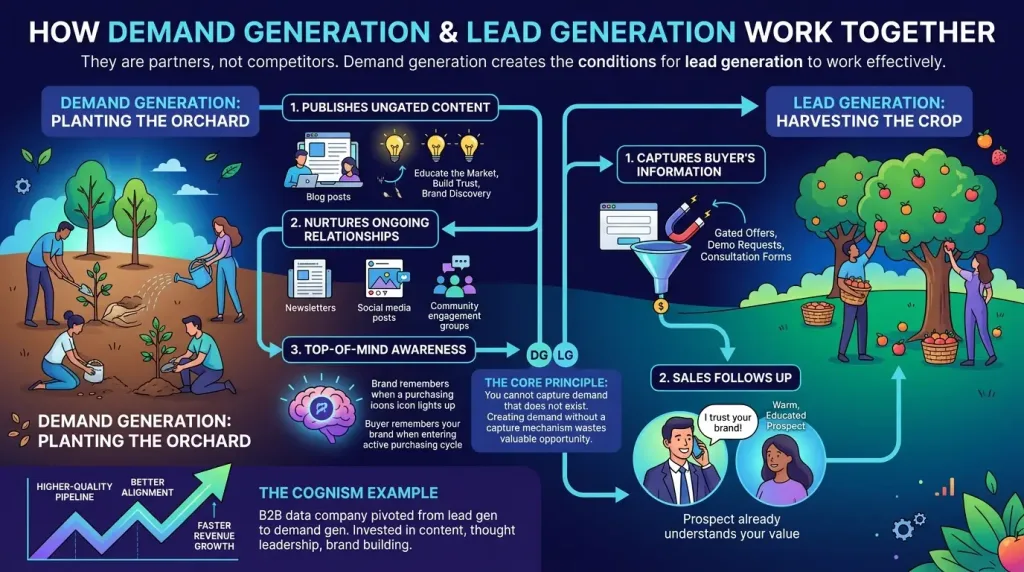
These strategies are not competitors. They are partners. Demand generation creates the conditions for lead generation to work effectively.
Here is the workflow:
- Demand generation publishes ungated content that educates the market. Buyers discover your brand, read your insights, and start trusting your expertise.
- Demand generation nurtures ongoing relationships through email, social media, and community engagement. Your brand stays top-of-mind.
- When a buyer enters an active purchasing cycle, they remember your brand. They search for you directly or click through to your site.
- Lead generation captures that buyer’s information through a gated offer, demo request, or consultation form.
- Sales follows up with a warm, educated prospect who already trusts your brand and understands your value.
Want to build a lead generation system that actually captures ready-to-buy prospects? Explore our end-to-end lead generation services to turn traffic into qualified leads.
You cannot capture demand that does not exist. And creating demand without a capture mechanism wastes valuable opportunity.
The Cognism Example
Cognism, a B2B data company, made a strategic pivot from lead generation to demand generation. They stopped chasing low-quality leads through aggressive outbound tactics. Instead, they invested heavily in educational content, thought leadership, and brand building. The result Higher-quality pipeline, better alignment between marketing and sales, and faster revenue growth.
The Plant-and-Harvest Analogy
- Demand generation = planting an orchard. You prepare the soil, plant seeds, water consistently, and wait years for trees to mature. You build the infrastructure for ongoing harvests.
- Lead generation = harvesting the crop. You pick ripe fruit when it is ready. You cannot harvest before the trees bear fruit. And if you never planted trees, you have nothing to harvest.
Building a Balanced Demand Generation Strategy
Creating effective demand generation requires patience, consistency, and a clear understanding of your ideal customer profile (ICP).
Step 1: Define Your Ideal Customer Profile Deeply
Being precise in your understanding of your ICP is the cornerstone of high-impact demand generation. Identify their pains, gains, shifts, blockers, and motivators.
Document the following:
- Industries and company sizes you serve best
- Job titles and buying committee roles involved in decisions
- Common trigger events that push them to seek solutions
- Pressing problems that keep them up at night
- Desired business outcomes they want to achieve
Step 2: Map Content to the Full Buyer Journey
Create content for every stage of awareness:
- Problem unaware – Educational content that helps buyers recognize challenges they may not know exist
- Solution exploring – Content comparing approaches, explaining methodologies, and building frameworks
- Vendor considering – Detailed product information, case studies, and proof points
- Decision ready – Pricing guides, ROI calculators, and implementation resources
Step 3: Choose Channels That Reach Your Audience Where They Learn
According to Gartner, high-growth organizations identify SEO and in-person events as their top MQL sources, not just paid ads.
Effective demand generation channels include:
- Organic search through SEO-optimized content that answers buyer questions
- Social media platforms where your audience spends time (LinkedIn for B2B, Instagram or TikTok for consumer)
- Email newsletters that deliver ongoing value without aggressive selling
- Webinars and virtual events that teach skills and frameworks
- Industry podcasts where you appear as a guest or host your own show
- Community platforms like Slack groups, Reddit, or specialized forums
- Earned media and PR that puts your brand in trusted publications
Step 4: Give Value Without Immediate Return
The golden rule of demand generation: Give value without asking for anything in return. At least 80% of your demand content should be ungated. No forms. Skip the email requirements. Remove every point of friction.
When you provide genuine value consistently, buyers remember your brand. When they eventually enter a buying cycle, you appear on their shortlist without having to chase them.
Already generating leads but struggling to manage them effectively? Discover how proper lead management transforms raw leads into predictable revenue.
Building a High-Performing Lead Generation Engine
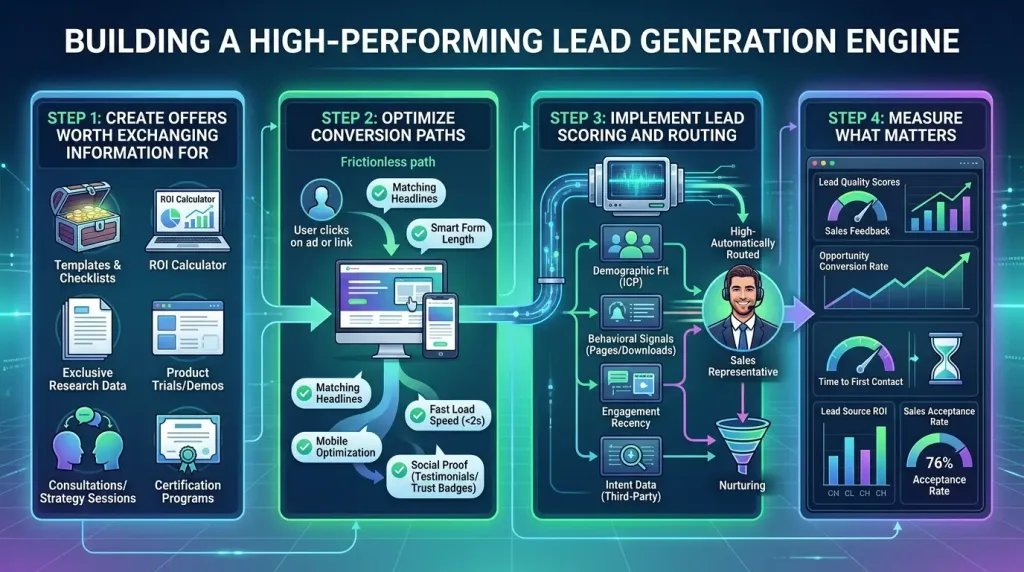
Once you create demand, you need systems to capture it efficiently.
Step 1: Create Offers Worth Exchanging Information For
Your lead generation offers must provide clear value that justifies the exchange of contact information. Weak offers produce weak leads.
Strong lead generation offers include:
- Detailed templates and checklists that save hours of manual work
- ROI calculators that help prospects quantify their potential savings
- Exclusive research data not available anywhere else
- Product trials and demos that deliver immediate value
- Consultation or strategy sessions with your experts
- Certification programs that build professional credentials
Step 2: Optimize Conversion Paths
Every step from click to conversion must be frictionless:
- Landing page headlines match the ad or link that brought the visitor
- Form length matches offer value (short forms for low-commitment offers, longer forms for high-value content)
- Page load speed stays under two seconds to prevent abandonment
- Mobile optimization ensures forms work flawlessly on phones
- Social proof like testimonials, case studies, and trust badges builds confidence
Step 3: Implement Lead Scoring and Routing
Not all leads deserve immediate sales attention. Implement a lead scoring system that assigns numerical values based on:
- Demographic fit (industry, company size, job title alignment with your ICP)
- Behavioral signals (page visits, content downloads, pricing page views)
- Engagement recency (how recently they interacted with your brand)
- Intent data (third-party signals indicating active buying research)
When a lead hits your qualification threshold, automatically route them to the right sales representative. Speed wins deals. Delayed follow-up kills conversion.
Step 4: Measure What Matters
Beyond basic volume metrics, track:
- Lead quality scores from sales feedback on each lead
- Opportunity conversion rate from lead to qualified opportunity
- Time to first contact and its correlation with conversion
- Lead source ROI comparing cost per opportunity across channels
- Sales acceptance rate showing how many leads sales actually pursues
The Role of AI and Automation in 2026
Both demand generation and lead generation have transformed dramatically with AI adoption. According to Gartner, 92% of businesses are investing in AI-powered marketing tools.
AI in Demand Generation
- Predictive audience targeting that identifies accounts showing early buying signals before they actively search
- Content personalization at scale that serves tailored messages based on industry, role, and behavior
- Conversational AI that engages visitors in natural dialogue without friction or forms
- Intent data analysis that surfaces which accounts are researching your category
AI in Lead Generation
- Automated lead scoring that continuously refines qualification models based on conversion data
- Chatbot lead capture that engages visitors 24/7 and qualifies them before human handoff
- Personalized email nurturing that adapts content based on engagement signals
- Predictive lead routing that assigns prospects to the sales rep most likely to close them
Common Mistakes and How to Avoid Them
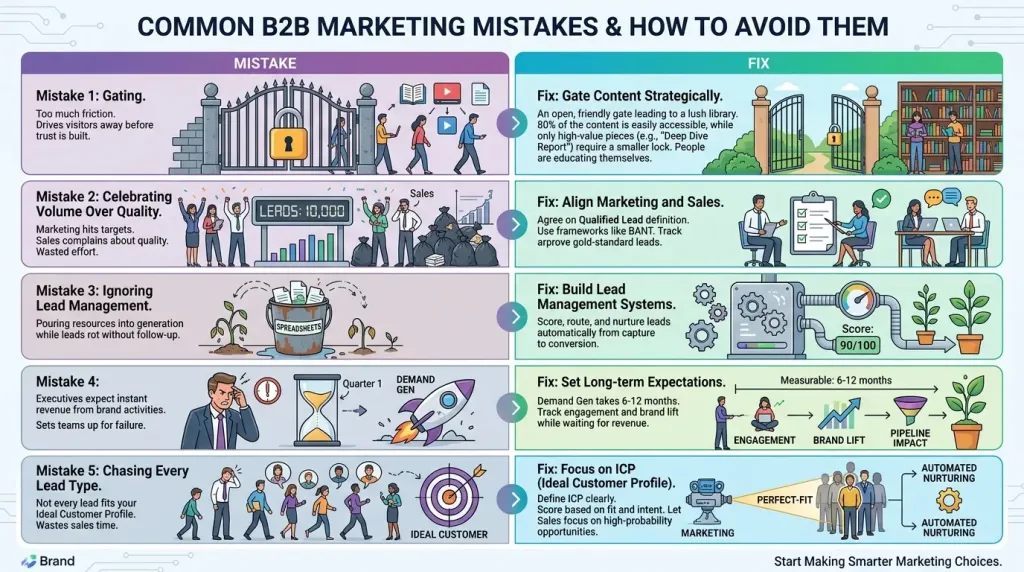
Mistake 1: Gating Everything
Many marketers gate every piece of content, thinking they capture more leads. Instead, they create friction that drives visitors away before trust is established.
Fix: Gate only content that high-intent buyers truly value. Keep 80% of your content ungated. Let visitors educate themselves without barriers.
Mistake 2: Celebrating Lead Volume Over Quality
Marketing teams celebrate hitting lead targets while sales complains about quality. This creates toxic dynamics and wasted effort on both sides.
Fix: Align marketing and sales on a shared definition of a qualified lead. Use frameworks like BANT (Budget, Authority, Need, Timeline) to ensure quality before handoff. Track sales acceptance rate as a key metric for marketing success.
Mistake 3: Ignoring Lead Management After Capture
Companies pour resources into lead generation while leads quietly rot in spreadsheets, never receiving follow-up.
Fix: Build lead management systems that automatically score, route, and nurture leads from capture to conversion. Lead generation without management is like filling a bucket with holes.
Mistake 4: Expecting Immediate ROI from Demand Generation
Demand generation takes time. Executives who expect next-quarter revenue from brand-building activities set teams up for failure and budget cuts.
Fix: Set appropriate expectations from the start. Demand generation typically takes 6–12 months to show measurable pipeline impact. Track leading indicators like engagement and brand lift while waiting for revenue contribution.
Mistake 5: Chasing Every Lead Type
Not every lead fits your ideal customer profile. Chasing unqualified leads wastes sales time and lowers morale.
Fix: Define your ICP clearly. Score leads based on fit and intent. Let low-scoring leads nurture through automated sequences while sales focuses on high-probability opportunities.
Frequently Asked Questions
Q1: Can a business succeed with only lead generation and no demand generation?
Yes, but only in very specific circumstances. If you sell a commodity product in a well-established category with constant in-market demand, you may succeed with pure lead capture. However, for most B2B businesses, ignoring demand generation means fighting for the 5% of buyers actively searching while ignoring the 95% who will enter the market later. Over time, lead-only strategies become increasingly expensive as you compete on price against every other vendor chasing the same small pool.
Q2: How do I know if my team is doing demand generation or lead generation?
Ask two questions: “Are we asking for something in return?” and “Who are we targeting?” If you require a form fill before delivering value, you are doing lead generation. If you give value freely to a broad audience without immediate return expectations, you are doing demand generation. Most teams do both. The key is recognizing which activity serves which purpose.
Q3: What budget split should I use between demand generation and lead generation?
Marketing effectiveness research suggests a 60/40 split between brand building (demand generation) and sales activation (lead generation) for most businesses. However, the right split depends on your market position. Startups in new categories may need 80% demand generation to educate the market. Established brands in mature categories may shift toward 50% lead generation to capture existing demand efficiently.
Q4: How long does it take to see results from demand generation?
Demand generation typically requires 3–12 months to show measurable pipeline impact. Brand awareness builds slowly. Trust develops over multiple touchpoints. The good news: once demand generation works, it creates compounding returns. Each month of consistent effort makes the next month easier. Early indicators like engagement rates, brand search volume, and direct traffic appear within 1–3 months. Revenue contribution usually follows in 6–12 months.
Q5: What’s the difference between MQLs, SQLs, and PQLs?
MQLs (Marketing Qualified Leads) have engaged with your content but may need more nurturing before sales outreach. SQLs (Sales Qualified Leads) have demonstrated clear buying intent and are ready for direct sales engagement. PQLs (Product Qualified Leads) are unique to SaaS, representing free trial or freemium users who have experienced product value and are now primed for conversion. Understanding these distinctions helps marketing and sales work efficiently together.
Q6: Should I gate my content or keep it ungated?
Gate selectively. Keep 80% of your content ungated to build trust and educate your audience without friction. Gate only the top 20% of your highest-value content the assets that buyers with genuine intent actively seek out. A hybrid approach works best: use ungated content for demand generation and gated offers for lead capture when buyers are ready.
Q7: How does SEO fit into demand generation and lead generation?
SEO serves both strategies. For demand generation, SEO helps you reach problem-unaware buyers through educational content targeting informational queries. For lead generation, SEO captures in-market buyers through transactional and commercial investigation queries targeting product comparisons and solution searches. According to Gartner, high-growth organizations identify SEO as their top MQL source.
Q8: How do I get sales to actually follow up on leads marketing generates?
Build shared qualification criteria and closed-loop reporting. When sales sees that marketing delivers leads that actually close, follow-up rates increase. Use frameworks like BANT to ensure quality before handoff. Track sales acceptance rate and opportunity conversion rate as key metrics for both teams. Hold regular meetings where marketing and sales review lead quality together and adjust criteria based on real outcomes.
Keep reading
All articles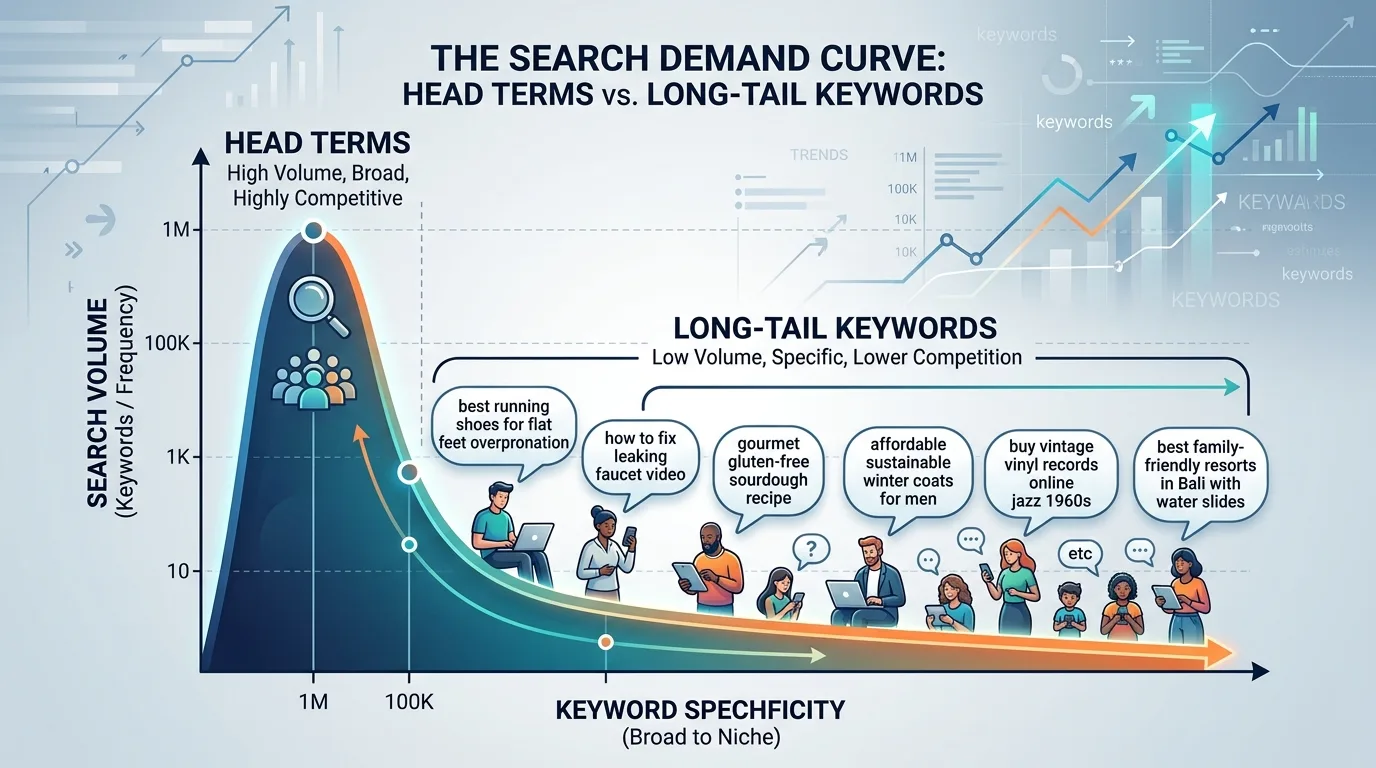
What Is Long-Tail SEO? A Complete Strategy for High Ranking
Learn what long-tail SEO is and how to use it to drive high-quality organic traffic. Boost your website's conversion rates by targeting…
Read article
What is Google E-E-A-T? Guidelines and SEO Benefits
Imagine you’re searching for advice on a health symptom or a critical financial decision. You land on two articles. One is written…
Read article
SEO vs. CRO: Why They Should Always Go Together
Digital marketing often forces businesses into artificial silos. Teams divide budgets, specialists work in isolation, and executives chase fragmented metrics. The most…
Read article