

Imagine you’re searching for advice on a health symptom or a critical financial decision. You land on two articles. One is written by a named doctor with decades of clinical experience, complete with citations from medical journals. The other is an anonymous blog post with no author credentials, peppered with generic statements. Which one would you trust? Google’s algorithms are now sophisticated enough to make that same judgment, and they use a framework called E-E-A-T to do it.
E-E-A-T stands for Experience, Expertise, Authoritativeness, and Trustworthiness. It forms the backbone of Google’s Search Quality Rater Guidelines the handbook used by thousands of human evaluators to assess the quality of search results. While E-E-A-T isn’t a direct ranking factor like Page Speed or backlinks, Google confirms it’s a critical signal that shapes how the algorithm interprets page quality. For any website owner, content creator, or SEO professional, understanding and demonstrating E-E-A-T has become non-negotiable for long-term organic visibility.
Eager to strengthen your authority? Learn how strategic backlinks can lift your site’s trust signals explore our SEO backlinks guide now.
This article unpacks everything you need to know about Google E-E-A-T: its evolution from the original E-A-T, how each pillar works, actionable guidelines, undeniable SEO benefits, and how to future-proof your content for AI-powered search. Let’s dive deep.
The Evolution from E-A-T to E-E-A-T
Google first introduced the concept of E-A-T (Expertise, Authoritativeness, Trustworthiness) in its 2014 Search Quality Rater Guidelines. For years, SEOs obsessed over proving “expertise” and “authority,” often forgetting the human element behind the content. Then, in December 2022, Google made a monumental update: it added Experience to the mix, placing it before Expertise and doubling down on the importance of Trust.
Why the shift? Because Google recognized that some of the most valuable information on the web comes from people who have actually lived through a situation, used a product, or visited a place not just from credentialed experts. A product review by someone who has genuinely used the item for six months offers insights a lab test might miss. A travel guide written by a local who navigates those streets daily provides texture no generic tourism board can match. The extra “E” now rewards that real-world, first-hand involvement.
The updated E-E-A-T acronym now reads as:
- Experience – First-hand or life experience with the topic.
- Expertise – The depth of knowledge or skill in a specific field.
- Authoritativeness – The reputation you hold among peers and your industry.
- Trustworthiness – The accuracy, honesty, and reliability of your content and website.
Crucially, Trust sits at the center of the entire framework. Google states in its Search Quality Rater Guidelines (section 3.4) that “Trust is the most important member of the E-E-A-T family because untrustworthy pages have low E-E-A-T no matter how Experienced, Expert, or Authoritative they may seem.” You can have all the certificates and glowing reviews, but if users can’t trust the information or the security of your site everything collapses.
Breaking Down Each Pillar of E-E-A-T

To implement E-E-A-T effectively, you need to understand what each element demands from your content and website. Let’s break them down one by one, with actionable guidelines you can start applying today.
Experience: Showing Real-World Involvement
Experience evaluates whether the content creator has first-hand, real-world contact with the subject. This goes beyond theoretical knowledge. Google wants to see evidence that you’ve actually used the product, visited the destination, navigated the illness, or worked in the job you’re writing about.
How Google assesses experience:
- Does the content demonstrate that the author actually used the service or product?
- Are there unique photos, videos, or anecdotes that a third-party summary couldn’t fake?
- For YMYL (Your Money or Your Life) topics, does the creator share personal insights that add depth without compromising medical or financial accuracy?
Guidelines to showcase experience:
- Include original images of the product or location, not just stock photos. A real screenshot of you using a software tool adds more weight than a glossy marketing image.
- Add a short author narrative: “I’ve tested over 50 blenders in my 10 years as a professional chef,” or “After visiting this trail three times in different seasons, I can confidently say…”
- Encourage user-generated content such as customer reviews, testimonials, and case studies that document real experiences with your brand.
- For e-commerce, enable verified purchase badges and honest review sections. Google’s helpful content system specifically rewards content created for people, not search engines, and real experience is a massive part of that.
- If you are not the content creator, clearly label who contributed and their relevant experience. For example, “This article was written by Jane Doe, who has been managing rental properties for 15 years.”
Expertise: Demonstrating Deep Knowledge
Expertise is the depth of formal or informal knowledge someone holds. For medical, legal, or financial topics, Google expects formal expertise accredited education, certifications, and professional standing. For everyday topics like gardening tips or video game reviews, everyday expertise gained through years of passionate hobby can suffice.
Guidelines to prove expertise:
- Author bylines with credentials: Every article should feature the author’s full name, a short bio, and links to their professional profiles (LinkedIn, industry associations). A health article without a verified doctor’s name simply won’t rank well.
- Cite authoritative sources: Link to peer-reviewed studies, official government data, or recognized industry publications. When you quote statistics, make sure the source is reputable and current.
- Create comprehensive “topic clusters”: Rather than a single shallow post, build interconnected content that covers a subject from multiple angles. This signals topical authority to search engines. For instance, a finance site should cover budgeting, investing, taxes, and retirement planning all interlinked.
- Secure guest posts from industry experts: A contributed article from a recognized cardiologist will elevate your health blog’s expertise far more than another generic listicle.
- Mention continuous learning: If the author recently attended a conference, gained a new certification, or published a research paper, weave that into the bio. Showing growth reinforces expertise.
Find keywords that showcase your subject-matter expertise explore our complete guide to SEO keywords today.
Authoritativeness: Building a Respected Reputation
Authority is a measure of how well-known and respected you are within your niche. Think of it as your digital reputation report card. Google looks at mentions, reviews, references, and backlinks from other credible sources to gauge your standing.
Guidelines to build authority:
- Earn high-quality backlinks: This remains one of the strongest authority signals. Focus on getting links from respected industry sites, news outlets, .edu domains, and government pages. A single link from a top-tier publication can outshine dozens of low-quality directory links.
- Claim and optimize your knowledge panel: When someone searches for your brand, a knowledge graph panel confirms you are a recognized entity. Ensure your Wikipedia page (if relevant) and Wikidata entries are accurate.
- Secure brand mentions on trusted platforms: Get cited in industry roundups, expert interviews, and major review platforms. Even unlinked mentions contribute to entity association.
- Display trust badges and affiliations: Show memberships in recognized organizations (e.g., Better Business Bureau, industry chambers, ISO certifications) prominently on your site.
- Engage actively in your community: Speak at conferences, publish on LinkedIn, appear on podcasts. These off-site signals build your reputation and often lead to organic backlinks.
- Maintain a strong social presence: While social signals aren’t a direct ranking factor, active engagement on platforms like Twitter/X, Reddit, and niche forums shows real-world authority and drives secondary traffic.
Trustworthiness: The Core That Holds Everything Together
Trustworthiness is the quality that tells users and search engines your site is safe, accurate, and honest. It encompasses content accuracy, website security, transparent contact information, and a clear commitment to user satisfaction. A site can be experienced and expert, but if it hides its ownership or pushes misleading claims, it fails the trust test.
Guidelines to enhance trust:
- Publish transparent contact and business information: Include a physical address, phone number, email, and clear “About Us” and “Team” pages. Anonymous sites inherently lose trust.
- Secure your site with HTTPS: This is a baseline, but essential. Also, prioritize clean UX, fast load times, and mobile-friendliness.
- Define content policies: Maintain an editorial policy page that explains how you research, fact-check, and update content. For example, “Our medical articles are reviewed by a licensed physician and updated every 12 months.”
- Fact-check rigorously: Every claim must be supported by a reliable source. Use inline citations and a reference section at the bottom of articles. Outdated statistics erode trust rapidly.
- Make refunds, privacy, and terms crystal clear: E?commerce sites must display easy return policies. All sites need a comprehensive privacy policy. This is especially critical for YMYL sites.
- Display genuine reviews and ratings: Embed a third-party review aggregator or showcase Google Customer Reviews. Respond to both positive and negative feedback publicly and constructively this proves you value honesty over perfection.
Balance user experience and optimization to build lasting trust see how SEO and CRO work together for better results.
How Google Evaluates E-E-A-T Through Quality Raters
It’s essential to understand that E-E-A-T does not have a numeric score inside Google’s algorithm. Instead, Google employs over 10,000 search quality raters worldwide who follow the detailed Search Quality Rater Guidelines. These raters do not directly influence rankings. Their assessments help Google’s engineers refine the algorithm so that it learns to recognize E-E-A-T patterns automatically.
Key concepts raters use include:
- Page Quality (PQ) rating: Raters assign a PQ score from Lowest to Highest based on how well the page achieves its purpose and demonstrates E-E-A-T.
- YMYL (Your Money or Your Life) topics: Pages that could potentially affect a person’s health, financial stability, safety, or happiness are held to the highest E-E-A-T standards. A blog post about “how to treat a heart attack” without medical credentials would receive a “Lowest” rating.
- Beneficial Purpose: Every page must have a beneficial purpose and work to help users, not deceive them. Deceptive affiliate reviews or clickbait titles that fail to deliver are severely penalized.
- Reputation Research: Raters look for independent reviews, news articles, and Wikipedia entries about the website or content creator to gauge real-world reputation. Your off-site reputation matters enormously.
Even though your site may never be manually reviewed by a rater, the algorithm is trained to mimic their judgment. That means websites displaying clear E-E-A-T signals consistently outperform those that don’t especially for sensitive queries.
The Undeniable SEO Benefits of Strong E-E-A-T
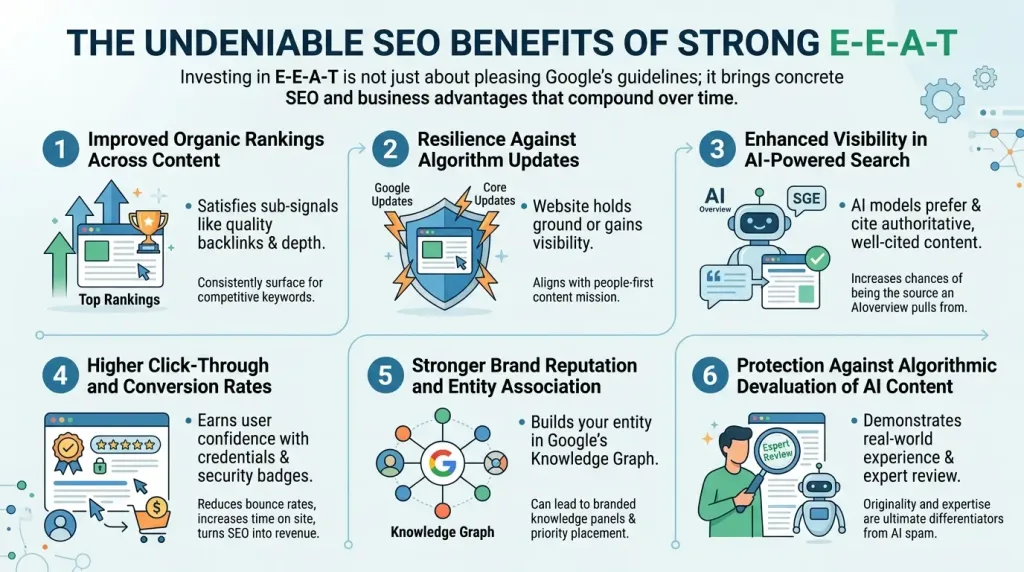
Investing in E-E-A-T is not just about pleasing Google’s guidelines; it brings concrete SEO and business advantages that compound over time.
1. Improved Organic Rankings Across Content
While Google’s algorithm doesn’t contain an “E-E-A-T score,” pages that exhibit high experience, expertise, authority, and trust tend to satisfy the myriad sub?signals that the ranking system relies on—such as backlink quality, user engagement, and content depth. These sites consistently surface for competitive keywords.
2. Resilience Against Algorithm Updates
When Google rolls out core updates or helpful content updates, websites with robust E-E-A-T signals typically hold their ground or even gain visibility. They align with Google’s long-term mission to rank people-first content. Flimsy sites that skip author transparency or use thin, AI-spun content often see catastrophic drops.
3. Enhanced Visibility in AI-Powered Search (SGE and Featured Snippets)
Generative AI search experiences, like Google’s Search Generative Experience (SGE), cite sources that demonstrate high trust. AI models are trained to prefer authoritative, well-cited content. By embedding E-E-A-T, you increase your chances of being the source an AI overview pulls from putting your brand directly in front of users at the top of the SERP.
4. Higher Click-Through and Conversion Rates
A page that clearly displays author credentials, security badges, and genuine testimonials earns user confidence instantly. Trustworthy pages reduce bounce rates and increase time on site. When visitors feel safe, they’re more likely to subscribe, purchase, or share your content, turning SEO into a sustainable revenue engine.
5. Stronger Brand Reputation and Entity Association
E-E-A-T work builds your entity in Google’s Knowledge Graph. The more consistent your digital footprint across authoritative platforms, the more Google understands your brand as a reliable resource. This can lead to branded knowledge panels, sitelinks, and priority placement for branded queries further distancing you from competitors.
6. Protection Against Algorithmic Devaluation of AI Content
With the explosion of AI-generated content, Google has doubled down on rewarding human-first, experience-backed pages. Demonstrating real-world experience and expert review shields your content from being lumped in with generic, unverified AI spam. As Backlinko’s comprehensive E-A-T guide points out, originality and expertise are now the ultimate differentiators.
Practical Steps to Elevate Your E-E-A-T Game (Checklist)
Moving from theory to action, here is a clear checklist you can use to audit and improve your site’s E-E-A-T signals:
- Create detailed, human-centric About Us and Author pages – Each author needs a photo, full bio, credentials, and links to professional networks.
- Implement a fact-checking workflow – Require a second pair of expert eyes for YMYL content. Display a “medically reviewed by” or “fact-checked by” badge.
- Showcase first-hand experiences – Add original photos, personal stories, or video walkthroughs that prove you’ve used the product or lived the advice.
- Earn at least one high-authority backlink per core piece of content – Use data-driven PR, original research, and relationship-based outreach.
- Add trust seals and secure payment badges – For e?commerce, display SSL certificates, money-back guarantees, and third-party security logos.
- Update cornerstone content regularly – Set a review calendar and note the “last updated” date prominently. Outdated content kills trust.
- Collect and respond to reviews – Actively request Google reviews, Trustpilot ratings, or industry-specific platform feedback. Address negative reviews gracefully.
- Cite credible, high-quality sources – Link out to peer-reviewed studies, .gov data, and original research. Outbound links to authoritative domains act as trust signals.
- Optimize site structure for transparency – A clear, easy-to-navigate site with accessible contact info and policies shows you have nothing to hide.
If managing all these elements feels overwhelming, integrating expert guidance can accelerate your progress and ensure no signal is missed. Collaborating with a seasoned SEO agency like Vastcope gives you access to tailored strategies that align perfectly with E-E-A-T best practices from technical audits to content creation that demonstrates real-world experience.
Common E-E-A-T Myths You Should Ignore

Misconceptions about E-E-A-T can lead to wasted effort or misguided panic. Let’s clear up the most persistent myths.
Myth 1: E-E-A-T Is a Direct Ranking Factor
E-E-A-T itself is not a measurable score in Google’s algorithm. Instead, it’s a conceptual framework that informs many ranking signals. Working on trust and authority indirectly lifts all the metrics that do affect rankings.
Myth 2: Only Medical and Financial Sites Need E-E-A-T
While YMYL sites face the strictest scrutiny, every website benefits from demonstrating E-E-A-T. A hobby blog with an identifiable, passionate author will outperform an anonymous one in competitive niches.
Myth 3: Adding an Author Bio Instantly Boosts Rankings
An author bio is a positive signal, but it must be backed by real-world reputation and off-site proof. Google checks external references about the author. A fake doctor bio will eventually backfire.
Myth 4: AI-Generated Content Automatically Fails E-E-A-T
Google doesn’t ban AI content; it bans unhelpful, unverified content. If an expert reviews, fact-checks, and adds personal experience to AI-generated drafts, the final article can satisfy E-E-A-T. The emphasis is on human oversight and originality.
Myth 5: E-E-A-T Is a One-Time Fix
E-E-A-T requires ongoing maintenance. Reputation changes, credentials expire, and content grows stale. Regular audits and updates are essential to preserve trust.
E-E-A-T in the Age of Generative AI Search
Generative Engine Optimization (GEO) has emerged as a crucial discipline because AI-powered search engines like Google’s SGE, Bing Chat, and perplexity.ai are becoming primary entry points for users. These AI models do not simply look at keyword density; they read, synthesize, and cite content that demonstrates the highest E-E-A-T.
To optimize for generative experiences, you must structure your content in ways that AI models can easily parse and trust:
- Use clear question-based headings that mirror natural language queries.
- Provide concise, standalone answers in the first paragraph, then expand. This increases the chance of your content being extracted as a featured snippet or AI citation.
- Incorporate schema markup like Article, Author, FAQ, and HowTo where appropriate. Structured data helps AI understand the entities and relationships in your content.
- Build comprehensive topic clusters that cover every nuance of a subject. AI prefers sources that demonstrate a full, interconnected body of knowledge.
- Prioritize citation-worthy statistics and quotes. AI models cite specific claims. The more unique, well-sourced data you provide, the more likely the AI will reference you.
By applying GEO principles on top of a solid E-E-A-T foundation, you future-proof your visibility for both traditional search and the rapid expansion of AI-driven results.
Apply these GEO tactics to your overall plan gain a deeper understanding of climbing Google rankings with our dedicated guide.
Conclusion: Trust Is Your Ultimate Competitive Moat

Google E-E-A-T redefines what it means to create quality content. It pushes us beyond shallow SEO tricks and into building digital brands that genuinely serve users. When you design a website that transparently showcases real experience, deep expertise, respected authority, and ironclad trust, you’re not just checking boxes for search engines you’re creating a resource that people return to, share, and trust.
Start with the foundational checklist: audit your author bios, secure authentic reviews, link to credible sources, and demonstrate first-hand experience at every touchpoint. Over time, these efforts compound, protecting you from algorithm volatility and positioning you as the go-to source in your niche. The future of search rewards human-first, trustworthy content. Embrace E-E-A-T today, and you’ll own the results for years to come.
Frequently Asked Questions (FAQs)
What does E-E-A-T stand for in SEO?
E-E-A-T stands for Experience, Expertise, Authoritativeness, and Trustworthiness. It’s the framework Google uses in its Search Quality Rater Guidelines to evaluate the credibility and quality of web content. The addition of “Experience” in December 2022 rewards content backed by first-hand, real-world involvement.
Is E-E-A-T a direct ranking factor?
No, E-E-A-T is not a direct, measurable ranking factor like page speed or mobile-friendliness. Instead, Google trains its algorithms using patterns identified by human quality raters. Sites that exhibit strong E-E-A-T characteristics tend to align with dozens of indirect ranking signals, helping them perform well in search.
How can a product review site demonstrate Experience?
A product review site can demonstrate experience by including original photographs of the item in use, detailed comparisons based on long-term testing, video walkthroughs, and clear statements of how long and in what context the product was used. Verified purchase badges and user-submitted photo reviews also add proof.
Does E-E-A-T apply to non-YMYL websites?
Absolutely. Although health, finance, and safety topics face the strictest scrutiny, every site benefits from showing E-E-A-T. Even a recipe blog gains trust by featuring an author who is an experienced home cook, includes step-by-step cooking photos, and links to reputable culinary sources.
Can AI-generated content meet E-E-A-T standards?
Yes, but only with significant human oversight. Raw AI output without fact-checking, expert review, or personal experience falls short. When a subject-matter expert edits, adds real-world anecdotes, verifies data, and stamps the content with their credentials, the final piece can satisfy E-E-A-T guidelines.
How often does Google update the Search Quality Rater Guidelines?
Google updates the guidelines periodically, typically once or twice a year, to reflect evolving search priorities. The last major refresh was the addition of “Experience” in late 2022. It’s wise to review the guidelines or follow reputable SEO news sources to stay informed of changes.
What is the connection between E-E-A-T and backlinks?
Backlinks from authoritative, relevant sites serve as a powerful trust and authority signal. When a respected industry publication or .edu domain links to your content, it vouches for your credibility. This directly supports the Authoritativeness pillar of E-E-A-T and influences how quality raters and algorithms perceive your site.
Keep reading
All articles
Top 10 SEO Goals Your Business Should Target for 2026
Search engine optimization never stands still. Just when you master one update, the next wave of technology reshapes how people find information.…
Read article
Marketing KPIs for Business Leaders: The Ultimate Growth Guide
Marketing often feels like a mix of creative intuition and financial risk. However, for business decision-makers, the difference between a high-growth brand…
Read article
SEO Content Strategy: 9 Steps to Higher Rankings
The digital landscape changes constantly. Search engines no longer simply scan for repetitive keywords; they now evaluate content depth, expertise, and overall…
Read article