

New patients search for a dentist the same way they search for the best pizza in town they pull out a phone, type a few words, and tap the top results. If your practice does not appear in those first few listings, you become invisible to the people who need you most. This guide removes the mystery from dental SEO. You will learn exactly how to optimize your website, what Google values in a local healthcare business, and how to turn search traffic into booked appointments.
Every day, thousands of potential patients ask Google to find a “dentist near me,” an “emergency root canal specialist,” or “cosmetic dentist reviews.” The dental practices that show up first capture up to 70% of clicks. The rest fight over crumbs. Investing time in dental SEO protects your practice from that feast-or-famine cycle. You build a consistent stream of high-intent visitors without paying for every single click. You own your digital real estate.
Yet many practice owners feel lost when they hear terms like “meta tags,” “schema markup,” or “local citations.” This beginner’s guide translates every technical concept into clear actions you can start using this week. You do not need a computer science degree. You need a strategic approach, reliable information, and the patience to implement small improvements that compound over time.
Looking for a faster way to turn website visitors into booked patients? Explore our handpicked selection of the best lead generation tools that help dental practices automate appointment requests and follow-ups. Discover the best lead generation tools .
What Is Dental SEO

Understanding Search Engine Optimization for Dental Practices
Dental SEO means systematically improving your practice website and online presence so that search engines rank you higher for relevant queries. Unlike paid ads that stop the moment your budget runs out, SEO builds lasting visibility. You attract patients organically—people who are actively searching for the services you provide.
Three pillars support every successful dental SEO strategy:
- On-page SEO: Everything you control directly on your website—titles, headings, content quality, image descriptions, and internal links.
- Off-page SEO: Signals that come from outside your domain, mainly backlinks from trusted websites and positive reviews across the web.
- Technical SEO: The behind the scenes foundation that helps Google crawl, understand, and index your pages without friction.
Local SEO acts as the fourth pillar for dentists. Because patients rarely travel 50 miles for a cleaning, Google treats dental queries as inherently local. Your goal is to dominate both the organic blue links and the local Map Pack—the three highlighted businesses that appear with a map.
When you get dental SEO right, a patient who types “kid friendly dentist in Austin” finds your beautifully optimized page, reads genuine testimonials, and books an appointment before they ever click a competitor’s listing.
Why Dental SEO Matters for Your Practice
The Power of Local Visibility
Patients trust search engines. Most do not scroll past the first page. A study by BrightLocal found that 97% of consumers read online reviews for local businesses—and that behavior shapes their decision to call. Your dental SEO efforts influence whether your practice appears credible, helpful, and nearby.
SEO delivers distinct advantages over other marketing channels:
- Cost efficiency: Once you rank, the traffic costs nothing. Contrast that with pay per click ads, where a single “emergency dentist” click can exceed $15.
- Patient quality: Someone searching “gentle root canal specialist” has high intent. They know what they need and are ready to schedule.
- Long term compounding: A page that ranks today can bring new patients for years with minimal upkeep.
- Trust transfer: Google’s algorithm prioritizes expertise, authoritativeness, and trustworthiness (E E A T). When you rank highly, patients infer that you are a reputable provider.
- Competitive defense: If you ignore SEO, the practice down the street claims your patients. They appear in the search results; you do not.
Think of your website as a digital storefront. A bright, well signed practice on Main Street attracts walk ins. An optimized website attracts Google searchers. Both need regular maintenance to stay inviting.
How Google Ranks Dental Websites
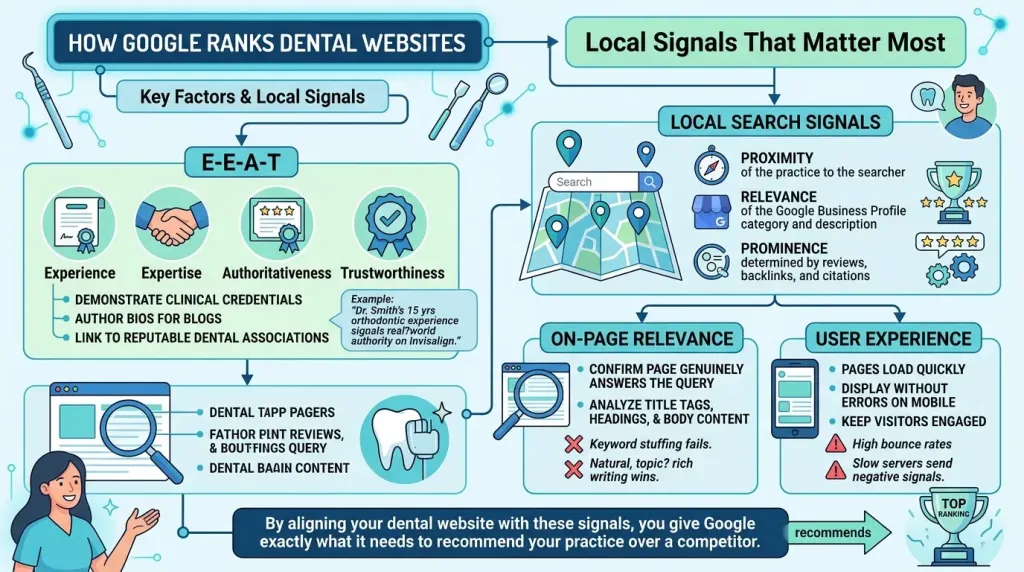
Local Signals That Matter Most
Google does not reveal its full algorithm, but years of testing and official documentation highlight the most important ranking factors for a dental practice.
(Experience, Expertise, Authoritativeness, Trustworthiness):
Google wants to surface content created by people who have genuine experience with the topic. For a dentist, that means demonstrating clinical credentials, adding author bios to blog posts, and linking to reputable dental associations. When you publish an article about Invisalign, a short blurb about Dr. Smith’s 15 years of orthodontic experience signals real world authority.
Local search signals:
- Proximity of the practice to the searcher
- Relevance of the Google Business Profile category and description
- Prominence determined by reviews, backlinks, and citations
On page relevance:
Google scans your title tags, headings, and body content to confirm that a page genuinely answers the query. Keyword stuffing fails. Natural, topic rich writing wins.
User experience:
Pages that load quickly, display without errors on mobile devices, and keep visitors engaged earn a ranking boost. High bounce rates and slow servers send negative signals.
By aligning your dental website with these signals, you give Google exactly what it needs to recommend your practice over a competitor.
Keyword Research for Dentists
Finding the Terms Patients Actually Search
Keyword research uncovers the exact words and phrases potential patients type into Google. You move from guessing what people want to targeting proven queries.
Start by brainstorming service categories: general dentistry, cosmetic dentistry, pediatric dentistry, emergency care. Then expand each into long tail phrases that mirror how real people speak.
- “invisalign cost near me”
- “does dental bonding hurt”
- “best teeth whitening for sensitive gums”
- “pediatric dentist open Saturday”
- “root canal recovery timeline”
A keyword research tool like Ahrefs’ keyword explorer reveals monthly search volume and competition level. Prioritize terms with moderate volume and clear local intent. “Dentist in [Your City]” might have high competition, but “holistic dentist in [Your Neighborhood]” could be far easier to capture.
Map each keyword to a specific page on your site. A service page for dental implants should target implant related keywords, while a blog post can answer “how long do dental implants last ”. This prevents keyword cannibalization the mistake of having multiple pages compete for the same term.
Struggling to identify which keywords will actually bring patients through your door? Get a clear, jargon free explanation of what SEO keywords are and how to choose the right ones. Learn what SEO keywords really mean .
On Page SEO for Dental Websites
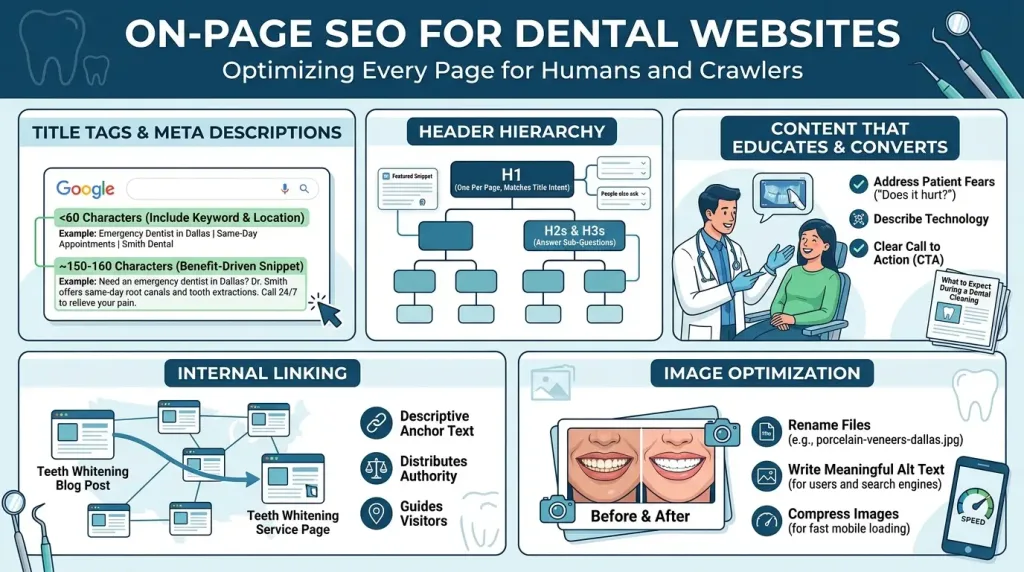
Optimizing Every Page for Humans and Crawlers
On page SEO translates your keyword research into a website that Google understands and patients enjoy reading.
Title Tags and Meta Descriptions
The title tag appears as the clickable headline in search results. Keep it under 60 characters and include your primary keyword and location. For example: Emergency Dentist in Dallas | Same Day Appointments | Smith Dental.
Meta descriptions do not directly influence rankings, but they impact click through rates. Write a 150 character benefit driven snippet: “Need an emergency dentist in Dallas Dr. Smith offers same day root canals and tooth extractions. Call 24/7 to relieve your pain.”
Header Hierarchy
Use one H1 tag per page that matches the title’s intent. Break content with H2s and H3s that answer sub questions. This structure helps Google generate featured snippets and “People also ask” boxes.
Content That Educates and Converts
Every service page needs to do more than list a price. Address patient fears (“Does a root canal hurt”), describe the technology you use, and include a clear call to action. Blog posts should answer common questions in depth. A post titled “What to Expect During a Dental Cleaning” builds trust and captures informational searches.
Internal Linking
Connect related pages with descriptive anchor text. From a blog post about teeth whitening, link to your teeth whitening service page. This distributes authority across your site and guides visitors toward booking.
Image Optimization
Before and after photos showcase your skill, but they also need SEO attention. Rename image files from “IMG_4021.jpg” to “porcelain-veneers-before-after-dallas.jpg.” Write meaningful alt text that describes the image for visually impaired users and search engines. Compress images so they load quickly on mobile devices.
Technical SEO for Your Dental Website
Building a Fast, Healthy Foundation
Technical SEO ensures that Google can crawl and index your site without encountering broken links, slow load times, or mobile usability errors. These improvements often yield quick ranking wins.
- Mobile friendliness: Over 60% of dental searches happen on a phone. Use responsive design so your site adapts to any screen. Test pages with Google’s Mobile Friendly Test tool.
- Site speed: A delay of even one second reduces patient satisfaction. Compress images, enable browser caching, and use a content delivery network (CDN). Google’s page experience documentation outlines the metrics that matter most.
- Secure connection (HTTPS): An SSL certificate encrypts data. Google marks HTTP sites as “not secure,” which scares away patients. Most web hosts provide free SSL.
- Clean URL structure: Use readable slugs like “/cosmetic-dentistry/porcelain-veneers” rather than “/page-id=123.”
- XML sitemap: Submit a sitemap through Google Search Console so Google finds every important page.
- Schema markup: Add dental specific structured data to help Google display rich results. Local Business schema, Dentist schema, and FAQ schema make your listing stand out with star ratings, office hours, and question and answer snippets.
When your technical foundation is solid, every other SEO effort multiplies in effectiveness.
Local SEO: Dominating the Google Map Pack

Google Business Profile Optimization
Your Google Business Profile (GBP) often appears before your website. An incomplete or neglected profile costs you appointments.
Claim and verify your profile if you have not already. Then optimize every field:
- Business name consistent with your signage
- Primary category “Dentist” or “Dental Clinic,” plus secondary categories like “Cosmetic Dentist” or “Pediatric Dentist”
- Accurate address and service area
- Local phone number, not a generic call center line
- Website link and appointment URL
- High quality photos of your office, team, and equipment; add new images monthly
- Business description that naturally includes services and location
Google’s own GBP help guide walks you through every setting. Spend an hour completing it thoroughly. The return on that time is substantial.
Citations and NAP Consistency
NAP stands for Name, Address, Phone number. List your practice consistently on directories like Healthgrades, Zocdoc, Yelp, and your local chamber of commerce. Even a minor inconsistency like “Suite 100” vs. “#100″ confuses search engines and weakens your local authority. Use a citation management tool to audit and fix listings.
Review Generation and Management
Reviews influence both rankings and patient decisions. According to BrightLocal’s consumer survey, 97% of consumers read online reviews for local businesses. Build a simple system: ask happy patients for reviews via a follow up text or email that links directly to your GBP review form.
Respond to every review, positive or negative, with professionalism. Thank the patient, mention the service they received, and reinforce your practice name. This adds fresh, keyword rich content to your profile.
Content Marketing That Builds Trust and Attracts Links
Blogging for Dentists
A blog transforms your website from a static brochure into a living resource. Each post targets a specific question a patient might ask. Over time, this library of helpful content earns backlinks from other health sites, local news outlets, and dental associations.
Publish consistently on topics such as:
- “How to Prepare for Wisdom Teeth Removal”
- “Electric vs. Manual Toothbrush: What the Science Says”
- “Is Teeth Whitening Safe During Pregnancy”
- “What Insurance Plans Cover Dental Implants”
Always include an author box linking to your professional bio. Cite dental research or the American Dental Association when possible. These details boost and build trust.
Visual Content: Before and After Photos, Videos
Dentistry is visual. Patients want proof of your results. High quality before and after galleries drive engagement and conversions. But grainy, poorly cropped images hurt your credibility. To capture professional grade mouth shots and product photography in office, many practices use a dedicated macro lens. If you are building your in house content studio, a sharp lens like the ones reviewed in this guide to the best Nikon lens for product photography makes a dramatic difference in image clarity.
After you capture great photos, ensure the editing is precise. Sloppy clipping paths around teeth can make a cosmetic procedure look unnatural. Small editing mistakes distract the viewer and erode trust. Before you publish your next patient gallery, learn how to avoid the most common clipping path errors that sabotage professional images. Fix your photo editing mistakes →
Videos also boost SEO. Record a short office tour, a patient testimonial, or an explanation of a procedure. Host videos on YouTube (the second largest search engine) and embed them on your site. Optimize video titles and descriptions with dental keywords.
Link Building and Off Page SEO

Earning High Quality Backlinks
A backlink is a vote of confidence from another website. When a respected dental association links to your page on gum disease prevention, Google interprets that as a trust signal. Quality matters far more than quantity.
Effective link building strategies for dentists:
- Guest posting: Write articles for dental industry blogs or local health magazines. In your author bio, link back to your site.
- Local partnerships: Sponsor a community 5K run or a school sports team. Local event pages and news sites will often link to your practice.
- Scholarships: Create a small dental scholarship for a local high school student. .edu domains from schools linking to your scholarship page are incredibly powerful.
- Broken link outreach: Find dead links on dental resource pages and suggest your content as a replacement. Moz’s beginner’s guide to link building explains how to execute this tactfully.
- Digital PR: Publish newsworthy research or a patient success story. Pitch it to local journalists.
Avoid buying links or participating in link schemes. Penalties from Google can wipe out your visibility overnight.
Strengthening your backlink profile is one of the fastest ways to outrank competing practices. Explore proven, white hat methods for building SEO backlinks that move the needle. Build authoritative backlinks the right way .
Measuring Your Dental SEO Success
Key Metrics That Reveal Growth
Without tracking, SEO feels like throwing darts in the dark. Install Google Analytics and Google Search Console (both free) to monitor what works.
Track these metrics monthly:
- Organic clicks: Total visitors arriving from unpaid search results.
- Keyword rankings: Positions for your top 20 target keywords. Use a rank tracker or Search Console’s query report.
- Google Business Profile insights: How often your profile appeared in searches, how many people called, and how many requested directions.
- Conversion actions: Phone calls, contact form submissions, and online appointment bookings.
- Bounce rate and dwell time: A high bounce rate on a service page may indicate the content does not match the searcher’s intent.
- Backlink growth: The number of new referring domains pointing to your site.
Set realistic expectations. Meaningful ranking improvements often take 4–6 months. Look for upward trends, not daily fluctuations.
Common Dental SEO Mistakes to Avoid
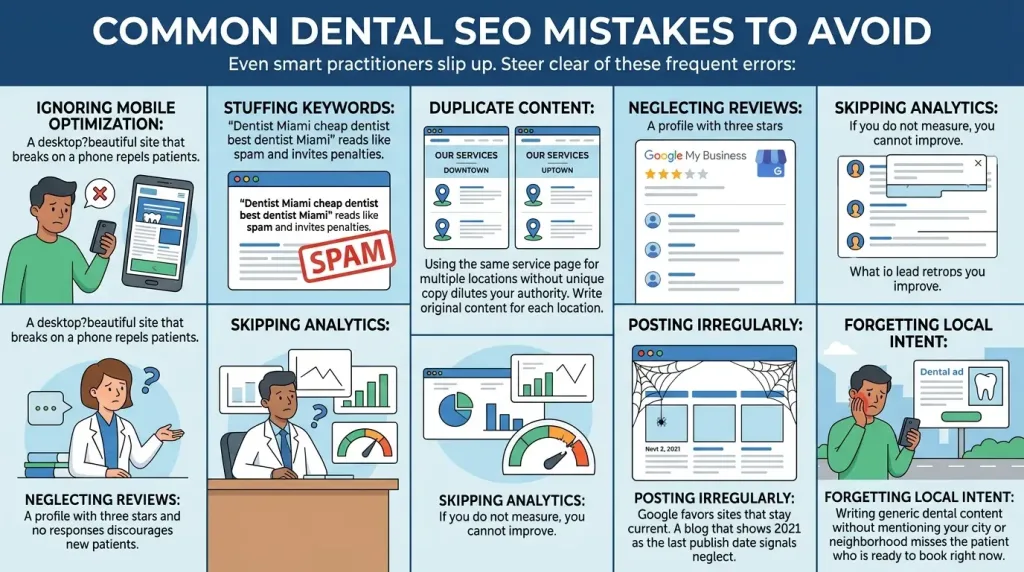
Even smart practitioners slip up. Steer clear of these frequent errors:
- Ignoring mobile optimization: A desktop beautiful site that breaks on a phone repels patients.
- Stuffing keywords: “Dentist Miami cheap dentist best dentist Miami” reads like spam and invites penalties.
- Duplicate content: Using the same service page for multiple locations without unique copy dilutes your authority. Write original content for each location.
- Neglecting reviews: A profile with three stars and no responses discourages new patients.
- Skipping analytics: If you do not measure, you cannot improve.
- Posting irregularly: Google favors sites that stay current. A blog that shows 2021 as the last publish date signals neglect.
- Forgetting local intent: Writing generic dental content without mentioning your city or neighborhood misses the patient who is ready to book right now.
Frequently Asked Questions about Dental SEO
1. How long does dental SEO take to show results?
Most dental practices see meaningful ranking improvements within 4 to 6 months of consistent effort. Highly competitive metropolitan areas may take 8 to 12 months. Quick wins, like fixing technical errors and optimizing your Google Business Profile, can generate leads in weeks.
2. Can I do dental SEO myself, or should I hire an agency?
You can absolutely handle the fundamentals optimizing your GBP, updating meta tags, and writing blog posts with a moderate time investment. As your practice grows, an agency that specializes in healthcare SEO can accelerate growth through technical audits, link building, and advanced content strategy.
3. Are online reviews really a ranking factor?
Yes. Google considers review quantity, recency, and overall rating as strong local ranking signals. Beyond SEO, reviews shape patient trust. A practice with 50 glowing reviews usually wins the click over one with four mixed reviews.
4. How often should I publish new content on my dental blog?
Consistency trumps frequency. Publishing one deeply researched article every two weeks outperforms a hurried weekly post. Prioritize quality answers to real patient questions over filler content.
5. Does social media activity help my dental SEO?
Social media signals do not directly influence rankings, but an active social presence amplifies your content, drives traffic, and can earn backlinks when people discover and share your posts. Platforms like Instagram are especially valuable for showcasing cosmetic dentistry results.
6. What is the difference between local SEO and regular SEO?
Regular SEO aims to rank nationwide or globally. Local SEO targets users in a specific geographic area. For dentists, local SEO is far more critical because patients need a provider nearby. Optimizing your GBP, building local citations, and using location?based keywords are local SEO essentials.
7. Should I build separate pages for each location if I have multiple practices?
Yes. Create a dedicated, unique page for each physical office. Include the clinic’s address, phone number, team photos, and relevant local content. This avoids confusion and improves rankings for each neighborhood.
8. Is voice search important for dental SEO?
Absolutely. Patients increasingly use voice assistants to ask “dentist near me open now” or “best teeth whitening dentist.” Voice queries tend to be longer and more conversational. Creating FAQ pages that answer spoken?language questions captures that traffic.
Your Next Step Toward a Fully Booked Practice
Dental SEO is not a one time project. It is a long term investment in your practice’s visibility, credibility, and patient pipeline. Each element a polished Google Business Profile, a fast website, thoughtful content, and genuine backlinks works together to tell Google, “This dentist deserves the top spot.”
Start small. Claim your profile. Fix your title tags. Answer five patient questions on your blog. Track what changes. Over the next six months, those small actions compound into a reputation that draws new patients predictably, affordably, and sustainably.
Effective SEO also depends on how your practice presents itself visually. A compelling composition can turn a simple dental office photo into a conversion magnet. Explore how composition photography principles elevate your website’s look and feel. Learn the art of composition photography .
Keep reading
All articles
SEO Content Strategy: 9 Steps to Higher Rankings
The digital landscape changes constantly. Search engines no longer simply scan for repetitive keywords; they now evaluate content depth, expertise, and overall…
Read article
Can You Do SEO Yourself? Yes! Learn DIY SEO (& When to Outsource)
Can You Do SEO Yourself? Yes! Learn DIY SEO (& When to Outsource) The digital landscape shifts constantly, leaving many business owners…
Read article
The Ultimate Guide to SEO Conferences in 2026: Where to Learn, Network, and Grow
The digital marketing world never sleeps, but 2026 promises to be a waking dream for SEO professionals. Search engines continue to evolve…
Read article