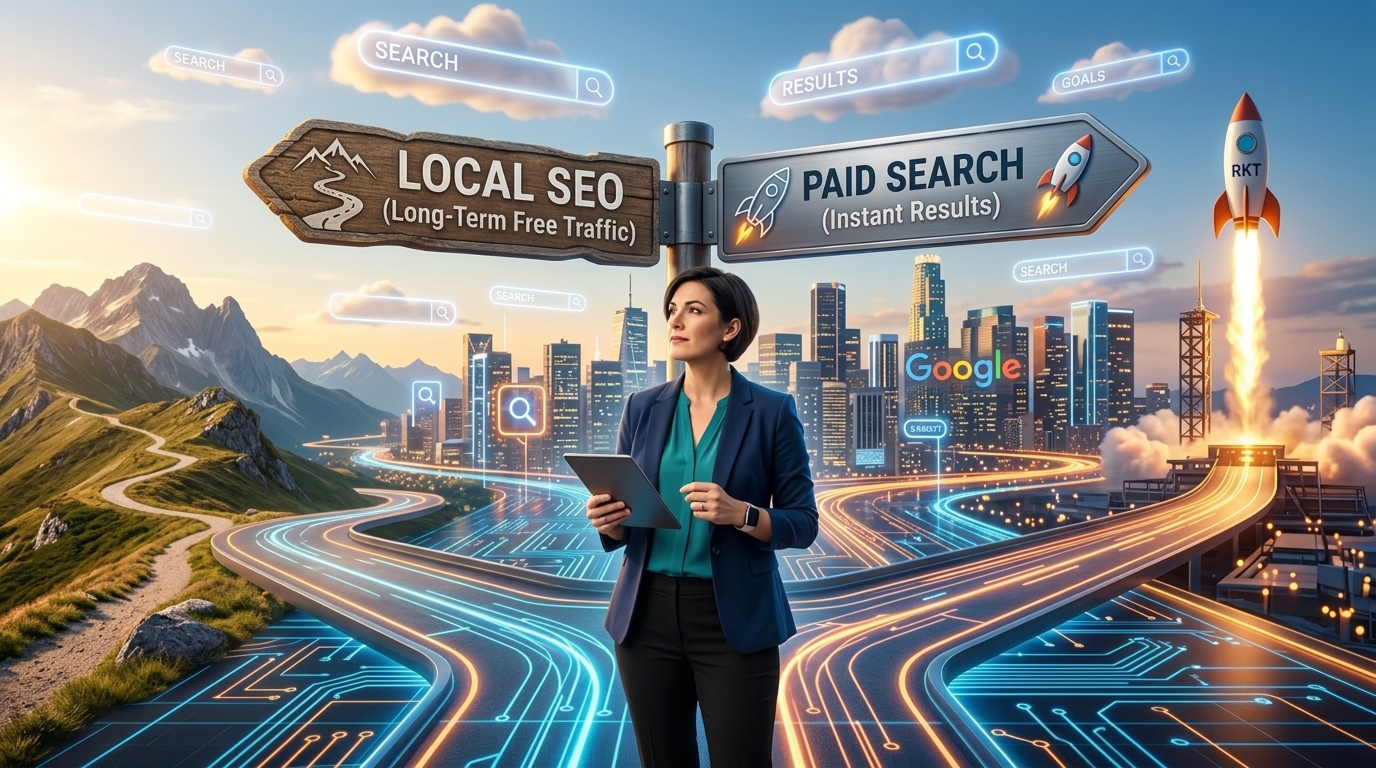
Every local business owner faces this exact dilemma. You open your laptop, stare at the search results, and wonder: should I invest in climbing those organic rankings, or simply pay to appear at the very top? The answer isn't a simple "yes" or "no." Both strategies can drive customers through your door. But they operate on completely different timelines, budgets, and levels of trust.
We analyzed real data, business outcomes, and user behavior to settle this debate. You will walk away knowing exactly which path—or combination—fits your unique situation. Let's cut through the noise and find your smartest investment.
Ready to dominate your local market without wasting ad spend? Explore our data-driven SEO services to build a foundation that pays you back for years.
Understanding the Core Difference (Beyond Just Money)
Before picking a side, you need to see how these two strategies function differently under the hood. Many people think the only difference is cost. That assumption costs them real opportunities.
How Local SEO Works for Your Business
Local SEO helps Google trust that you belong in a specific geographic area. You optimize your website, claim your Google Business Profile, gather genuine customer reviews, and build local citations. When someone searches for "bakery near me" or "plumber in Austin," Google pulls relevant local businesses.
Think of Local SEO as planting an orchard. You prepare the soil (your website), plant the seeds (keywords and content), water them consistently (citations and reviews), and after a season, you harvest fruit for years. The traffic you earn costs nothing per click. It flows to you because you proved your relevance and authority.
How Paid Search (PPC) Instantly Places You at the Top
Paid search operates on a pay-per-click (PPC) model. You bid on keywords like "emergency roofer Chicago" or "best pizza downtown." When someone searches that term, your ad appears above all organic results. You pay only when a user clicks.
This method offers instant gratification. You launch a campaign today, and you see traffic within hours. However, the moment you stop funding the campaign, your visibility vanishes completely. It resembles renting a prime storefront: great location, but you pay rent every single month without building equity.
Key Differences at a Glance:
-
Cost Structure: Local SEO requires upfront time and ongoing maintenance (no per-click fees). Paid Search requires a daily or monthly budget for each click.
-
Time to First Result: Local SEO takes 3-6 months to show significant traction. Paid Search delivers traffic within 24 hours.
-
Longevity: Local SEO results compound over time. Paid Search results stop the second you pause your credit card.
-
Trust Level: 80% of users skip paid ads to click organic results. People trust the "earned" spot more than the "bought" spot.
-
SERP Real Estate: Paid ads occupy the very top. The Local Map Pack (3 businesses with pins) sits right below ads, followed by standard organic listings.
The Case for Local SEO: Sustainable Growth That Compounds
Local SEO often wins for businesses playing the long game. You will not see overnight success. But the momentum you build becomes very hard for competitors to steal.
Why Most Marketers Call Local SEO a Success
The numbers speak clearly. Organic search drives 51% of all website traffic. That share crushes social media, direct visits, and referrals combined. More importantly, research from DataBox confirms that users trust organic results significantly more than paid advertisements. You can review their full findings on user trust in search results.
Consider buyer psychology. When someone searches for a service, they usually scroll right past the ads. They want the business that earned its spot through good service and reputation. An organic listing signals, "Google verified me as relevant." An ad signals, "I have a budget."
Local SEO also unlocks the Local Map Pack. This precious real estate shows three local businesses with ratings, hours, and a map. According to a BrightLocal consumer survey, 46% of all Google searches seek local information. Appearing in that pack drives foot traffic and phone calls without paying per click.
Who Benefits Most from Local SEO?
Local SEO works wonders for businesses with physical locations or service areas. You do not need a national presence. In fact, hyper-local focus gives you an edge.
-
Service providers: Plumbers, electricians, HVAC technicians, and cleaners thrive because people search for them urgently.
-
Brick-and-mortar stores: Boutiques, coffee shops, gyms, and dental clinics need nearby customers who discover them while walking or driving.
-
Professional services: Lawyers, real estate agents, insurance brokers, and accountants win by building trust through reviews and local content.
-
Restaurants and bars: Diners almost always search "best Italian near me" rather than a specific restaurant name.
If you operate on thin margins, Local SEO fits perfectly. You avoid the bidding wars that drive PPC costs to $50 or more per click in competitive industries. Instead, you invest in content, citations, and customer experience—assets that keep paying dividends.
The Real Cost of "Free" Organic Traffic
Let's address the elephant in the room. Nothing is truly free. Local SEO costs you time, expertise, or agency fees. You might spend money on:
-
High-quality backlinks from local directories and news sites
-
Ongoing content creation (blog posts, service pages, FAQs)
-
Citation management and review generation tools
-
Technical fixes to make your site mobile-friendly and fast
Despite these costs, the long-term ROI crushes paid search for most local businesses. A single blog post optimized for "how to fix a leaking pipe in Denver" can bring calls for two years. A PPC ad stops the moment you hit pause.
Want to build backlinks that Google loves without the guesswork? Check our premium SEO backlink packages to boost your domain authority naturally.
The Case for Paid Search: Speed and Control When You Need It
Paid Search is not the villain. Smart businesses use it strategically. You just need to know exactly when to deploy this weapon.
Instant Visibility for Time-Sensitive Offers
Imagine you run a landscaping company. A sudden storm knocks down trees across your city. Homeowners urgently search "24-hour tree removal." Your organic content might rank in a few weeks. But people need help now.
PPC saves the day. You launch an ad campaign focused on emergency keywords. You appear at the very top within an hour. You pay for each click, but each click represents a desperate homeowner ready to hire. The cost per acquisition often stays reasonable because the buyer intent is extremely high.
Paid search also excels for seasonal businesses. A Halloween costume shop needs massive traffic in October. They do not need rankings in March. PPC allows them to turn traffic on and off like a light switch. You cannot do that with organic optimization.
Who Should Prioritize Paid Search?
These business characteristics make PPC a smart primary investment:
-
High customer lifetime value (LTV): Dentists, attorneys, and software companies can spend 100toacquireacustomerworth5,000.
-
High margins: Luxury boutiques, car dealerships, and high-end electronics retailers can absorb high click costs.
-
Hard-to-find products: A specialty tool supplier or rare collectible seller needs to reach scattered buyers quickly.
-
Well-funded startups: New brands with zero domain authority cannot rank organically for months. PPC buys them market entry.
If you have the budget to sustain campaigns for at least 6-12 months, PPC builds brand awareness while your organic presence catches up. Many successful companies run both systems simultaneously. Google’s own guide on local ad campaigns explains how to integrate paid strategies effectively.
The Hidden Trap of Paid Search
PPC feels addictive at first. You see traffic spike. You receive phone calls. But look closer at the numbers. HubSpot found that 80% of online customers ignore paid ads entirely. They train their eyes to jump straight to organic results.
Additionally, click fraud drains budgets faster than you think. Competitors or bots can click your ads maliciously. While platforms offer some protection, you still lose money to invalid clicks every month.
The worst trap involves stopping the campaign. Maybe you cut your budget during a slow season. Your phone stops ringing immediately. You own nothing. You built no equity. That money is gone forever. Organic visibility, in contrast, keeps delivering traffic even if you take a month off from active work.
Making the Final Decision: 5 Questions to Ask Yourself
Stop wondering which strategy is "better." Start asking the right questions about your specific situation.
1. How Quickly Do You Need Customers?
If you need leads next week to pay your bills, start with PPC. Set a modest daily budget of $20-50 and test keywords. You cannot afford to wait 4-6 months for organic growth to mature.
If you can invest time for bigger future gains, prioritize Local SEO. Build assets that accumulate value. Your patience will reward you with lower costs and higher trust.
2. What Does Your Monthly Marketing Budget Look Like?
Less than 1,000permonth?FocusalmostentirelyonLocalSEO.PPCcostsincompetitiveindustries(legal,medical,realestate)run5-50 per click. Your budget might buy only 200 visits. Local SEO gives you unlimited organic clicks for the same investment.
More than $3,000 per month? Run both. Use 70% of your budget on organic growth and 30% on PPC for testing and immediate traffic.
3. How Strong Is Your Current Online Presence?
Brand new website with zero reviews? PPC will struggle because users check your reputation before calling. They see your ad, search your name, find no reviews, and bounce. First, build basics: Google Business Profile, 10+ genuine reviews, and 5-10 local service pages. Then run ads.
Established business with 50+ reviews and decent rankings? Pour fuel on the fire with both approaches. Own the entire first page of Google.
4. Are You in a Highly Seasonal Industry?
Tax preparers, pool cleaners, and Christmas light installers need PPC. Their busy seasons last 2-3 months. Organic growth takes too long to ramp up and fades slowly. Use PPC to flood the zone during peak demand.
Year-round businesses like dentists, plumbers, and chiropractors benefit more from consistent organic growth.
5. How Much Risk Can You Tolerate?
PPC offers predictable costs but volatile performance. Algorithm changes don't affect your ads. But competitor bidding wars can double your cost per click overnight.
Organic visibility involves algorithm risk. Google might update its local ranking factors. You could drop from #1 to #5 without warning. However, high-quality work that follows best practices rarely suffers catastrophic drops. The risk is lower than most business owners fear.
The Hybrid Strategy That Wins Almost Every Time
Stop choosing. Start sequencing. The smartest local businesses layer these strategies over time.
Phase 1 – The First 3 Months:
Launch a low-cost PPC campaign targeting your top 5-10 service keywords. Set a strict daily budget. This generates immediate cash flow while you build your organic foundation. Simultaneously, optimize your Google Business Profile and basic on-page elements.
Phase 2 – Months 4-9:
Shift 60% of your budget to organic growth. Create location-specific service pages. Earn backlinks from local chambers of commerce and news sites. Generate customer reviews consistently. Reduce PPC spending on branded terms you now rank for organically.
Phase 3 – Months 10+:
Run PPC only for high-intent, high-profit keywords that remain too competitive for organic ranking. Use organic visibility for everything else. Your cost per lead drops dramatically because you no longer pay for brand traffic or informational queries.
This hybrid approach gives you short-term survival and long-term dominance. You never bleed cash waiting for organic results. You never rent your entire presence.
Common Mistakes That Wreck Local Campaigns
Avoid these painful errors that we see small business owners make repeatedly.
Stop Organic Efforts Because You Started PPC
Bad move. PPC gives you temporary placement. Organic visibility gives you permanent authority. Run them together. Your organic rankings lower your PPC costs because Google rewards relevance.
Use the Same Keywords for Both
Your organic content should target informational and commercial intent keywords ("how to fix," "best price for"). Your PPC ads should target transactional intent keywords ("buy now," "emergency plumber near me"). Different stages of the buyer journey.
Ignore Your Google Business Profile
This single action destroys more local campaigns than anything else. Complete every field. Add photos weekly. Respond to every review. Post offers. Google prioritizes active profiles for both organic and paid visibility.
Send PPC Traffic to Your Homepage
You pay for a click. Do not waste it on a generic homepage. Create specific landing pages for each ad group. "Emergency plumbing services" ad should go to a page about emergency plumbing, not your services overview.
Real-World Example: How a Local Bakery Chose Wisely
A real bakery in Nashville faced this exact question. They had $2,000 monthly to spend. Their competitors all ran Google Ads for "wedding cakes Nashville" and "birthday cakes near me."
Instead of jumping into expensive bidding wars, they invested $1,500 in Local SEO. They created pages for each cake type (wedding, birthday, gender reveal). They earned links from local wedding blogs. They collected 80+ Google reviews.
After six months, they ranked in the Local Pack for all major cake keywords. Their phone rang 40 times per week organically. Then they spent their remaining 500onPPCtargeting"lastminutebirthdaycake"withasame−daydeliveryoffer.Thathybridapproachdoubledtheirrevenuewhilecompetitorsspent2,000 a month just to break even on ad spend.
Looking to turn local visitors into paying customers? Our lead generation services help you build a system that captures and converts every lead.
Final Verdict: Which One Wins?
Local SEO wins for sustainable, profitable, long-term growth. It builds equity. It earns trust. It keeps working while you sleep. Every local business should prioritize organic visibility as their primary channel.
Paid Search wins for speed, testing, and seasonal spikes. Use it as a tactical tool, not your entire strategy. Never rely on rented land.
The best answer? Combine them using the hybrid sequence we outlined. Start with both if you have budget. If you must choose one, choose Local SEO. Then add PPC later as a growth accelerator.
Your specific business type guide:
-
Restaurants, retail stores, salons: 90% Local SEO, 10% PPC for new location announcements
-
Plumbers, electricians, roofers: 70% Local SEO, 30% PPC for emergency keywords
-
Doctors, dentists, chiropractors: 80% Local SEO, 20% PPC for new patient specials
-
Attorneys, real estate agents: 60% Local SEO, 40% PPC for high-value case types
-
Ecommerce with local pickup: 70% Local SEO, 30% PPC for product-specific ads
Frequently Asked Questions (FAQ)
1. Can I completely stop PPC once my organic rankings perform well?
Yes, but test carefully. Reduce your PPC budget slowly while monitoring traffic. Some keywords will continue needing paid support, especially high-competition terms with national companies bidding against you.
2. How long until I see results from Local SEO on a brand new website?
Expect 4-6 months for significant local pack appearances. You might see smaller gains (impressions, clicks to your website) within 8-12 weeks if you target low-competition keywords.
3. Why do my PPC ads show but no one calls?
Three common reasons: your ad goes to a generic homepage (not a service-specific landing page), your Google Business Profile looks inactive with old photos, or your competitors offer better reviews or prices.
4. Is PPC worth it for a small budget of 500permonth?Onlyforveryniche,low−competitionkeywords.Formostindustries,500 buys limited clicks. Use that budget to hire a freelancer for citation building or content creation instead. You will see better long-term returns.
5. Does running PPC help my local organic rankings?
Indirectly, yes. PPC brings traffic to your site. If those visitors stay, click around, and convert, Google sees positive engagement signals. However, Google denies any direct ranking boost for running ads. The benefit comes through user behavior, not a backdoor deal.
6. Which industries absolutely need both strategies?
Medical practices, law firms, and home service franchises. These fields face fierce competition. Relying on only one channel leaves money on the table. Competitors will outbid you on PPC or outrank you organically if you ignore either channel.
7. What is the single biggest factor for local SEO success?
Your Google Business Profile and customer reviews. No other factor comes close. Complete your profile 100%. Reply to every review—good or bad. Post photos weekly. This single activity drives more local visibility than backlinks or on-page content.
8. Can I do Local SEO myself without hiring an agency?
Absolutely for basic steps: claiming your Google Business Profile, getting reviews, adding location pages to your website. For technical aspects (site speed, schema markup, backlink acquisition), consider professional help. Many business owners handle the basics first, then hire for advanced work.
Stop guessing which strategy fits your budget and goals. Take the next step with our complete website development and ecosystem to unify your local search presence today.