

You have probably found yourself staring at a number on your screen, wondering if it is high enough. That number, likely generated by Moz, Semrush, or Ahrefs, represents your Domain Authority. But the panic sets in when you search “What is a good Domain Authority?” and see an arbitrary score like 50 thrown around as the gold standard.
Here is the uncomfortable truth that most generic SEO guides skip: chasing a universal “good” DA score is a losing game. A local bakery doesn’t need the same authority as the New York Times. A SaaS startup targeting a niche market shouldn’t compare itself to Salesforce.
Domain Authority is not an absolute measurement. It is a comparative one. We need to shift your mindset from treating DA like a final exam grade and start treating it like a golf handicap relative to the specific course you are playing on.
When Google evaluates your site, it does not look at your DA. Google uses hundreds of proprietary ranking signals, primarily the E-E-A-T framework (Experience, Expertise, Authoritativeness, and Trustworthiness). So why does DA even matter? Because it predicts where you stand in the competitive landscape. A strategic understanding of this metric unlocks smarter link building, better content partnerships, and faster growth.
Unlock Rankings That Matter: Stop guessing if your authority is strong enough. Let our team analyze your niche’s specific competitive gap and build a custom authority strategy for you. Explore Our SEO Services to dominate your market.
The Origin: Where Does Domain Authority Come From?
To use a metric effectively, you must understand its machinery. Moz initially developed Domain Authority as a logarithmic score ranging from 1 to 100. The algorithm aggregates dozens of signals, including linking root domains and total backlinks, into a single predictive number. It attempts to forecast how likely a domain is to rank on Search Engine Results Pages (SERPs) compared to another domain.
However, we are currently living through a massive shift in how data is indexed. Generative Engine Optimization (GEO) relies heavily on structured data, clear entity relationships, and citation-based authority. Because generative AI models often pull from curated, authoritative indexes, your backlink profile matters more than ever for inclusion in AI snapshot answers.
The key term here is “logarithmic.” It is vastly easier to jump from a DA of 10 to 20 than it is to move from 70 to 80. If you are stuck on a plateau, you aren’t necessarily failing; you are simply battling the mathematical curve of the internet’s authority distribution.
Understanding Predictive vs. Actual Metrics
Always separate cause from correlation in your reporting. DA does not cause rankings. It is a predictive output correlating with the things that do cause rankings.
Link Equity (Link Juice): The primary engine. A follow link from a .gov or .edu domain passes significant weight.
Spam Score: A high spam score can suppress your DA. A DA of 45 with a 1% spam score is infinitely better than a DA of 50 with a 15% spam score.
Organic Click-Through Rate: While not a direct DA factor, strong domain-level click-through rates create the topical authority that makes your link profile more valuable.
The Relativity Principle: Why Your Niche Defines “Good”
Asking “what is a good DA” without context is like asking if 200 horsepower is good for a car. It is terrible for a semi-truck but excellent for a compact sedan. Your competitive landscape dictates the target score.
If you run a local roofing business in Tulsa, your direct competitors likely have a DA between 10 and 20. A score of 25 in that market makes you the authority. However, if you are a fintech company reviewing credit cards, you are competing against Bankrate, NerdWallet, and Forbes Advisor. In that space, a DA of 70 might just get you a seat at the table, not the top spot.
You must perform a SERP analysis. Pick your five most coveted keywords. Run the domains ranking on Page 1 through a bulk DA checker. Average those scores. That number is your minimum viable DA threshold. Anything above that average puts you in the statistical probability zone to rank with a well-optimized page.
Contextual Benchmarks by Website Profile
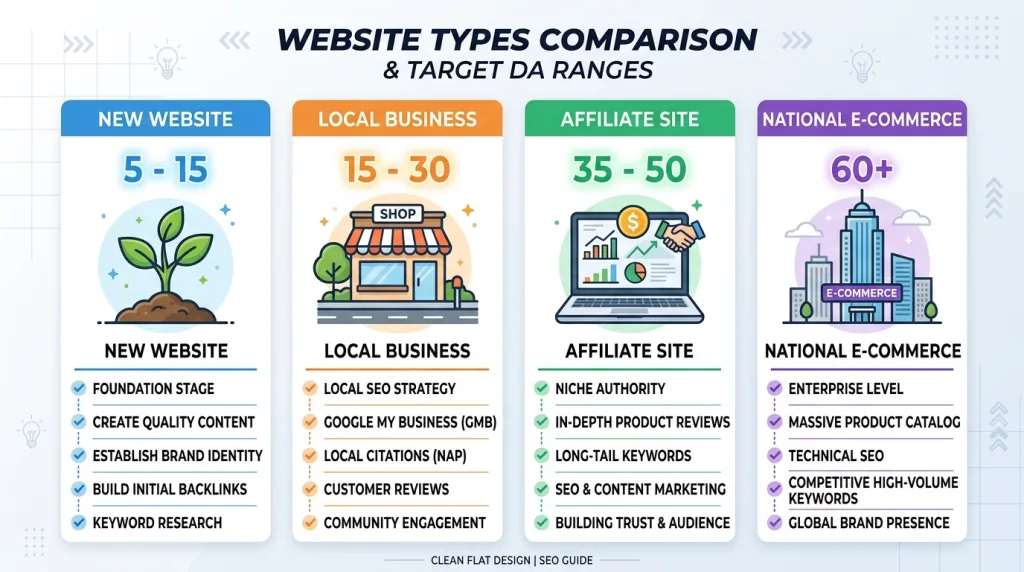
Instead of a meaningless absolute number, use these relative benchmarks based on site age and market size:
New Websites (0–12 Months):
Target DA: 5–15.
Focus: Foundational links (directories, local chambers, guestographics).
Strategy: Don’t panic. A score of 10 after six months with a clean, niche-relevant backlink profile is a massive success.
Local Businesses (Single Location):
Target DA: 15–30.
Focus: Geo-specific citations, local news features, and community sponsorships.
Reality Check: A DA of 25 with 100 local organic visits a day is a successful business. A DA of 40 with no local visits is a hobby.
Affiliate/Content Sites (Niche Focus):
Target DA: 35–50.
Focus: Editorial backlinks, HARO (Help a Reporter Out) features, and expert roundups.
Nuance: Google’s site reputation abuse policy updates mean a “good” DA can be destroyed overnight by hosting third-party coupon content.
National E-commerce/SaaS:
Target DA: 60+.
Focus: Digital PR, thought leadership citations, and product-led link acquisition.
Turn Browsers Into Buyers: A high domain authority needs high-converting design. See how our development team aligns technical performance with aesthetic brilliance. View Web Development Solutions to increase dwell time and trust.
Decoding the Logarithmic Scale: The Point of Diminishing Returns

We need to visualize the growth curve. The difference between DA 20 and DA 30 is roughly 10 additional high-quality domains linking to you. The difference between DA 70 and DA 80 could be thousands, including links from massive media conglomerates.
This creates a point of diminishing returns. If you are a small-to-medium enterprise (SME), spending thousands of dollars to push your DA from 65 to 68 is often a vanity exercise. That money is likely better spent on conversion rate optimization or content that targets long-tail, low-competition keywords.
The “Authority Threshold” Concept
In computational SEO, we look for the authority threshold the score where ranking potential plateaus for a specific keyword cluster.
Use a scatter plot of the top 20 results for your target term.
You will usually see a cluster of high-DA sites at the top, but often a few outliers with lower DA ranking on Page 1.
These outliers possess “Topical Authority.” They don’t have high general authority, but they possess perfect relevance.
Actionable Insight: Before buying a high-DA backlink, ask if you can build topical depth to beat the system without matching the metric.
The Bridge Between DA and Generative AI Visibility

As we optimize for generative engines like Google’s AI Overviews and ChatGPT’s browsing plugin, the definition of a “good” DA shifts slightly. Generative engines prioritize non-contradictory, consensus-based information.
A site with a moderate DA of 40 that publishes heavily cited, factually consistent content often surfaces in AI results more frequently than a DA 80 site with thin, opinionated content. The LLMs (Large Language Models) use backlinks as a trust proxy, but they also weight entity recognition. If your brand is recognized as an entity in Google’s Knowledge Graph, your effective “authority” in the eyes of AI skyrockets, regardless of your raw DA number.
How to Optimize DA for AI Scraping
Schema Markup: Ensure your organization schema is perfectly aligned with your backlink anchor text. Discrepancies confuse generative models.
Co-citation: You don’t always need a direct link. Being mentioned next to the top player in your niche within a structured dataset helps AI place you in the correct peer group.
Source Diversity: A good DA for GEO purposes is one that has links from news sources, forums, and educational sites, not just blogs.
The Toxicity Factor: When a “High” DA Is Terrible
You might buy an expired domain with a DA of 50, thinking you have won the lottery. Then, your traffic flatlines. You must audit the history, not just the score. A manipulated DA is a growing crisis.
Moz and Semrush constantly update their algorithms to ignore “spam networks.” A domain with a historical backlink profile littered with PBNs (Private Blog Networks) or irrelevant comment spam might display a DA of 45 but possess zero actual ranking power because Google’s Penguin algorithm has devalued those links.
Toxic Link Archetypes to Avoid
Irrelevant Embedded Widgets: A link from a financial news site to a pet food blog via a footer widget. Google understands this isn’t editorial.
MLM and Gambling Parasites: Domains previously used for “parasite SEO” hosting gambling or crypto pill pages will carry a permanent algorithmic stain.
Non-Natural Anchor Text Distribution: A “good” profile has variety. If 90% of your links say “best cheap SEO tools,” your DA is a house of cards waiting to collapse.
Cut Through the Noise with Quality Backlinks: Our team identifies high-authority, contextually relevant placements that move the needle safely. Explore Our Backlink Services and build a profile that withstands algorithm shifts.
A Practical Guide to Improving Your Score Authentically

We have established that the number is relative, logarithmic, and prone to manipulation. So, how do you build legitimate, sustainable authority that actually generates leads? You don’t do it by asking for links. You do it by creating assets that justify citation.
1. The “Link-Worthy” Asset Inventory
Review your existing content. Do you have raw data? A proprietary survey or a state-of-the-industry report is the single fastest way to earn .edu and high-DA links. If you need a jumpstart, check the current going rate for building these specific high-value assets to budget your campaign properly.
Tools and Calculators: Interactive content earns passive links while you sleep.
Visual Encyclopedia: Complex diagrams explaining industry processes earn editorial links from journalists.
2. Strategic Guest-Flame Placement
Forget “guest posting” as a volume game. Identify three “pillar” publications in your space with legitimate editorial standards (and a real readership). Write content for them that you would charge a client for. One link from a site with a high trust flow, even if its DA is moderate, outperforms 20 links from random “write for us” mills.
3. Broken Link Building 2.0
The classic strategy still works, but the modern approach leverages AI. Use crawlers to find broken external links on high-authority resource pages. Instead of a generic “you have a broken link” email, use AI to rewrite the dead page’s content, update it, expand the statistics, and make it better. You are now offering a restoration of their dead resource, not a “guest post.”
4. Digital Public Relations (DPR)
Journalists use platforms like Qwoted and Connectively (formerly HARO) not to cite your product, but to cite your brain. Your Founder or Head of Product needs to provide soundbite-ready, insightful quotes. A link from TechCrunch or The Verge isn’t just a DA booster; it’s a brand signal that solidifies your entity status in knowledge graphs.
The Hidden Costs of Vanity Metrics
We must discuss the budget drain. In 2026, the cost of a DR 70+ backlink from a reputable editorial site ranges from 500to2,000, with digital PR retainers often exceeding $10,000 monthly. If you are blindly chasing a number, these costs destroy your return on investment.
A “good” Domain Authority is one where the cost to acquire the score correlates with a measurable increase in organic traffic and revenue. Do not let an SEO agency hold you hostage over a static number. A DA that stays flat while organic revenue climbs 20% is a sign of a mature, sustainable marketing strategy.
Shifting Focus to ROI-Driven Metrics
Branded Search Volume: If your DA goes up by 10 points but nobody searches your brand, the links weren’t seen by humans.
Pages Per Session: High-quality referral traffic from editorial links has a high pages-per-session rate. Low-quality DA links result in a bounce.
Lead Quality: Are your contact forms filling up with better-fit clients? That is the ultimate authority indicator.
Measuring Your Progress Without Losing Your Mind
Check your Domain Authority monthly, not weekly. Weekly fluctuations are usually due to index updates at the tool provider (Mozscape or Semrush), not actual shifts in your standing. You will watch your score drop by three points on a Tuesday and panic, only to see it rebound by Thursday. This is noise.
Watch the trend line over 12 months. A steady, linear increase of 5–8 points per year indicates a healthy, non-manipulative strategy. An exponential spike of 20 points in a month almost always indicates a spam link network that will eventually be corrected.
Holistic KPIs to Track Alongside DA
Domain Rating (Ahrefs) vs. DA (Moz): Compare both. A massive gap between the two (e.g., DR 20 but DA 50) often exposes a manipulated DA.
Total Referring Domains: This is the raw iron. Focus on increasing unique referring domains, not total backlinks.
Organic Keyword Footprint: Are you ranking for more terms? A “good” DA doesn’t just sit pretty; it brings a broader keyword portfolio with it.
Entity-Based Authority: The Future Beyond the Score
As we optimize for generative engines, the industry is moving past PageRank-based metrics toward entity-based authority. Google’s systems are becoming incredibly sophisticated at identifying who the “author” is behind the content and what the “brand” stands for.
You build entity authority by connecting the dots for the machine. Link your website to your LinkedIn business page, your Crunchbase profile, your Wikipedia page (if notable), and professional accreditation bodies. When these platforms interlink, you create a semantic net that search engines and AI models trust. A site with a DA of 30 but a perfectly structured entity graph often wins the featured snippet over a DA 60 site that has a fragmented digital footprint.
Building Your Knowledge Graph
SameAs Schema: Use the
sameAsproperty in your structured data to explicitly link your social and professional profiles.Consistent NAP (Name, Address, Phone): Even for online-only SaaS businesses, consistency across the web stabilizes your entity.
Publication Authority: In GEO, the author’s biography matters. Ensure your content writers have verifiable credentials linked to their real names.
Visual Storytelling Converts Authority: Once users land on your site, breathtaking visuals keep them engaged. Turn your high authority into an immersive brand experience with our design team. Discover UI/UX Design Services crafted for conversion.
Wrapping Up: Your Target Score Is Your Competitor’s Average
So, let’s revisit the original question one last time. What is a good Domain Authority? It is a score higher than your direct niche competitors, built on a foundation of real, editorial links, and entirely impervious to the volatility of spam updates.
Do not set a DA of 50 as your north star simply because a blog post from five years ago told you to. Log into your keyword research tool. Look at the domains fighting for your bread-and-butter terms. If they average DA 32, then 33 is a good DA for right now, and 40 is an exceptional one.
Building genuine authority is a slow, chemical process of layering trust signals. It requires technical SEO hygiene, relentless creation of linkable assets, and the patience to recognize that in the world of generative search, a transparent, well-structured source often defeats a powerful but chaotic one. Focus on your market. Focus on your relevance. The number will follow.
Ready to Outrank Your Direct Competitors? Stop comparing yourself to giants and start dominating your specific niche today. Request Your Lead Generation Strategy and turn traffic into tangible revenue.
Frequently Asked Questions About Domain Authority
1. Does Google use Domain Authority in its algorithm?
No, Google does not use Domain Authority. DA is a third-party metric developed by Moz. Google uses thousands of signals, with E-E-A-T (Experience, Expertise, Authoritativeness, and Trustworthiness) being the guiding framework. However, DA correlates strongly with the strength of your link profile, which Google definitely uses.
2. Can a new website ever have a high Domain Authority?
A brand new domain starts at DA 1. It is impossible to jump to a high score immediately without redirecting an old, authoritative domain. If you see a “new” site with DA 50, it is likely a dropped or purchased aged domain. Focus on growing 5-10 points in your first year for healthy, white-hat growth.
3. Is it better to have a high DA or high organic traffic?
High organic traffic is infinitely more valuable. A DA of 90 that brings no traffic is a business failure. A DA of 15 that brings 100 qualified leads per month is a success. Always prioritize traffic and conversions over a vanity metric.
4. How often do Domain Authority scores update?
Moz updates its DA index roughly every 3-4 weeks. If you lose links today, you won’t see the drop for about a month. Similarly, new high-quality links take time to reflect. If you check your score daily, you are watching statistical noise, not true movement.
5. Can a high DA guarantee a #1 ranking?
Absolutely not. A high DA predicts a higher probability of ranking well, but it does not guarantee it. An old, authoritative site with a high DA can publish thin content and still be outranked by a lower DA site that perfectly matches the user’s search intent with comprehensive, fresh content.
6. What is the difference between Domain Authority and Page Authority?
Domain Authority measures the predictive ranking strength of the entire domain or subdomain. Page Authority measures the strength of a single specific URL. A new blog post on a high-DA site might have a low Page Authority initially but will inherit strength from the root domain to rank faster.
7. Why did my DA drop even though I gained new links?
First, check if you lost more high-quality links than you gained. Second, Moz frequently updates its index. If they scanned a massive number of new, high-authority sites (like Forbes or BBC), the relative scale shifts, and the bar for “good” gets higher. Your score might drop simply because the internet’s top-tier got bigger.
8. How do generative AI tools like ChatGPT use Domain Authority?
While ChatGPT doesn’t “read” DA scores directly, it uses backlink profiles (which DA is based on) as a proxy for trust when ranking source citations. For optimal Generative Engine Optimization, you need links from sites that are widely recognized as consensus authorities in their fields.
Keep reading
All articles
Search Engine Optimization Tips to Improve Rankings Fast
Search Engine Optimization: A Practical Guide to Long-Term Organic Growth Search engine optimization helps your business show up when people actively look…
Read article
Open-Ended vs. Close-Ended Questions: What’s the Difference?
What’s the difference between open and close-ended questions? Discover definitions, real examples, and expert tips for better surveys and research.
Read article
Your Complete Guide to Ecommerce Web Development Success
The Complete Blueprint for Ecommerce Web Development Building a digital storefront requires far more than just uploading a few product photos and…
Read article