

Guest posting remains one of the most effective strategies for improving your website’s search engine rankings. But what exactly does this term mean, and why do SEO professionals invest so much time in it? If you have ever wondered how to earn powerful backlinks without paying for them directly, guest posting offers a clear and rewarding path.
In simple terms, guest posting means writing and publishing an article on someone else’s website. You contribute valuable content to another publisher, and in return, you typically receive one or more links back to your own site. Search engines like Google view these links as votes of confidence. When a reputable site links to your content, Google recognizes your website as more trustworthy and relevant. This process directly boosts your organic rankings.
Guest posting differs from other link building tactics because it emphasizes genuine value creation. You do not buy links or spam comment sections. Instead, you earn links by sharing expertise, helping another website’s audience, and building relationships with site owners. This approach aligns perfectly with Google’s quality guidelines. When executed correctly, guest posting drives targeted referral traffic, strengthens your brand authority, and establishes you as a thought leader in your niche.
Ready to build a powerful backlink profile that drives real results? Check out our professional SEO backlink services to amplify your guest posting efforts today.
Now, let us explore every aspect of guest posting in SEO. You will learn how to find opportunities, craft winning pitches, write high-impact content, and measure your success. We will also cover common mistakes and advanced strategies that separate beginners from seasoned link builders.
What Exactly Is Guest Posting? A Clear Definition

Guest posting, often called guest blogging, involves creating content for another website or blog. You act as a guest author. The host website publishes your article under your name, usually with a short author bio. That bio typically contains one or two links pointing to your own website.
Think of it as a mutually beneficial arrangement. The host site receives free, high-quality content for their audience. You receive exposure, traffic, and most importantly, backlinks. These backlinks signal to search engines that your site has authority and relevance.
For example, suppose you run a digital marketing agency. You might write a guest post for a popular small business blog. In your author bio, you include a link to your agency’s homepage or a specific service page. When readers click that link, they discover your services. When search engines crawl that guest post, they follow the link and attribute some of the host site’s authority to your site.
Guest posting is not a new concept. Bloggers have used this strategy for over a decade. However, the way search engines evaluate guest posts has evolved significantly. In the early days, many people abused guest posting by publishing low-quality articles on spammy sites just to get links. Google responded with algorithm updates like the 2014 guest posting crackdown, which penalized manipulative practices.
Today, successful guest posting requires genuine value. You must target relevant, reputable websites. Your content must educate, entertain, or solve problems for the host’s audience. When you follow these principles, guest posting remains one of the safest and most rewarding SEO tactics available.
Why Guest Posting Matters for SEO: Core Benefits

Guest posting delivers multiple SEO advantages that work together to improve your online visibility. Let us break down each major benefit.
High-Quality Backlinks
Backlinks remain one of Google’s top three ranking factors. Not all backlinks carry equal weight. A link from a trusted, authoritative website in your industry holds far more value than dozens of links from obscure directories. Guest posting allows you to earn these high-quality backlinks naturally.
When you publish a guest post on a respected site, you typically place a link within the content or author bio. Search engine crawlers discover that link and follow it to your website. They interpret the link as a recommendation. The stronger the host site’s domain authority, the more ranking power that link passes to you.
Referral Traffic
Guest posts send direct visitors to your website. A well-written article on a popular blog exposes your brand to thousands of potential customers. When readers find your insights valuable, they click your bio link or in-content links to learn more about you.
This referral traffic often converts better than cold traffic because it comes from a trusted source. The host site has already built credibility with its audience. By association, that audience trusts you as well.
Brand Authority and Recognition
Every guest post you publish positions you as an expert. Over time, readers recognize your name across multiple industry publications. They begin to associate your brand with knowledge and reliability. This increased authority leads to more organic mentions, social shares, and even natural backlinks from other sources.
Faster Indexing and Crawl Efficiency
Search engines discover new pages faster when they receive links from established sites. A guest post on a high-traffic blog can get crawled within hours. The link from that post helps search engines find and index your own newer pages more quickly.
Relationship Building
Guest posting opens doors to collaborations, partnerships, and joint ventures. When you contribute valuable content to another site owner, you build a professional relationship. That relationship can lead to future guest posting opportunities, co-marketing campaigns, or even business referrals.
Want to turn your guest posting traffic into loyal customers? Our lead generation services help you capture and convert every visitor effectively.
How Search Engines View Guest Posts Today
Search engines have become extremely sophisticated at evaluating guest posts. Google’s algorithms assess multiple signals to determine whether a guest post serves users or simply manipulates rankings.
Quality Signals Google Looks For
Google evaluates the overall quality of the host site before assigning value to a guest post. Original, helpful content and genuine audience engagement are strong indicators of a trustworthy website. Compliance with Google’s Webmaster Guidelines also plays an important role. Publishing guest posts on low-quality or spammy websites can actually harm your SEO rather than improve it.
The algorithms also evaluate the guest post’s relevance. Your article should naturally fit the host site’s topic and audience. A guest post about gardening on a cryptocurrency blog will raise red flags. Relevance matters because search engines want to deliver coherent, topic-specific results.
Anchor text plays another critical role. Over-optimized anchor text (exact match keywords like “best SEO services”) appears manipulative. Google’s Penguin algorithm specifically targets unnatural link patterns. Diversify your anchor text with brand names, generic phrases (like “click here” or “learn more”), and natural variations.
E-E-A-T and Guest Posting
Google’s Search Quality Rater Guidelines emphasize E-E-A-T: Experience, Expertise, Authoritativeness, and Trustworthiness. Guest posting directly supports these principles. When you publish on authoritative sites, you borrow their trust signals. When you demonstrate genuine expertise in your writing, you build your own E-E-A-T profile.
Guest posts also provide valuable external validation. If multiple respected websites feature your contributions, search engines infer that you are a trustworthy source. This credibility boosts your entire website’s rankings, not just the pages receiving backlinks.
Avoiding Guest Posting Penalties
Google does not penalize guest posting itself. It penalizes manipulative guest posting. The distinction matters.Avoid publishing the same article on dozens of websites, as duplicate content reduces its value. Instead of stuffing links with keyword-rich anchor text, use natural and relevant anchors that fit the context. Focus on reputable, relevant websites rather than submitting guest posts to low-quality or spammy sites.
Stay away from “guest posting networks” or services that guarantee hundreds of backlinks. These networks typically consist of low-value, auto-generated blogs. A single link from a real, respected publication outperforms fifty links from fake blogs.
For a deeper understanding of how Google evaluates your site’s overall health, review our complete website audit checklist for better SEO and UX.
Key Components of a Successful Guest Post
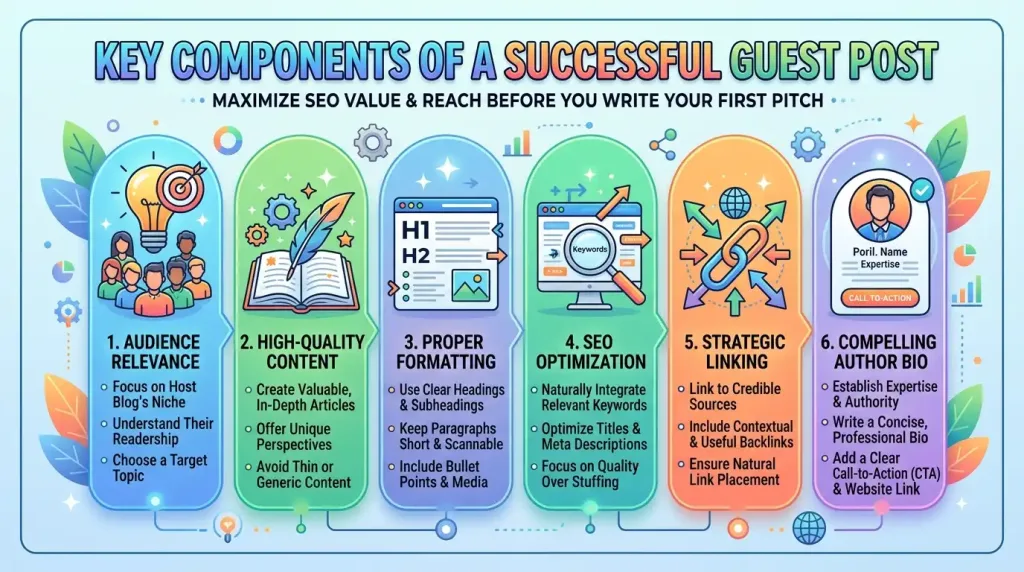
Not every guest post delivers SEO value. Successful guest posts share several common characteristics. Master these components before you write your first pitch.
Relevant and Reputable Host Site
Start by identifying websites that actually matter to your industry. A relevant site shares your target audience and covers topics related to your niche. A reputable site has consistent traffic, engaged readers, and a clean backlink profile.
Use tools like Ahrefs, Semrush, or Moz to check domain authority (DA) and domain rating (DR). Look for sites with DA above 30 or 40 for meaningful impact. Also check that the site publishes content regularly and has an active comment section or social media presence.
Original, High-Value Content
Your guest post must provide unique value that the host site’s audience cannot find elsewhere. Do not repurpose old blog posts from your own site. Do not submit thin content with generic advice. Write something original, actionable, and detailed.
The best guest posts solve specific problems. They offer step-by-step tutorials, original research, case studies, or expert roundups. They include data, screenshots, examples, and practical templates. The more value you pack into your post, the more likely the host site will accept it and readers will engage with it.
Natural, Relevant Links
You usually get one or two links within a guest post. Some sites allow a link in the author bio, others permit in-content contextual links. Make every link count.
Link to your most relevant, high-quality pages. If you write about email marketing, link to your best email marketing guide or tool. If you write about web design, link to your portfolio or service page. Avoid linking to low-value pages like your contact or about us page unless the context absolutely demands it.
Use natural anchor text. Write “check out our complete guide to [topic]” rather than “best [keyword] services.” This approach reads naturally and avoids triggering spam filters.
Compelling Author Bio
Your author bio introduces you to a new audience. Keep it concise but compelling. State your name, role, and one key achievement or value proposition. Include a single link to your homepage or a specific landing page.
For example: “John Smith is an SEO strategist at VastCope, where he helps businesses grow organic traffic. Download his free checklist for [resource].” This bio builds credibility and encourages clicks without being overly promotional.
Finding Quality Guest Posting Opportunities
Discovering the right websites for guest posting requires research and strategy. Here are the most effective methods.
Google Search Operators
Use advanced Google search commands to find sites that accept guest posts. Try these search strings:
your niche + "write for us"your niche + "guest post guidelines"your niche + "contributor guidelines"your niche + "become a contributor"your niche + "submit a guest post"
Replace “your niche” with terms like “digital marketing,” “small business,” “web development,” or whatever industry you serve. These searches reveal sites actively seeking guest authors.
Analyze Competitor Backlinks
Identify where your competitors have published guest posts. Use backlink analysis tools to see their external links. Filter for blog posts or articles, then look for author bios that indicate guest contributions.
This method works extremely well because you find proven opportunities. If a site accepted a guest post from a competitor, they will likely accept one from you, especially if you offer better content.
Social Media and Communities
Follow industry leaders and influencers on LinkedIn, Twitter, and Facebook. Many editors and site owners announce guest posting opportunities on these platforms. Join niche-specific Facebook groups or Reddit communities where members share guest posting leads.
Existing Relationships
Reach out to colleagues, partners, or former clients who run blogs. Offer to write a guest post for them. Since you already have a relationship, they will likely agree quickly. These internal opportunities often produce the highest quality links.
Vetting Your Opportunities
Before you invest time in writing a guest post, vet the host site thoroughly. Check these factors:
- Domain authority: Use free tools like MozBar or Ubersuggest.
- Traffic: Look for sites with consistent organic traffic (SimilarWeb or Ahrefs can estimate this).
- Engagement: Do readers leave comments? Do posts get social shares?
- Indexation: Check if the site’s content appears in Google search results.
- Spam score: Many SEO tools provide a spam score metric. Avoid sites with high spam scores.
Avoid any site that asks for payment in exchange for a guest post. Google considers paid links a violation of its guidelines. Also avoid sites that publish dozens of guest posts daily with thin content.
A well-optimized website attracts more guest posting opportunities. Explore our web development services to build a site that other publishers want to link to.
Pitching Your Guest Post: A Step-by-Step Guide

Your pitch determines whether an editor accepts your idea or deletes your email. Follow this process to craft pitches that get responses.
Research the Site Deeply
Read at least five recent posts on the target site. Understand their tone, formatting, and typical topics. Identify gaps or questions their audience still has. Your pitch should fill one of those gaps.
Find the Right Contact Person
Do not send pitches to generic “info@” email addresses. Find the editor or content manager. Check the site’s “Contact” or “Team” page. Use LinkedIn or Twitter to identify the right person. Address them by name.
Write a Personalized Subject Line
Your subject line must stand out in a crowded inbox. Use something like “Guest post idea for [site name]: [specific topic]” or “Article suggestion for your readers about [topic].”
Avoid clickbait or overhyped phrases. Stay professional and direct.
Craft a Short, Value-Focused Pitch
Keep your email under 200 words. Editors receive dozens of pitches daily. Respect their time.
Open with a genuine compliment about their site. Show that you actually read their content. Then propose 2–3 specific topic ideas. For each idea, explain why their audience would benefit. Mention any unique data, case studies, or examples you will include.
Close with a brief introduction about yourself, including one relevant credential. Offer to send a full outline or a draft if they show interest.
Example Pitch Template
Subject: Guest post idea for [Site Name]: [Topic Idea]
Hi [Editor Name],
I have followed [Site Name] for the past six months. Your post on [specific post] really helped me understand [concept].
I noticed you have not covered [specific subtopic] recently. I would love to write a guest post titled “[Compelling Title].” This piece would include original data from a survey of 200 [industry professionals] and a step-by-step template they can use immediately.
Two other ideas:
- [Second topic idea]
- [Third topic idea]
I run [Your Website/Business], where I help [audience] achieve [result]. I have written for [mention 1–2 other reputable sites if applicable].
May I send a detailed outline for your review?
Best,
[Your Name]
Follow Up Once
If you do not hear back within 7–10 days, send a brief follow-up. Reply to your original email. Write something like: “Hi [Name], just circling back on this. Do you have any interest in a guest post about [topic]?” Do not follow up more than twice.
Writing Guest Posts That Drive Real Results
Once the editor accepts your pitch, deliver exceptional content. Your writing quality directly affects the SEO value you receive.
Match the Host Site’s Style
Study their existing posts. Note their average word count (typically 1500–2500 words for in-depth articles). Observe their heading structure, use of images, bullet points, and callouts. Mirror that style closely.
Lead with a Strong Hook
Your opening paragraph must grab attention immediately. Start with a surprising statistic, a relatable problem, or a bold statement. Clearly state what readers will learn and why it matters.
Provide Actionable Advice
Break complex concepts into simple steps. Use numbered lists, tables, and screenshots. Include real examples from your work or industry case studies. Give readers templates, checklists, or worksheets they can implement right away.
Optimize for Readability
Write short sentences and paragraphs (2–4 sentences each). Use subheadings every 300–400 words. Bold key phrases. Include bullet points for lists. This format keeps readers engaged and helps search engines understand your content structure.
Include a Clear Call to Action Within the Post
Guide readers on what to do next. Suggest they download a related resource, try a specific technique, or visit your website for more information. Make this CTA natural and helpful, not overly salesy.
For inspiration on creating content that ranks, study our guide on improving your Google rankings through quality writing and optimization.
Common Guest Posting Mistakes to Avoid
Even experienced marketers make these errors. Steer clear of them to maximize your results.
Targeting the Wrong Sites
Writing for sites with zero relevance or low authority wastes your time. A link from a DA 10 site in a different industry offers almost no SEO benefit. Worse, it might appear manipulative to Google. Focus only on sites that align with your niche and have established trust.
Over-Optimizing Anchor Text
Using the exact same keyword-rich anchor text in every guest post triggers spam flags. Diversify your anchor text profile. Include branded anchors (your company name), generic anchors (“this article”), and natural phrase anchors (“learn more about SEO strategies”).
Neglecting the Host’s Guidelines
Many sites provide detailed guest posting guidelines. Ignoring them guarantees rejection. Read every guideline carefully. Follow word count limits, formatting rules, and link restrictions precisely.
Writing Low-Value Content
Thin, generic, or overly promotional content damages your reputation. Editors will not accept future posts. Readers will not click your links. Search engines may discount the entire page. Invest time in creating genuinely useful content.
Forgetting to Promote Your Guest Post
After publication, share the post on your social media channels. Email your newsletter subscribers. Tag the host site and editor. Promotion drives additional traffic and engagement, which signals value to search engines.
Ignoring the Relationship
Do not treat guest posting as a one-time transaction. Thank the editor after publication. Leave thoughtful comments on their future posts. Share their content regularly. This relationship building leads to repeat opportunities and stronger links.
Measuring the SEO Impact of Your Guest Posts

You cannot improve what you do not measure. Track these key metrics to evaluate your guest posting success.
Referral Traffic
Use Google Analytics to monitor traffic from each guest post. Under “Acquisition” > “All Traffic” > “Referrals,” find the host site’s domain. Check visits, bounce rate, pages per session, and conversion rate. High-quality guest posts generate consistent referral traffic for months or years.
Backlink Quality and Quantity
Use Google Search Console or SEO tools to track new backlinks. Check the authority of linking domains. Monitor how many internal pages on the host site link to your post. Also watch for any natural backlinks that your guest post attracts from other websites.
Keyword Rankings
Track whether your target keywords improve after publishing guest posts. Use rank tracking tools like Semrush, Ahrefs, or AccuRanker. Look for upward movement on keywords related to your guest post’s topic and your linked pages.
Brand Mention Growth
Set up Google Alerts for your brand name. Monitor how often people mention your brand across the web. Successful guest posting increases brand mentions, which builds online reputation and can lead to additional linkless brand mentions (a positive ranking signal).
Engagement Metrics
Check the guest post’s social shares, comments, and time-on-page if you have access to host site analytics. Higher engagement suggests the post resonates with readers, which increases its SEO value over time.
Guest Posting vs Other Link Building Strategies
How does guest posting compare to other popular link building methods? Understand the differences to allocate your time wisely.
| Strategy | Pros | Cons |
|---|---|---|
| Guest Posting | High-quality links, brand exposure, relationship building | Time-intensive, requires excellent writing |
| Broken Link Building | Helps webmasters, can earn links from authority sites | Low success rate, requires significant research |
| Resource Link Building | Creates lasting assets, attracts natural links | Hard to get noticed, requires truly unique resources |
| Skyscraper Technique | Can earn many links from one asset | Very high effort, depends on promotion |
| Directory Submissions | Easy and fast | Mostly low value, many directories are spammy |
| Forum/Comment Links | Very easy | Almost no SEO value, can hurt you |
Guest posting strikes the best balance between effort and reward for most businesses. It delivers consistent, high-quality links while building your personal brand. Unlike one-off tactics, guest posting creates ongoing relationships that yield multiple opportunities over time.
For businesses looking for professional help with link building, our comprehensive SEO services integrate guest posting with technical audits, content optimization, and performance tracking.
Building Long-Term Relationships Through Guest Posting
The most successful guest posters treat each contribution as the start of a relationship, not the end of a transaction.
Become a Reliable Contributor
Submit your drafts on time. Respond quickly to editor feedback. Make requested revisions without argument. Editors appreciate reliability. When you prove yourself, they will invite you to write again or refer you to other editors.
Share the Spotlight
Mention other contributors or experts in your guest posts. Link to their work when relevant. Tag them on social media. This generosity builds goodwill and often results in reciprocal opportunities.
Offer Value Beyond Guest Posts
Send the editor useful resources even when you are not pitching. Share an interesting industry report. Introduce them to a potential sponsor. Offer to help promote their content. These gestures transform a transactional relationship into a true partnership.
Over time, these relationships become your most valuable SEO asset. Editors will prioritize your pitches, give you more links, and even ask you to write cornerstone content for their sites.
Conclusion: Start Your Guest Posting Journey Today
Guest posting in SEO offers a clear, sustainable path to higher rankings, more traffic, and greater brand authority. Unlike black-hat tactics that risk penalties, guest posting rewards genuine effort and expertise. Each quality guest post you publish builds a permanent asset that continues to drive value for years.
Remember these core principles: target relevant, reputable sites; write exceptional content that solves real problems; use natural anchor text; build lasting relationships; and track your results diligently. Avoid spammy networks, over-optimization, and low-value publications.
Start small. Pitch one site this week. Write one outstanding guest post. Measure the results. Then repeat the process. Over six to twelve months, these efforts compound into a powerful backlink profile that competitors cannot easily replicate.
Transform your website into a guest posting magnet with a stunning user experience. Discover our UI/UX design services to keep visitors engaged and coming back for more.
Frequently Asked Questions (FAQs)
1. How many backlinks should I include in a guest post?
Most reputable sites allow one or two links per guest post. One link in the author bio and one contextual link within the content works well. Do not push for more links, as editors will reject your post or mark it as spam.
2. Does guest posting still work for SEO in 2026?
Yes, guest posting remains highly effective when done correctly. Google values editorial links from authoritative, relevant sites. Focus on quality over quantity, and you will see positive ranking improvements.
3. How long should a guest post be?
Aim for 1,500 to 2,500 words. This length provides enough depth to demonstrate expertise while respecting the host site’s audience attention span. Some sites prefer shorter posts (800–1,200 words), so always check their guidelines.
4. Can I pay someone to write guest posts for me?
You can hire a writer to create content, but you must retain editorial control and ensure the post provides genuine value. Never pay a site to publish your guest post, as that violates Google’s paid link policies and can lead to penalties.
5. How do I find guest posting opportunities without using paid tools?
Use Google search operators like “write for us” + your niche. Check competitor backlinks manually by viewing page source or using free tools like MozBar. Also network in industry forums and LinkedIn groups where editors post opportunities.
6. What anchor text should I use in guest posts?
Use a natural mix of branded anchors (your company name), generic phrases (“learn more here”), and partial-match keywords (“effective SEO strategies”). Avoid exact-match keyword anchors, as they appear manipulative to Google.
7. How often should I publish guest posts?
Quality matters more than frequency. Publishing one outstanding guest post per month on a high-authority site outperforms ten low-quality posts on mediocre sites. Focus on building relationships with top-tier publications in your niche.
8. Can guest posting hurt my SEO?
Yes, if you target spammy sites, use over-optimized anchor text, or publish duplicate content. Guest posting on irrelevant or low-quality sites can trigger Google penalties. Always vet host sites thoroughly before contributing.
9. How do I measure the ROI of guest posting?
Track referral traffic in Google Analytics, monitor keyword ranking improvements, measure new backlinks in Search Console, and calculate conversion value from visitors who arrive via guest posts. Compare these gains against your time investment.
Ready to take your SEO strategy further? Explore our CMS development services to build a website that search engines and users love.
Keep reading
All articles
How to Rank Higher on Google in 2026 (Complete SEO Guide)
Search engines change fast, but one thing stays constant: you want your website on the first page of Google. In 2026, ranking…
Read article
Anchor Text: The Definitive Guide to Boosting SEO & Generative Engine Rankings in 2026
Search engines have evolved faster in the last two years than in the previous decade. Google now serves AI-generated overviews, Bing integrates…
Read article
Can You Do SEO Yourself? Yes! Learn DIY SEO (& When to Outsource)
Can You Do SEO Yourself? Yes! Learn DIY SEO (& When to Outsource) The digital landscape shifts constantly, leaving many business owners…
Read article