

Mastering search visibility requires more than just guessing what your target audience types into a search bar. You must engineer a precise, data-backed strategy to capture attention in an increasingly competitive digital landscape. As artificial intelligence transforms how users discover information, traditional Search Engine Optimization (SEO) merges rapidly with Generative Engine Optimization (GEO). This evolution means you must understand not only the exact words your audience uses but also the deeper context and intent behind their searches.
When you uncover the perfect search terms, you build a direct bridge between your valuable content and the people who actively seek it. Effective keyword selection drives qualified organic traffic, improves engagement rates, and significantly boosts your revenue. This comprehensive guide walks you through every necessary step to find, evaluate, and choose the most impactful keywords for your business goals while aligning perfectly with modern generative search engines.
Want to build a strong foundation first? Read our complete guide to truly understand what are SEO keywords today.
The Evolution of Search: SEO Meets Generative Engine Optimization

Search engines no longer simply match exact phrases to web pages. Today, algorithms utilize advanced natural language processing to comprehend the semantic relationships between concepts. This shift birthed Generative Engine Optimization (GEO). To rank well, you must optimize your content for both traditional algorithms and AI-driven summary engines like Google’s AI Overviews.
Why Keyword Context Matters More Than Ever
Generative engines prioritize direct answers, authoritative sources, and highly structured information. If you only stuff basic phrases into your paragraphs, AI crawlers will bypass your site. Instead, you must weave your target terms naturally into highly informative, context-rich sentences. Search engines now evaluate how comprehensively you cover a topic.
Bridging the Gap Between AI and Human Readers
You face a unique challenge: you must satisfy complex AI algorithms while keeping human readers fiercely engaged. You accomplish this by writing directly, using active voice, and formatting your insights clearly. When you choose keywords today, you select topics and questions rather than isolated words. You must answer the specific questions your audience asks with absolute clarity. For a baseline understanding of how search algorithms interpret site structure, you can always review the official SEO starter guidelines provided by Google.
The Core Types of SEO Keywords You Must Target
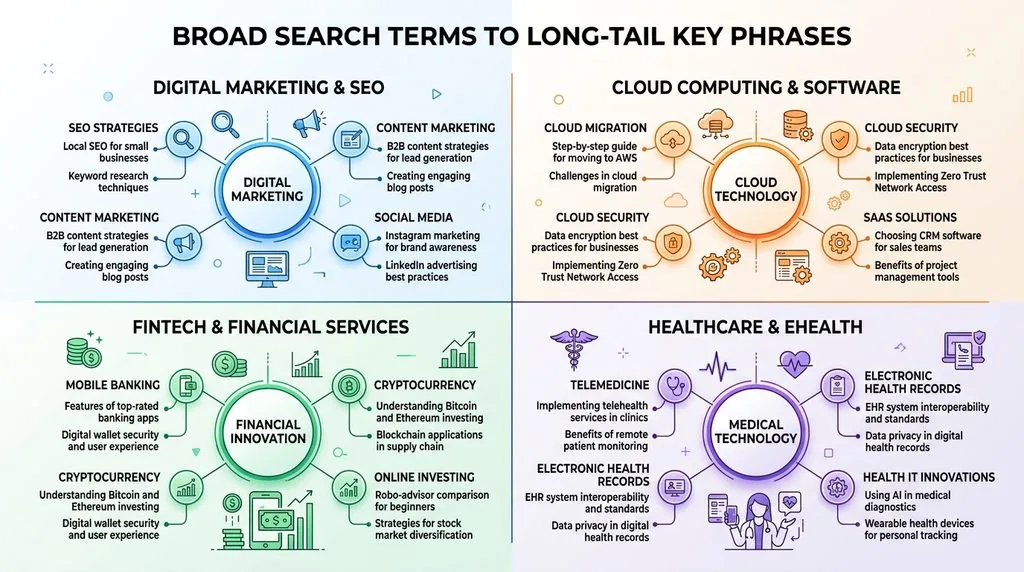
Before you begin mining data, you must understand the different categories of search terms. Each category plays a specific role in your broader digital marketing strategy. You achieve the best results when you balance these different types within your content architecture.
Short-Tail Keywords
Marketers often call these “head terms.” Short-tail keywords consist of one or two broad words, such as “shoes” or “digital marketing.”
- High Search Volume: These terms generate massive amounts of monthly searches.
- Intense Competition: Millions of websites fight for the top spots.
- Low Conversion Rate: Users searching broad terms usually sit at the very beginning of their buying journey.
You should use short-tail terms to define your core pillar pages, but you should not rely on them to drive immediate sales.
Long-Tail Keywords
Long-tail keywords contain three or more words and target a highly specific niche. An example includes “best waterproof running shoes for flat feet.”
- Lower Search Volume: Fewer people search for these exact phrases.
- Lower Competition: You can rank for these terms much faster.
- High Conversion Rate: Users typing long-tail phrases know exactly what they want and stand ready to buy or subscribe.
Generative engines love long-tail keywords because they usually form complete questions that AI models can answer directly.
LSI and Semantic Keywords
Latent Semantic Indexing (LSI) keywords represent terms closely related to your primary topic. If your main keyword is “coffee shop,” your LSI terms might include “espresso machine,” “barista,” “dark roast,” and “free Wi-Fi.” You do not use these terms to replace your main keyword; you use them to provide deep context. Search engines use these semantic clusters to verify that your content genuinely covers the subject matter in depth.
Local SEO Keywords
Local keywords include specific geographic modifiers. When a user searches for “emergency plumber in Chicago,” they demonstrate immediate local intent. If you operate a brick-and-mortar business or provide localized services, you must integrate local identifiers into your keyword strategy to capture neighborhood traffic.
Want to capture audiences actively seeking knowledge? Discover how to master informational keywords for incredible content success.
Decoding Search Intent: The Golden Rule of Modern SEO
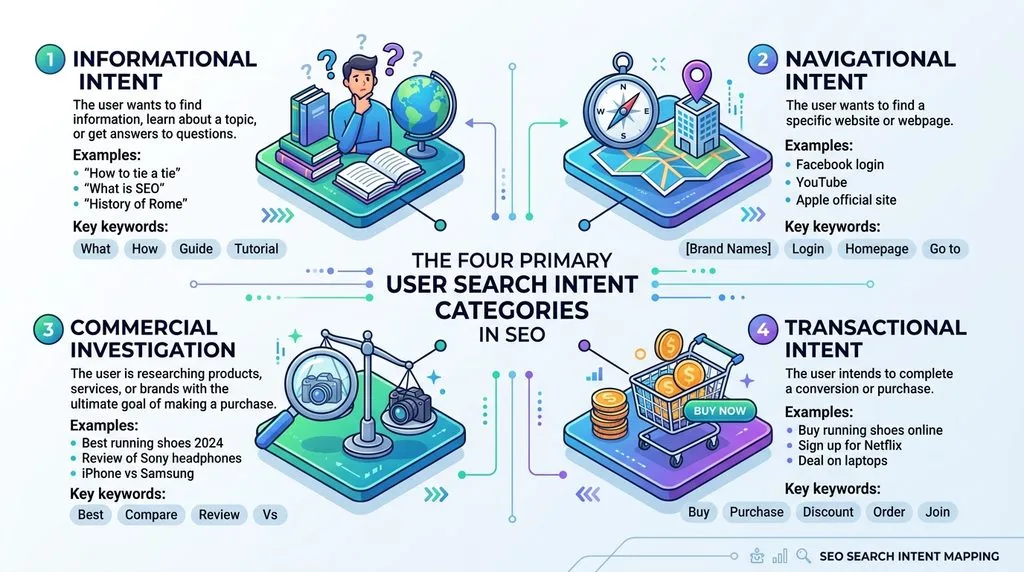
Search intent dictates the entire direction of your content. If you choose a keyword with massive search volume but misalign your content with the user’s actual goal, you will not rank. Search engines meticulously analyze user behavior to determine what type of content satisfies specific queries. You must categorize your target keywords into four distinct intent buckets.
Informational Intent
Users with informational intent want to learn something. They ask questions, seek tutorials, and look for comprehensive guides. These searches often include modifiers like “how to,” “what is,” “guide,” or “tips.” When you target informational intent, you must provide educational, fluff-free answers. AI generative engines excel at answering these queries, so you must format your content with clear headings, bullet points, and direct definitions to secure top visibility.
Navigational Intent
Navigational searchers want to reach a specific website or page. They type terms like “Facebook login” or “Vastcope customer service.” You generally only capture this traffic if the user searches for your specific brand. You should optimize your homepage and foundational pages to ensure your brand names rank flawlessly for these queries.
Commercial Investigation Intent
Users in this phase know they want to purchase a solution, but they need to compare their options first. They use modifiers like “best,” “top,” “review,” or “vs.” To capture this audience, you must create objective comparison charts, detailed product reviews, and listicles. You build trust during this phase, which directly influences the user’s final purchasing decision.
Transactional Intent
Transactional users stand ready with their credit cards. They have completed their research and want to buy right now. These keywords include terms like “buy,” “discount,” “near me,” or specific product model numbers. You must map these keywords directly to your product pages, landing pages, and service offerings. Ensure you remove all friction from the conversion process on these specific pages.
Step-by-Step Guide: How to Find the Best SEO Keywords

Finding the perfect search terms requires a systematic, investigative approach. You cannot rely on guesswork. You must leverage data, explore hidden corners of the internet, and analyze your competitors relentlessly. Follow this structured process to build an expansive, high-potential keyword list.
Step 1: Brainstorm Your Seed Topics
You begin by identifying the core pillars of your business. Strip away all marketing jargon and define exactly what you sell or provide. If you run a digital marketing agency, your seed topics might include “SEO,” “web design,” and “content creation.” Write down 5 to 10 broad categories that define your niche. You will use these seed topics as the foundation for your deep-dive research.
Step 2: Leverage the Power of Competitor Analysis
Your competitors have already done a massive amount of research for you. You just need to extract their data. Identify the top three websites dominating your niche. Plug their URLs into a premium SEO analysis tool to reveal the exact keywords driving their traffic. Look for “content gaps”—the highly profitable keywords your competitors rank for, but you currently ignore.
Step 3: Utilize Autosuggest and Related Searches
Search engines give you direct insights into what users want. Open a search engine and type in one of your seed topics. Do not press enter. Look at the dropdown autosuggestions. Search engines generate these suggestions based on real-time, high-frequency user queries. Next, execute the search and scroll to the bottom of the results page. The “Related Searches” section provides a goldmine of semantically relevant long-tail variations that you can seamlessly weave into your content plan.
Step 4: Explore Niche Forums and Communities
To truly humanize your content and align with Generative Engine Optimization, you must understand how real people talk about your industry. Visit platforms like Reddit, Quora, and specialized industry forums. Search for your seed topics and read the questions users ask. You will discover unique, conversational long-tail keywords that traditional SEO tools completely miss. By answering these specific community questions, you naturally optimize for AI-driven search models.
Step 5: Partner with Experienced Strategists
Sometimes, finding the perfect terms requires advanced auditing and enterprise-level tools. You can accelerate your growth immensely by collaborating with professionals who map out high-ROI keyword strategies daily. For businesses wanting a completely customized approach, exploring professional customized SEO strategies provides the fastest route to search dominance.
Boost your new keywords with massive authority. Explore our expert SEO backlink services to dominate search rankings today.
Step-by-Step Guide: How to Choose the Right Keywords for Your Goals
Finding hundreds of keywords only completes the first half of the battle. You must now filter your massive list down to the specific terms that will actually move the needle for your business. You must weigh several critical metrics before dedicating time and resources to content creation.
Analyze Monthly Search Volume (MSV)
Search volume indicates how many times users search for a specific term every month. You want to target keywords with enough volume to generate meaningful traffic. However, you must avoid the trap of exclusively chasing massive numbers. A keyword with 10,000 monthly searches might look appealing, but if those searchers lack buying intent, the traffic holds zero value. Conversely, a highly specific long-tail keyword with only 150 monthly searches could generate ten high-paying clients.
Evaluate Keyword Difficulty (KD)
Keyword Difficulty metrics tell you how hard you will have to work to rank on the first page. SEO tools calculate this score (usually from 1 to 100) based on the domain authority and backlink profiles of the current top-ranking pages.
- If you own a brand-new website, you must target low-difficulty keywords (KD 1-30).
- If you run an established, authoritative site, you can aggressively pursue high-difficulty terms (KD 60+). You waste valuable time and money when you target keywords that heavily outmatch your website’s current authority.
Assess Business Value and Conversion Potential
You must ask yourself one critical question: “If I rank number one for this keyword, will it generate revenue?” You determine this by mapping the keyword to your specific products or services. Assign a business value score to each keyword:
- Low Value: The user just wants free information; no clear path to purchase.
- Medium Value: The user wants information closely related to your industry; you can capture their email for a newsletter.
- High Value: The user actively searches for the exact solution you sell; high potential for an immediate transaction. Always prioritize high-value keywords that align directly with your revenue goals.
Check Current SERP Features
Search Engine Results Pages (SERPs) look vastly different today than they did five years ago. Before finalizing a keyword, type it into the search engine and analyze the layout. Do you see an AI Overview, a massive featured snippet, a local map pack, or a video carousel? If an AI Overview or zero-click feature monopolizes the entire top half of the screen, you might receive very little actual click-through traffic even if you rank first organically. You can use platforms like Google Trends to continuously monitor shifting search trends and see how interest in these SERPs changes over time.
Top Keyword Research Tools for 2026

You cannot execute a flawless strategy without the right technology. Modern SEO tools leverage machine learning to provide incredibly accurate data points. You should utilize a mix of premium platforms and free resources to build a well-rounded keyword matrix.
Premium SEO Platforms
Market leaders provide the most comprehensive data available.
- Ahrefs: This tool offers unparalleled backlink analysis and an incredibly intuitive keyword explorer. It provides precise difficulty scores and click-stream data to estimate actual traffic.
- SEMrush: Marketers revere SEMrush for its robust competitor analysis features. It allows you to track keyword gaps, analyze paid search strategies, and audit your entire site’s technical health.
- Surfer SEO: This platform bridges the gap between keyword research and on-page optimization. It uses AI to analyze the top-ranking pages and tells you exactly which LSI keywords you must include in your content to outrank them.
You can learn more about how industry leaders maximize these premium platforms by studying authoritative keyword research strategies published by industry pioneers.
Free and Accessible Keyword Tools
You do not always need an expensive subscription to uncover high-value search terms.
- Google Search Console: This free tool shows you the exact queries users already type to find your website. You can identify “striking distance” keywords—terms where you currently rank on page two or three—and optimize your content to push them to page one.
- Google Keyword Planner: Originally designed for paid ads, this tool provides excellent baseline data for search volume and seasonal trends.
- Answer The Public: This visual tool scrapes autosuggest data and organizes it into beautiful diagrams of questions, prepositions, and comparisons. It provides the ultimate blueprint for targeting informational intent.
Build a technical foundation that supports your keywords perfectly. Discover our expert CMS development services for flawless management.
Applying Generative Engine Optimization (GEO) to Your Keywords
Finding and choosing keywords means nothing if you fail to deploy them correctly. Traditional keyword placement involved stuffing the phrase into your title, URL, and a few headers. Generative Engine Optimization requires a much more sophisticated, holistic approach. You must construct content that AI models easily digest, verify, and summarize.
Write for AI Summaries and Search Snippets
Generative engines pull information from highly structured data. To optimize your keywords for AI, you must present your answers concisely.
- Use the Inverted Pyramid Style: Answer the user’s primary question in the very first sentence of the section. Follow up with detailed explanations and supporting evidence.
- Leverage Formatting Rigorously: Use bulleted lists, numbered sequences, and bold text to highlight key concepts. AI models parse lists much easier than massive blocks of text.
- Target Question-Based Headers: Format your H2 and H3 tags as the exact questions your audience asks. Immediately follow the header with a definitive, accurate answer.
Maintain High EEAT Standards
Search engines rigorously evaluate Experience, Expertise, Authoritativeness, and Trustworthiness (EEAT). When you target a keyword, you must prove you possess the authority to speak on the topic.
- Include expert quotes and original data.
- Use internal links to connect your new keyword-focused article to your established pillar pages.
- Maintain an active, engaging voice that demonstrates firsthand experience. Generative AI detects and penalizes generic, rehashed content that lacks a unique perspective.
Structure Data with Precision
Schema markup acts as a direct translator between your website and search engine algorithms. By implementing proper structured data (such as FAQ schema, Article schema, or Product schema), you explicitly tell the generative engine exactly what your content contains. This technical implementation significantly increases your chances of appearing in rich snippets and AI overviews.
Filtering and Finalizing Your Keyword List
After gathering data and aligning your strategy with GEO principles, you must filter your list down to a precise, actionable content calendar. You cannot target 500 keywords simultaneously. You must prioritize execution.
Group Keywords by Topic Clusters
Do not write separate articles for keywords that share the exact same search intent. For example, “how to choose SEO keywords,” “selecting the right SEO keywords,” and “picking keywords for SEO” all mean the exact same thing. Group these semantically related terms into a single “Topic Cluster.” Assign one primary keyword to the page and weave the secondary variations naturally throughout your headers and body paragraphs.
Build a Content Roadmap
Organize your finalized topic clusters into a strategic timeline.
- Start by targeting the low-difficulty, long-tail keywords to secure quick wins and build initial organic momentum.
- Simultaneously, develop comprehensive, long-form content for your highly competitive seed topics.
- Ensure every piece of content you plan serves a specific business goal and guides the reader naturally toward a conversion.
Tracking, Monitoring, and Refining Your Keyword Strategy
SEO does not operate in a vacuum. Algorithms update constantly, competitors launch new campaigns, and user behavior shifts based on cultural trends. You must continuously monitor your keyword performance and adapt your tactics.
Set Up Rank Tracking
Deploy reliable rank-tracking software to monitor your keyword positions weekly. Do not obsess over daily fluctuations, but watch for long-term trends. If a previously successful keyword begins to drop in the rankings, you must audit the page immediately. Check the current SERPs to see if user intent has shifted or if a competitor has published a vastly superior, more comprehensive guide. Utilize free keyword generation tools periodically to ensure you aren’t missing newly trending variations of your core terms.
Adapt to Algorithm Shifts
Generative AI continues to evolve at a breakneck pace. Search engines update their core algorithms multiple times a year to prioritize helpful, human-first content. You must commit to updating your existing content regularly. Refresh outdated statistics, add new FAQs based on recent customer inquiries, and improve the overall readability of your pages. A keyword strategy only succeeds long-term when you treat your content as a living, breathing asset rather than a static publication.
Conclusion
Finding and choosing the right keywords for SEO requires a blend of technical analysis, psychological empathy, and strategic foresight. You can no longer rely on outdated keyword-stuffing tactics. You must embrace Generative Engine Optimization by prioritizing user intent, answering questions directly, and building immense topical authority.
By thoroughly brainstorming seed topics, ruthlessly analyzing competitors, and carefully filtering your list based on search volume and business value, you position your brand for sustainable, long-term growth. Remember to group your terms into semantic clusters, write with an active, authoritative voice, and structure your data flawlessly. When you execute this methodology with precision, you transform your website into an unstoppable organic traffic engine that consistently converts visitors into loyal customers.
Frequently Asked Questions (FAQs)
1. What is the main difference between traditional SEO and Generative Engine Optimization (GEO)?
Traditional SEO focuses heavily on exact keyword placement and backlink quantities to satisfy basic algorithms. Generative Engine Optimization focuses on formatting content for AI readability, prioritizing direct answers, high EEAT (Experience, Expertise, Authoritativeness, and Trustworthiness), and rich semantic context to rank in AI-generated summaries.
2. How many keywords should I target per page?
You should target one primary keyword per page and include 3 to 5 semantically related secondary keywords. Never force keywords where they do not belong; group terms by search intent and let them flow naturally within your expert explanations.
3. Are short-tail keywords completely useless for new websites?
No, short-tail keywords are not useless, but they serve a different purpose. New websites struggle to rank for them immediately due to high competition. You should use short-tail terms to define your broad category pages, while focusing your actual content creation efforts on low-competition, long-tail variations to drive initial traffic.
4. How long does it take to see ranking results after choosing new keywords?
Search engine ranking timelines vary widely based on your website’s existing authority and the keyword’s difficulty. Generally, you will start seeing initial movement within 3 to 6 months for low-difficulty long-tail keywords. Highly competitive terms often require 6 to 12 months of consistent optimization and link building.
5. Why do my keywords have high search volume but bring zero sales?
You likely chose keywords that misalign with user intent. If you target informational keywords (users seeking free knowledge) but attempt to force a hard sale on the page, the user will bounce. You must match transactional keywords with product pages and informational keywords with educational content.
6. What is keyword cannibalization?
Keyword cannibalization occurs when multiple pages on your own website compete for the exact same keyword and search intent. This confuses search engines, dilutes your authority, and usually results in neither page ranking well. You fix this by consolidating competing pages into one comprehensive master guide.
7. Can AI writing tools choose the best keywords for me automatically?
AI tools can generate fantastic lists of topic ideas and suggest LSI keywords, but they lack human business context. You must manually evaluate keyword difficulty, analyze SERP features, and determine the actual conversion value of a term before committing your marketing budget to it.
8. Do local businesses need a different keyword strategy?
Yes, local businesses must prioritize geographic modifiers. Instead of competing nationally for “roofing services,” you must target “roofing contractors in [Your City].” Local SEO also relies heavily on optimizing your Google Business Profile alongside your standard website keyword strategy.
Keep reading
All articles
How to Use Web Marketing: The Ultimate Beginner’s Guide
Learn the definition of web marketing and see how to leverage digital channels like email, search, and social media to reach more…
Read article
What is Conversion Rate Optimization in Marketing? The Ultimate Guide
You pour countless hours and thousands of dollars into driving traffic to your website. You optimize your search engine rankings, run expensive…
Read article
Expert Partners for Modern Search Visibility: 2026 Rankings
Stay ahead of the curve with our 2026 guide to digital visibility. We review the top agencies specializing in AI-driven discovery and…
Read article