
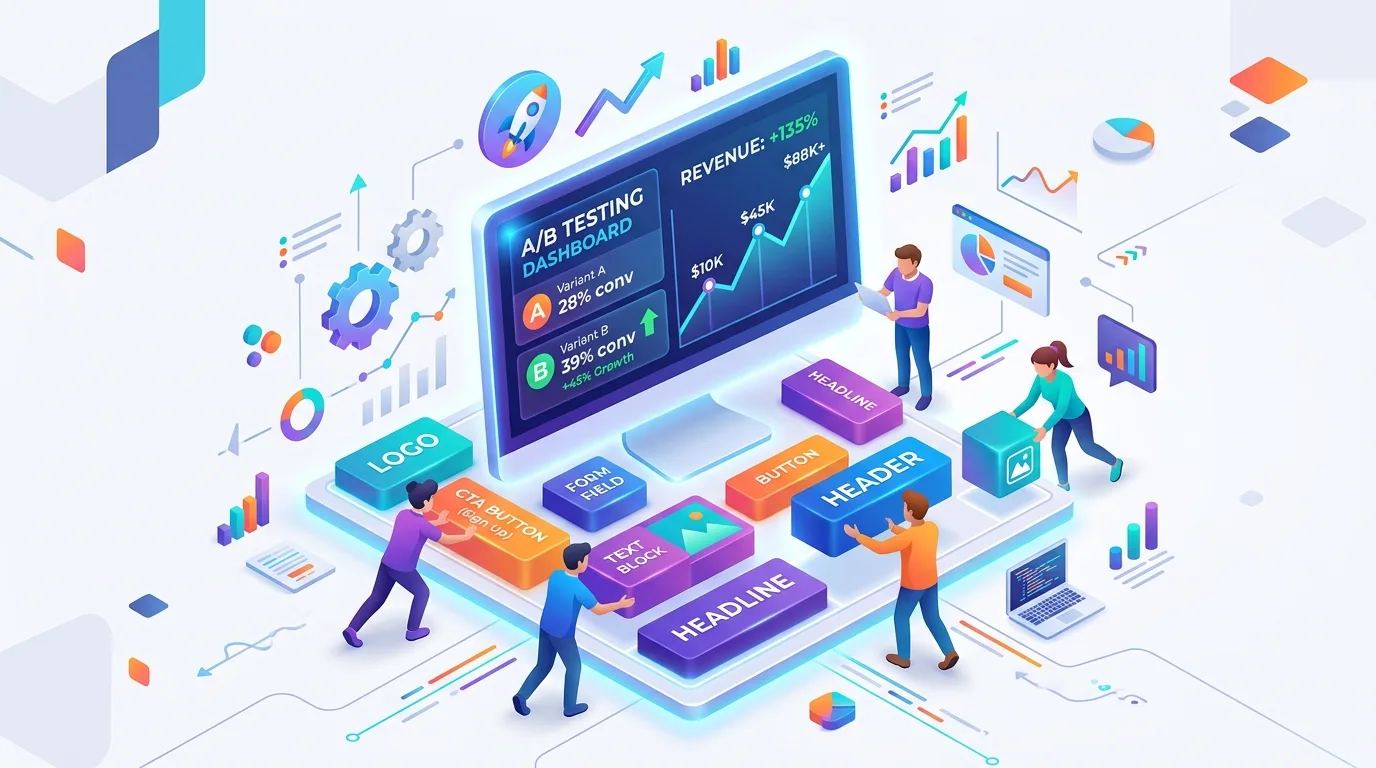
You pour countless hours and thousands of dollars into driving traffic to your website. You optimize your search engine rankings, run expensive pay-per-click campaigns, and blast out engaging social media posts. The traffic graph points up, and visitors flood your pages. Yet, when you check your sales dashboard or lead generation forms, the numbers remain stubbornly low. You face a frustrating reality: traffic means nothing if your visitors do not take action.
This exact scenario explains why modern digital marketing relies on a specific, data-driven discipline to bridge the gap between traffic and revenue. Marketers call this discipline Conversion Rate Optimization (CRO).
Instead of constantly chasing new visitors, CRO forces you to look inward. It demands that you extract maximum value from the users who already land on your digital doorstep. When you master this process, you transform your website from a passive digital brochure into a highly efficient, automated salesperson. This comprehensive guide explores everything you need to know about Conversion Rate Optimization, how it works, and how you can implement it to skyrocket your business growth.
Want to convert more visitors instantly? Discover how our targeted lead generation services maximize your website’s true potential today. Explore Lead Generation Services
Decoding the Definition: What Exactly is Conversion Rate Optimization?
Conversion Rate Optimization in marketing involves the systematic process of increasing the percentage of website visitors who complete a specific, desired action. Marketers design this strategic approach to understand how users navigate a site, what actions they take, and what specific obstacles stop them from completing your end goals.
To fully grasp this concept, you must first understand what constitutes a “conversion.” A conversion happens whenever a user completes an action that provides value to your business. We generally categorize these actions into two distinct buckets: macro-conversions and micro-conversions.
Macro-Conversions vs. Micro-Conversions
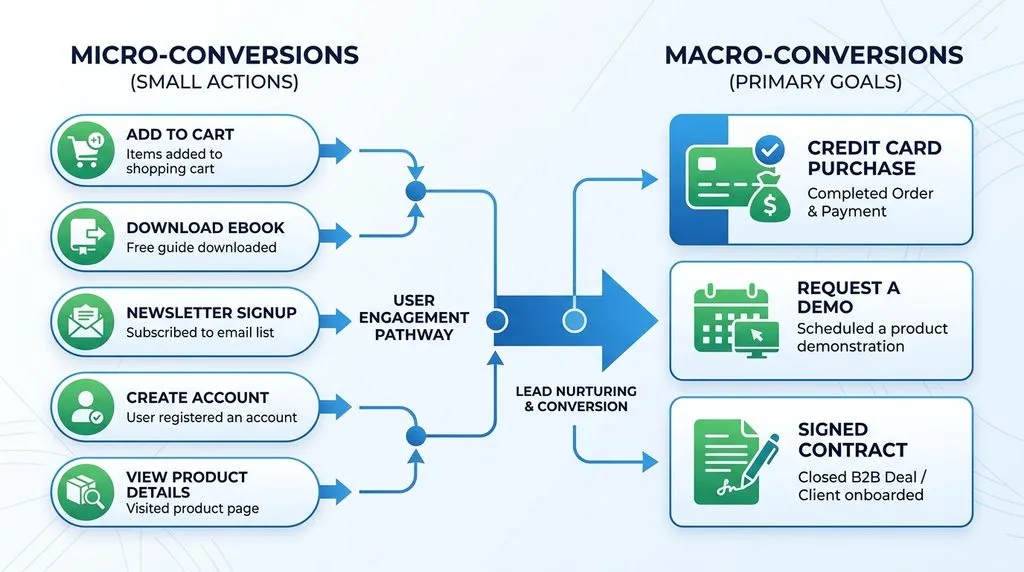
Businesses track different metrics depending on their industry, goals, and business models. You must track both large-scale and small-scale actions to get a complete picture of your user journey.
Macro-conversions represent your primary business objectives:
- Purchasing a product from an e-commerce store.
- Requesting a custom quote for a B2B software service.
- Subscribing to a premium, paid membership tier.
- Booking a direct consultation or appointment.
Micro-conversions represent smaller steps that move users down the funnel:
- Adding a specific product to the digital shopping cart.
- Signing up for a weekly email newsletter.
- Downloading a free eBook, whitepaper, or case study.
- Creating a free user account without making a purchase.
- Watching a promotional explainer video to the end.
Every time you improve the success rate of a micro-conversion, you naturally boost your macro-conversions.
The Mathematical Formula for Conversion Rate
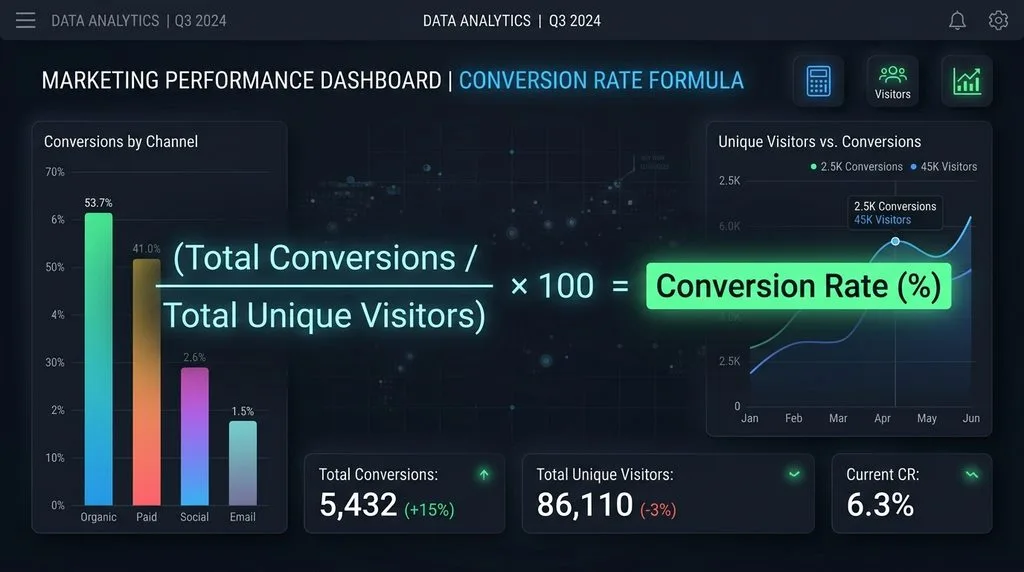
You cannot optimize what you do not measure. Calculating your conversion rate requires a simple but vital mathematical formula. You divide your total number of conversions by your total number of unique website visitors, and then you multiply that resulting number by 100 to get a percentage.
For example, if your landing page receives 5,000 visitors in a single month, and 200 of those visitors fill out your contact form, you calculate your rate like this: (200 / 5,000) x 100 = 4%.
Understanding your baseline metric gives you a starting point. From here, you can set realistic goals, benchmark your performance against industry average conversion rates, and launch targeted campaigns to push that percentage higher.
The Core Pillars of a High-Converting Website
Conversion Rate Optimization does not rely on random guesswork or sudden flashes of creative brilliance. Instead, successful marketers build their CRO strategies upon several foundational pillars. You must optimize each of these elements to create a frictionless, highly persuasive user journey.
Persuasive and Customer-Centric Copywriting
Words carry immense power on your website. Your copywriting must speak directly to your target audience’s deepest pain points, desires, and motivations. Many businesses make the critical mistake of focusing entirely on their product’s features. Successful copywriters focus heavily on benefits.
Instead of telling your customer that your software features a “cloud-based data architecture,” you tell them that they can “access their business data securely from any device, anywhere in the world.” You must write clear, concise, and highly scannable text. Web users rarely read every word; they skim pages to find relevant information. Use bold typography, short paragraphs, and clear subheadings to guide their eyes down the page.
Intuitive User Interface and Seamless User Experience
If users cannot figure out how to navigate your website within three seconds, they will leave. User Experience (UX) and User Interface (UI) design play monumental roles in your conversion rates. A high-converting website guides users logically from one step to the next without causing confusion or cognitive overload.
You must ensure your navigation menus feature clear labels. You need to standardize your website architecture so users intuitively know where to find your pricing, your services, and your contact information. Complex layouts introduce friction, and friction kills conversions.
Transform your frustrating website layout into a high-converting machine. Explore our expert UI/UX design services to boost engagement immediately. Upgrade Your UI/UX Today
High-Visibility, Action-Oriented Calls-to-Action (CTAs)

Your Call-to-Action represents the final tipping point between a bounce and a conversion. You must design CTAs that command attention and compel immediate action.
- Use contrasting colors: Your button should stand out vividly against your background color scheme.
- Deploy action-oriented verbs: Replace boring phrases like “Submit” or “Click Here” with value-driven commands like “Get Your Free Report” or “Start Your Free Trial Today.”
- Provide strategic placement: Place your primary CTAs above the fold, at the end of engaging content sections, and permanently in your sticky navigation bar.
Blistering Page Load Speeds
Modern internet consumers lack patience. If your page takes longer than three seconds to load, your bounce rate will skyrocket, and your conversions will plummet. You must compress your high-resolution images, minify your CSS and JavaScript code, and utilize powerful Content Delivery Networks (CDNs) to deliver your website assets instantly to users around the globe. Speed optimization represents the most technical pillar of CRO, but it often yields the most immediate and dramatic results.
Why CRO is a Non-Negotiable Asset for Modern Businesses
Many business owners treat CRO as an optional luxury—something they will eventually get to once they secure enough traffic. This backward mindset costs companies thousands of dollars in lost revenue every single month. You must prioritize CRO because it fundamentally changes the economic mechanics of your business.
Skyrocketing Your Return on Investment (ROI)
Advertising platforms continuously raise their cost-per-click (CPC) rates. Bidding on competitive keywords costs more today than it did five years ago. If you only focus on driving traffic, your marketing expenses will scale linearly with your revenue.
CRO breaks this linear relationship. When you double your conversion rate, you effectively double your cost-efficiency. You extract twice as many customers from the exact same advertising budget. This increased ROI gives you a massive competitive advantage. You can afford to outbid your competitors on ad networks because you extract more value from every single click you purchase.
Lowering Customer Acquisition Costs (CAC)
Customer Acquisition Cost represents the total amount of money you spend to acquire one new paying customer. You calculate this by dividing your total marketing and sales spend by the number of new customers acquired over a specific period.
When you implement a robust CRO strategy, your CAC drops drastically. Because you convert a higher percentage of your existing traffic, you generate more customers without increasing your ad spend. According to business data experts, actively lowering your customer acquisition cost acts as the fastest lever to increase your overall profit margins.
Enhancing Brand Trust and Credibility
Users instantly judge the credibility of your business based on their digital experience. A broken form, a confusing checkout process, or a slow-loading landing page signals unprofessionalism. Conversely, a smooth, heavily optimized website tells the user that you run a highly competent, trustworthy organization. By removing friction and creating a seamless journey, CRO inherently builds the brand equity and trust required to close high-ticket sales.
How Conversion Rate Optimization Synergizes with Marketing Channels
CRO does not exist in a vacuum. It acts as a force multiplier for every other marketing campaign you launch. When you optimize your website for conversions, you simultaneously boost the effectiveness of your SEO, PPC, and content marketing efforts.
Amplifying Search Engine Optimization (SEO)
Search engines like Google prioritize user experience above almost everything else. Google monitors how users interact with your website. If a user clicks your link in the search results, lands on your page, and immediately clicks the “back” button (a metric known as “pogo-sticking”), Google assumes your page provides a poor experience.
CRO directly combats these negative metrics. By optimizing your layout, improving readability, and adding compelling CTAs, you keep users engaged longer. You lower your bounce rate and increase your average time on page. These positive engagement signals tell search engines that your website deserves a higher ranking in the search results.
Ready to drive traffic that actually converts? Let our comprehensive SEO services elevate your rankings and skyrocket your revenue.
Maximizing Pay-Per-Click (PPC) Advertising Campaigns
Paid advertising platforms assign a “Quality Score” to your ad campaigns. This score dictates how much you pay per click and where your ad appears on the search page. Your landing page experience heavily influences this Quality Score.
When you use CRO principles to ensure your landing page perfectly matches the promise of your ad copy, you boost your ad relevance. A highly optimized, relevant landing page improves your Quality Score, which directly lowers your cost-per-click. CRO ensures you never waste expensive ad clicks on a confusing or poorly designed destination page.
Empowering Social Media and Email Marketing
Social media and email campaigns generate highly targeted, engaged traffic. However, users arriving from an Instagram ad or an email newsletter possess different mindsets than users arriving from a Google search. They expect immediate gratification and visual consistency.
CRO helps you design dedicated, campaign-specific landing pages. If your email promotes a 20% discount on shoes, CRO dictates that your landing page must prominently display that exact discount, feature the shoes immediately, and provide a frictionless checkout process. This seamless transition from email to website guarantees the highest possible conversion rate.
The Hidden Psychology Behind User Conversions
To master Conversion Rate Optimization, you must understand human psychology. People rarely make purely logical purchasing decisions. Instead, cognitive biases, emotional triggers, and psychological shortcuts drive human behavior. You can ethically leverage these psychological principles to gently nudge users toward a conversion.
The Power of Social Proof and the Bandwagon Effect
Humans act as social creatures. When we feel uncertain about a decision, we look at the behavior of others to guide our own actions. Marketers call this psychological phenomenon “social proof.”
You must actively weave social proof throughout your digital touchpoints.
- Embed authentic customer testimonials: Display real quotes with names and photos.
- Showcase user-generated content: Feature videos or photos of real customers using your product.
- Highlight impressive data points: Use statements like “Join 50,000+ satisfied marketers” to trigger the bandwagon effect.
- Display trust badges: Add security seals, industry awards, and media logos (e.g., “As Seen On Forbes”).
Creating Authentic Urgency and Scarcity
Fear of Missing Out (FOMO) acts as a powerful catalyst for action. When people believe a valuable item exists in limited quantities, or a special offer will soon expire, they act quickly to secure it.
You can implement scarcity by displaying low stock warnings (“Only 3 items left in stock!”). You can generate urgency by utilizing countdown timers for limited-time discounts. However, you must maintain strict authenticity. Modern consumers easily spot fake urgency. If your countdown timer resets every time a user refreshes the page, you will permanently destroy your brand’s credibility.
Overcoming the Paradox of Choice (Hick’s Law)
Many website owners believe that offering users more options leads to more sales. Psychological studies prove the exact opposite. The Paradox of Choice dictates that providing too many options overwhelms the user, leading to decision paralysis and an abandoned session.
In UX design, we refer to this as Hick’s Law: the time and effort required to make a decision increases logarithmically with the number of choices provided. You must simplify your user’s path. Remove unnecessary links from your landing pages. Reduce the number of pricing tiers you offer. Condense your form fields down to only the absolute essential information. By limiting choices, you drastically increase the likelihood of a conversion.
Need higher domain authority to build trust and boost organic traffic? Secure premium SEO backlinks to dominate your industry. Build Powerful Backlinks Today
A Step-by-Step Blueprint for Implementing a Winning CRO Strategy
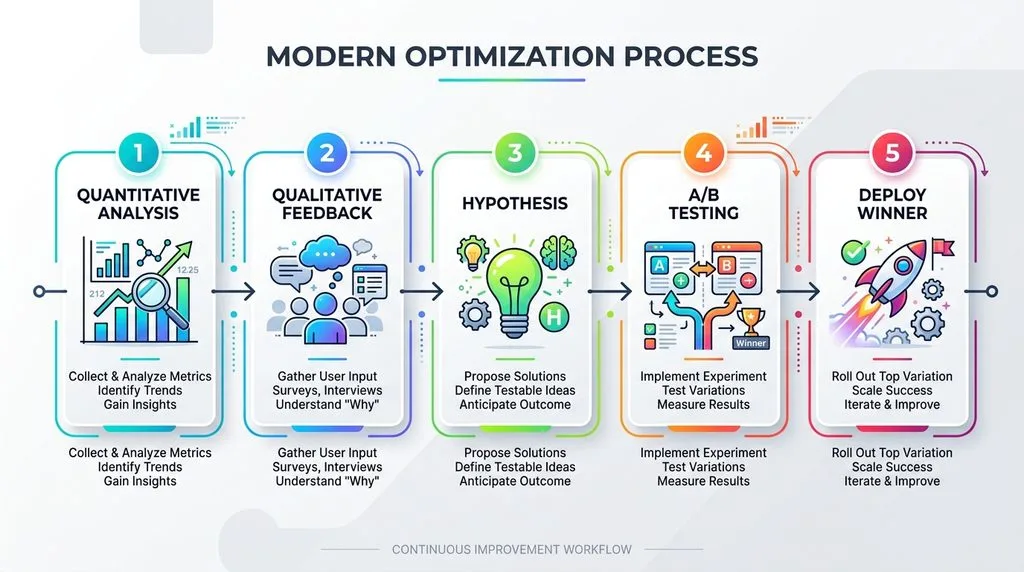
You cannot optimize a website blindly. Successful CRO requires a highly structured, scientific methodology. You must abandon your gut feelings and rely entirely on data. Follow this proven, step-by-step blueprint to implement a winning CRO strategy for your business.
Step 1: Conduct Comprehensive Quantitative Data Analysis
Before you change a single button color or headline, you must understand what currently happens on your website. You need to dive deep into your quantitative data using platforms like Google Analytics.
You must identify your “leaky buckets.” Look for web pages that receive high volumes of traffic but suffer from exceptionally high bounce rates or low conversion rates. Analyze your conversion funnels to pinpoint exactly where users drop off. For example, if 80% of users add an item to their cart, but only 10% complete the checkout, you know your checkout page contains a massive usability issue. Quantitative data tells you where the problem exists.
Step 2: Gather Qualitative User Feedback
While quantitative data tells you where users struggle, qualitative data tells you why they struggle. You must understand the emotional and practical barriers preventing your visitors from converting.
- Deploy heatmaps and scroll maps: These visual tools show you exactly where users click, how far they scroll down your page, and which elements they ignore completely.
- Record user sessions: Watch anonymous screen recordings of real users navigating your site. You will quickly spot frustrating glitches, confusing navigation menus, or broken links.
- Implement on-page surveys: Use non-intrusive pop-up surveys to ask users specific questions. Ask them, “What stopped you from completing your purchase today?” Their answers will provide a goldmine of optimization ideas.
Step 3: Formulate a Data-Backed Hypothesis
Once you gather your data, you must create a clear, testable hypothesis. A strong hypothesis clearly defines the proposed change, the expected outcome, and the underlying reasoning.
Use this specific framework: “If we change [Variable X] to [Variable Y], then [Metric Z] will improve, because [Data/Psychology Reason].”
For example: “If we reduce the checkout form from 8 fields to 4 fields, then our purchase completion rate will increase by 15%, because we remove unnecessary friction and lower the user’s cognitive load.”
Step 4: Execute Rigorous A/B Testing
With your hypothesis ready, you launch a split test. A/B testing involves creating a secondary version of your webpage (Variant B) that includes your proposed change, while keeping the original page (Variant A) exactly the same.
You use testing software to split your live website traffic evenly between the two variations. Half your users see the old form; half your users see the new form. You run this test until you achieve a statistically significant result. The data will declare a clear winner, removing all subjective opinions from your design process.
Step 5: Analyze Results and Deploy the Winner
After completing the test, you must analyze the final data. If Variant B drastically outperformed Variant A, you permanently deploy the winning design to your live website. You then document your learnings. If Variant B failed, you also document the failure, formulate a new hypothesis, and begin the testing cycle again. CRO represents an endless cycle of continuous improvement.
Common CRO Mistakes You Must Avoid at All Costs
Even experienced marketers frequently stumble when executing a CRO campaign. Because the process relies heavily on statistical accuracy and technical execution, small errors completely invalidate your results. Avoid these critical mistakes to ensure your optimization efforts yield true business growth.
Testing Too Many Variables Simultaneously
When you run an A/B test, you must only test one specific element at a time. If you simultaneously change the headline, the button color, and the hero image on Variant B, and it outperforms Variant A, you learn nothing. You have no mathematical way to determine which of those three changes actually caused the increase in conversions.
If you want to test multiple elements simultaneously, you must use Multivariate Testing (MVT). However, MVT requires massive amounts of daily traffic to achieve statistical significance. For 95% of businesses, strict, single-variable A/B testing remains the safest and most effective approach.
Neglecting the Mobile User Experience
The majority of global internet traffic now originates from mobile devices. Despite this reality, many designers and marketers still build and test websites on large desktop monitors. This creates a massive disconnect in the user experience.
A layout that looks stunning on a 27-inch monitor often becomes an unreadable, overlapping mess on a 6-inch smartphone screen. You must design and optimize with a “mobile-first” mindset. Ensure your buttons remain large enough to tap easily with a thumb. Keep your text legible without requiring users to pinch and zoom. Simplify your mobile menus to prevent endless scrolling.
Calling Tests Before Reaching Statistical Significance
Impatience ruins CRO campaigns. When marketers launch an A/B test, they often obsessively monitor the real-time data. If Variant B shows a massive lead after only 48 hours, they prematurely stop the test and declare it a winner.
This represents a fatal statistical error. Early data wildly fluctuates. You must let your tests run long enough to account for weekly traffic variations (e.g., weekend traffic behaves differently than Tuesday traffic) and reach a minimum of 95% statistical significance. If you stop a test too early, you risk deploying a “false positive” that actually hurts your long-term conversion rates.
Essential Tools to Power Your CRO Strategy

You cannot perform Conversion Rate Optimization manually. You need a robust technology stack to track user behavior, analyze data, and run accurate split tests. Equipping your marketing team with the right tools ensures your optimization strategy runs efficiently.
Quantitative Analytics Platforms
Google Analytics 4 (GA4) serves as the foundational tool for almost every CRO strategy. It provides the hard numbers you need to track traffic sources, measure bounce rates, and analyze user flow. You must properly configure your GA4 event tracking to ensure you accurately capture every micro-conversion and macro-conversion that occurs on your platform.
Qualitative Behavioral Tracking Tools
To understand user behavior visually, you need tools like Hotjar, Crazy Egg, or Mouseflow. These powerful applications generate heatmaps that show you exactly where users click most frequently. They provide scroll depth analysis to tell you exactly where users lose interest and abandon the page. Most importantly, they offer session recording features, allowing you to watch playback videos of actual users interacting with your digital interface.
Dedicated A/B Testing Software
To actively split your traffic and measure variant performance, you require dedicated testing engines. Platforms like VWO (Visual Website Optimizer), Optimizely, and AB Tasty dominate this space. These tools offer visual editors that allow your marketing team to change text, swap images, and hide elements without needing to write complex code. They handle the complex mathematics of traffic distribution and statistical significance automatically behind the scenes.
Stop wrestling with slow, outdated platforms that limit your testing capabilities. Upgrade your site with our custom CMS development services for seamless user experiences. Get Custom CMS Development
Conclusion: Transform Your Traffic into Tangible Revenue
Conversion Rate Optimization does not serve as a quick, temporary fix for a broken business model. Instead, it operates as a fundamental, ongoing philosophy of digital marketing. By continuously questioning your assumptions, analyzing user behavior, and systematically testing new ideas, you unlock the true potential of your website.
Remember that your website exists to serve your users. When you obsess over removing their friction, answering their questions clearly, and providing a flawless user experience, they reward you with their business. Stop obsessing exclusively over acquiring new traffic, and start focusing on treating your current visitors better. When you commit to the rigorous, data-driven methodology of CRO, you build a resilient, highly profitable digital ecosystem that scales effortlessly.
Stop losing valuable customers to poor website performance and friction. Partner with our elite web development team to build high-converting websites now.
Frequently Asked Questions (FAQ)
1. What is a “good” conversion rate?
A “good” conversion rate heavily depends on your specific industry, your product price point, and your traffic source. Generally, across all industries, an average e-commerce conversion rate hovers around 2% to 3%. B2B lead generation websites often see rates between 2% and 5%. However, instead of chasing arbitrary industry benchmarks, a truly “good” conversion rate is simply one that is consistently better than your rate from the previous month.
2. How long should I run an A/B test?
You should run an A/B test for an absolute minimum of two full weeks, even if you reach statistical significance earlier. Running the test for a minimum of 14 days ensures you capture behavioral differences between weekdays and weekends. However, you should generally not run a test for longer than 30 to 40 days, as cookie deletion and external seasonal factors can begin to pollute your test data over long periods.
3. Does Conversion Rate Optimization affect my SEO rankings?
Yes, CRO positively impacts your SEO rankings. Search engines like Google monitor user experience metrics such as dwell time, average time on page, and bounce rate. By applying CRO principles, you inherently improve these engagement metrics. When Google sees that users stay on your site longer and interact deeply with your content, it pushes your website higher in the organic search results.
4. What is the difference between CRO and UX Design?
UX (User Experience) Design focuses broadly on creating a pleasant, accessible, and meaningful experience for the user across the entire digital product. CRO focuses specifically on metrics and driving users to take a singular, profitable action. While they share many principles, UX is the overarching design philosophy, whereas CRO is the data-driven marketing tactic used to maximize business revenue.
5. Can small businesses with low traffic benefit from CRO?
Yes, but small businesses must adjust their approach. Traditional A/B testing requires thousands of visitors to reach statistical significance. If your website lacks high traffic volumes, you should focus your CRO efforts heavily on qualitative data. Conduct user interviews, watch session recordings, fix obvious friction points, and implement UX best practices until your baseline traffic grows large enough to support rigorous split testing.
6. What is multivariate testing and when should I use it?
Multivariate testing (MVT) involves testing multiple variables across multiple combinations on a single webpage simultaneously (e.g., testing 3 different headlines, 2 different images, and 2 button colors all at once). You should only use MVT if your website receives massive amounts of daily traffic, as the traffic splits into many tiny fractions to test every possible combination. If you do not have enterprise-level traffic, stick to standard A/B testing.
7. Why is my website traffic high but my conversions are zero?
If you generate massive traffic but zero conversions, you likely suffer from a severe “intent mismatch.” This means your marketing campaigns promise one thing, but your landing page delivers something entirely different, causing users to bounce immediately. Alternatively, you may have a critical technical failure, such as a broken “submit” button, a form that refuses to load on mobile devices, or page speed so slow that users abandon the site before it renders.
Keep reading
All articles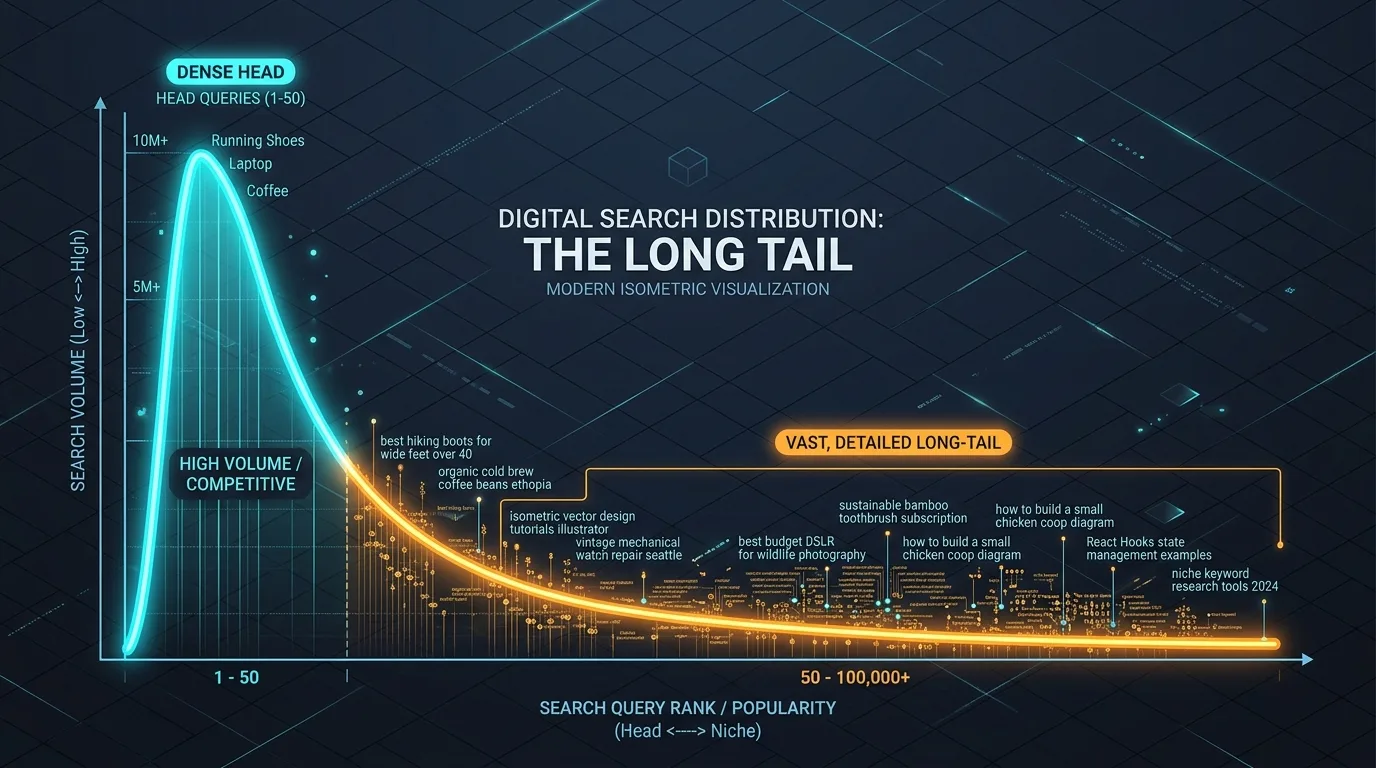
The Power of Specificity: A Guide to Niche Search Success
Learn how focusing on specific, niche search phrases can help your business bypass competition and attract high-quality leads with better intent.
Read article
How to Generate SEO Reports: KPIs & Frameworks
Data without a narrative serves no purpose. When you export raw numbers from Google Analytics or Search Console, you only provide a…
Read article
Advanced SEO Techniques to Try Now: The Ultimate Generative Engine Optimization Framework
The landscape of search engine optimization is undergoing its most radical transformation since the introduction of RankBrain. Traditional search engines no longer…
Read article