Unless you read minds, the only reliable way to understand what your customers, users, or audience truly think is to ask them directly. But here’s the catch—the way you phrase a question shapes the answer you receive. Get it wrong, and you end up with misleading data. Get it right, and you unlock insights that can transform your business.
Understanding the difference between open-ended vs. close-ended questions helps you design better surveys, conduct more effective user research, and collect actionable feedback. This guide breaks down everything you need to know: clear definitions, real-world examples, when to use each type, and proven best practices.
Want to design surveys that actually generate actionable insights? Let VastCope’s experts help you craft the perfect research strategy →
What Are Open-Ended Questions? Definition and Purpose
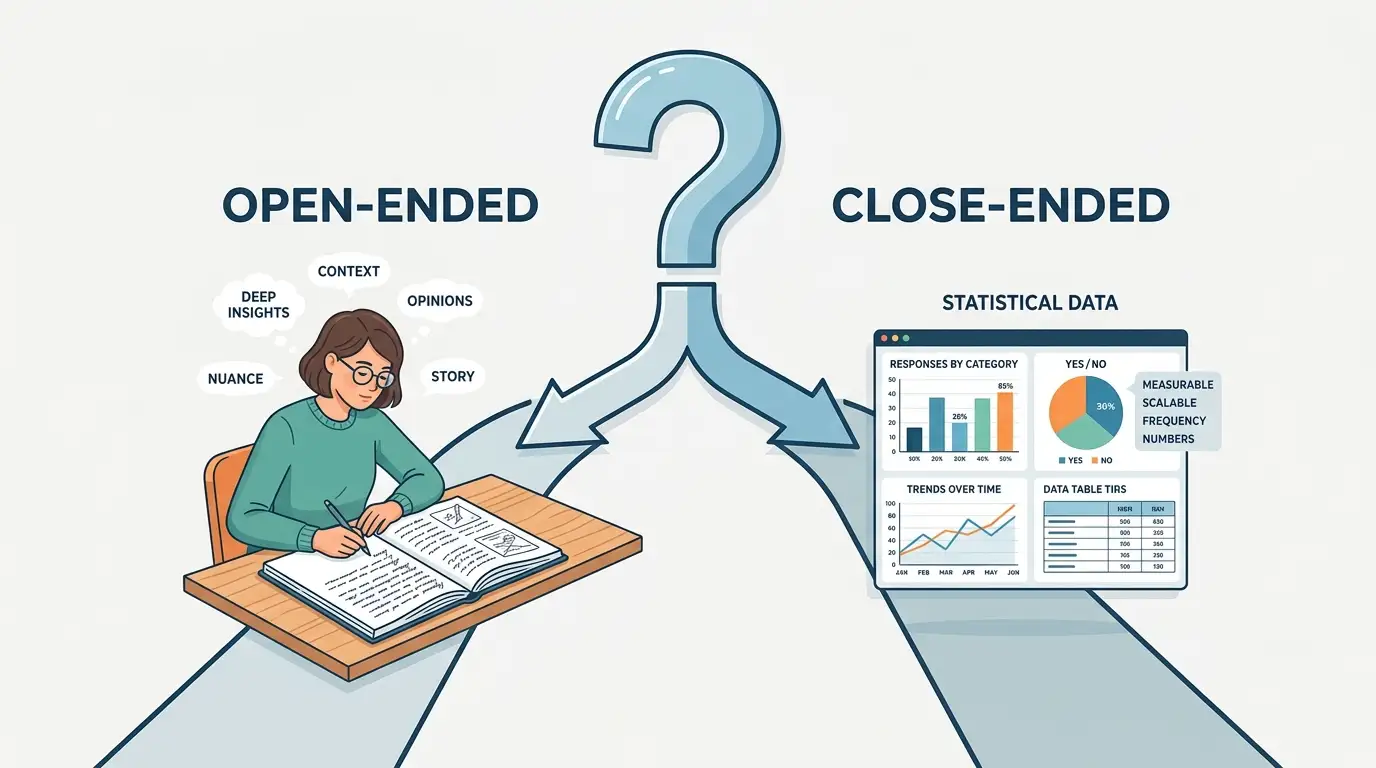
Open-ended questions invite respondents to answer in their own words, using complete sentences and free-form text. Unlike closed-ended questions, open-ended questions cannot be answered with a simple “yes,” “no,” or a single word from a predefined list. Instead, they require the respondent to elaborate, explain, or describe their thoughts, feelings, and experiences.
Key Characteristics of Open-Ended Questions
-
No preset answer options—respondents write or speak freely
-
Collect qualitative data rich in detail and nuance
-
Uncover unexpected insights you never anticipated
-
Reveal the “why” behind customer behaviors and attitudes
-
Require more effort from respondents (which can lower response rates)
-
Take more time and resources to analyze
Open-ended questions help you see things from a customer’s perspective because you receive feedback in their authentic voice instead of stock answers from a dropdown menu. They dig deep into the friction points that prevent a smooth experience with your cart, website, or customer service.
For example, instead of asking “Are you satisfied with our product?” (closed-ended), ask “What has your experience been like using our product?” The first gives you a simple data point; the second reveals why someone feels satisfied—or why they don’t.
What Are Close-Ended Questions? Definition and Purpose
Close-ended questions limit respondents to a predetermined set of answer options. These include multiple-choice questions, dichotomous (yes/no) questions, Likert scales, rating scales, and ranking questions. Close-ended questions are the workhorses of quantitative research, providing clean, comparable, and easily analyzable data.
Key Characteristics of Close-Ended Questions
-
Respondents choose from fixed response options
-
Collect quantitative data perfect for statistical analysis
-
Generate consistent, comparable results across large samples
-
Deliver higher response rates because they require minimal effort
-
Limit insight to what you anticipated asking about
-
May miss unexpected findings or nuanced perspectives
Close-ended questions measure what is happening and how often, while open-ended questions help explain why. In practice, most strong surveys use both types together.
For instance, the popular Net Promoter Score® (NPS®) survey asks “How likely are you to recommend this product on a scale of 0 to 10?” That’s a classic close-ended question that generates numerical data for easy trend tracking.
External Resource: SurveyMonkey’s guide to question types provides additional examples and best practices for designing close-ended questions.
Open-Ended vs. Close-Ended Questions: The Side-by-Side Comparison
Here’s how the two question types stack up across key dimensions:
| Feature | Open-Ended Questions | Close-Ended Questions |
|---|---|---|
| Answer format | Free text, sentences, paragraphs | Multiple choice, yes/no, scales |
| Data type | Qualitative (rich, descriptive) | Quantitative (numerical, categorical) |
| Analysis | Manual coding, thematic analysis | Automated, statistical |
| Response rate | Lower (requires effort) | Higher (quick and easy) |
| Depth of insight | Deep, nuanced, unexpected | Surface-level, expected |
| Time to analyze | Hours to days | Minutes to hours |
| Sample size | Best with smaller samples | Scales to thousands easily |
| Discoverability | Reveals unknown unknowns | Measures known variables |
Quick Definitions to Remember
-
Open-ended questions = free-form responses in the respondent’s own words
-
Close-ended questions = responses limited to pre-selected options
Real-World Examples: Open-Ended vs. Close-Ended Questions in Action
Seeing the difference side by side makes it click. Below are examples across common business scenarios.
Customer Satisfaction Survey
| Close-Ended (Limited Insight) | Open-Ended (Deep Insight) |
|---|---|
| “How satisfied are you with our support? (Very / Somewhat / Not)” | “What could our support team do to serve you better?” |
| “Would you buy from us again? (Yes / No / Maybe)” | “What would make you choose us again over a competitor?” |
| “Rate your checkout experience 1–5.” | “Walk us through your checkout experience. What went well? What didn’t?” |
Product Feedback
| Close-Ended | Open-Ended |
|---|---|
| “Do you use Feature X? (Yes / No)” | “Which features do you find most valuable, and why?” |
| “How would you rate product quality? (Poor / Average / Excellent)” | “What is the biggest problem our product solves for you?” |
| “Would you recommend us? (Yes / No)” | “How would you describe our product to a friend?” |
Website Usability Research
| Close-Ended | Open-Ended |
|---|---|
| “Did you find what you were looking for? (Yes / No)” | “What were you trying to accomplish on our site today?” |
| “Was the navigation clear? (Yes / No / Somewhat)” | “What stopped you from completing your purchase?” |
| “Rate page load speed 1–5.” | “What frustrated you most during your visit?” |
Market Research
| Close-Ended | Open-Ended |
|---|---|
| “Which age group do you belong to? (18–24 / 25–34 / etc.)” | “Tell us about your experience with similar products in the past.” |
| “Do you own a smartphone? (Yes / No)” | “How has your purchasing behavior changed in the last year?” |
| “How often do you shop online? (Daily / Weekly / Monthly)” | “What influences your purchase or ordering decision the most?” |
Employee Engagement Survey
| Close-Ended | Open-Ended |
|---|---|
| “Do you feel valued at work? (Yes / No / Sometimes)” | “What would make you feel more valued in your role?” |
| “Rate your work-life balance 1–5.” | “What is one change that would improve your daily work experience?” |
| “Would you recommend this workplace? (Yes / No)” | “What do you enjoy most about working here?” |
When to Use Open-Ended Questions
Open-ended questions shine in specific situations. Use them when:
-
You need to explore unknown territory. If you don’t know what you don’t know, open-ended questions help you discover unexpected themes, pain points, or opportunities. For example, asking “What’s on your mind about our service?” can surface issues your team never considered.
-
You want the “why” behind the numbers. A close-ended question tells you that 40% of users abandoned checkout. An open-ended follow-up asks “What stopped you from completing your purchase?” and reveals the actual reasons—unexpected shipping costs, confusing forms, or trust concerns.
-
You’re conducting exploratory or discovery research. When launching a new product or entering a new market, open-ended questions help you understand customer language, priorities, and unmet needs before you build structured surveys.
-
You need authentic, verbatim customer voices for case studies or testimonials. A customer describing their experience in their own words is far more powerful than a star rating.
Best Practices for Writing Open-Ended Questions
-
Keep questions clear and specific. Vague questions like “What do you think?” produce vague answers. Instead, ask “What suggestions do you have for improving our checkout process?”
-
Ask about one thing at a time. Avoid double-barreled questions like “How would you rate our product quality and customer service?” Respondents can’t answer both accurately.
-
Avoid leading or biased language. Don’t ask “How excellent was our amazing support team?” Ask “How would you describe your experience with our support team?”
-
Use open-ended questions sparingly. Most experts recommend limiting open-ended questions to 1–3 per survey. Too many cause respondent fatigue and drop-offs.
-
Place them strategically. Put easy, short questions at the beginning and longer open-ended ones toward the end to boost completion rates.
Need high-quality visuals to present your survey findings? Let Clipping Expert Asia handle professional photo retouching for your reports →
When to Use Close-Ended Questions
Close-ended questions are your default choice for most survey questions. Use them when:
-
You need quantifiable, comparable data. Close-ended questions generate data you can chart, graph, and analyze statistically. Track changes over time, compare segments, and calculate percentages with confidence.
-
You have a large sample size. Analyzing thousands of open-ended responses manually isn’t practical. Close-ended questions scale effortlessly to tens of thousands of respondents.
-
You already understand the possible answers. When you’ve done exploratory research and know the range of likely responses, you can design efficient close-ended questions.
-
You need higher response rates. Close-ended questions take seconds to answer. Surveys that rely heavily on them typically achieve higher completion rates.
-
You’re conducting standardized tracking studies. For ongoing metrics like NPS, CSAT, or CES, consistency matters. Close-ended questions ensure you measure the same thing the same way every time.
Best Practices for Writing Close-Ended Questions
-
Be clear and specific. Ensure your question focuses on a single concept. Compare “Do you own a car?” (good) with “Do you own a car or a bike?” (poor).
-
Provide balanced and exhaustive options. Include all reasonable answers. When in doubt, add an “Other (please specify)” option to catch outliers.
-
Avoid leading language. Don’t push respondents toward a particular answer. Neutral phrasing yields accurate data.
-
Use appropriate scales. Likert scales (Strongly Agree to Strongly Disagree) work well for attitudes. Numerical scales (1–5 or 1–10) work for ratings.
-
Keep questions short. One sentence, concise wording, and no unnecessary complexity.
Types of Close-Ended Questions
Not all close-ended questions are the same. Here are the main subtypes:
1. Dichotomous Questions
Two options only: Yes/No, True/False, Agree/Disagree. These are the simplest and fastest to answer.
-
Example: “Have you used our mobile app in the past 30 days? (Yes / No)”
2. Multiple-Choice Questions
Respondents select one or more answers from a list of options.
-
Example: “How did you hear about us? (Social media / Search engine / Friend referral / Advertisement / Other)”
3. Likert Scale Questions
Measure attitudes or opinions on a symmetric scale, usually 5 or 7 points from “Strongly Disagree” to “Strongly Agree.”
-
Example: “Our customer service resolved my issue quickly. (Strongly Disagree / Disagree / Neutral / Agree / Strongly Agree)”
4. Rating Scale Questions
Respondents rate something on a numerical scale (1–5, 1–10) or using stars.
-
Example: “How likely are you to recommend us to a friend? (0 = Not likely at all → 10 = Extremely likely)”
5. Rank-Order Questions
Respondents arrange options in order of preference or importance.
-
Example: “Rank the following features from most to least important to you.”
Turn your customer feedback into a lead generation machine. Discover VastCope’s lead generation services to convert insights into sales →
How to Combine Both Question Types for Maximum Insight
The best surveys use a hybrid approach—starting with close-ended questions for broad measurement and following up with open-ended questions for depth.
The Two-Question Sequence
Close-ended (quantitative): “How satisfied are you with our product? (Very / Somewhat / Not)”
Open-ended (qualitative): “What’s the main reason for your rating?”
This simple combination gives you both the what (satisfaction level) and the why (the reason behind it). A research study on political trust found significant discrepancies between trust levels indicated in close-ended questions and the trust described in open-ended responses, highlighting the unique value of open-ended questions in capturing nuanced perspectives.
Funnel Approach
Start with broad open-ended questions to explore the landscape, then narrow down with close-ended questions to measure specific dimensions you’ve discovered.
Follow-Up Logic
Use conditional logic: if someone selects “Dissatisfied” on a close-ended question, trigger an open-ended follow-up asking why. This keeps surveys efficient while capturing critical context.
The 80/20 Rule
For most business surveys, aim for about 80% close-ended questions and 20% open-ended questions. This balances analytical efficiency with depth of insight. Open-ended questions demand people speak up and express their thoughts—don’t overcomplicate it or overwhelm respondents.
How to Analyze Open-Ended Responses
Analyzing open-ended responses takes more work, but modern tools make it easier than ever.
Manual Coding
Read through responses and tag them with thematic codes. Group similar responses into categories. Calculate frequency of themes. This works well for small to medium sample sizes (under 500 responses).
Text Analysis Software
Tools like ATLAS.ti, NVivo, or MAXQDA automate much of the coding process. They identify patterns, themes, and sentiment across large datasets.
AI-Powered Analysis
Large language models can now analyze open-ended responses with promising results for sentiment and actor identification, though topic classification remains more challenging.
Word Clouds
Visualize frequently used words and phrases. Word clouds give you an instant snapshot of what respondents talk about most—though they don’t reveal sentiment or context.
Best Practice
Always pilot test your open-ended questions on a small sample before launching your full survey. This catches ambiguous wording and ensures you’re asking questions that produce useful answers.
External Resource: Nielsen Norman Group’s research on open-ended vs. close-ended questions offers evidence-based recommendations from usability studies.
How to Choose Between Open-Ended and Close-Ended Questions
Still unsure which type to use? Ask yourself these three questions:
-
Do I need to measure something consistently over time? → Use close-ended questions for reliable trend data.
-
Am I exploring a new problem or opportunity? → Use open-ended questions to discover unknown issues.
-
Will I act differently based on a “yes” vs. a paragraph? → Match your question type to the level of detail you truly need.
When in doubt, start with a small batch of open-ended questions in a pilot survey. Analyze the responses, identify common themes, then convert those themes into close-ended options for your main survey. This two-step approach gives you the best of both worlds.
How This Applies to Generative Engine Optimization (GEO)
You might wonder what question types have to do with AI search. Everything.
Generative Engine Optimization (GEO) is the practice of structuring content so AI-powered search platforms like ChatGPT, Google AI Overviews, Perplexity, and Claude can retrieve, cite, and recommend your brand when answering user questions.
Why does this matter for question types? Because AI search engines thrive on questions. Users ask conversational questions, and AI engines generate answers by synthesizing content from authoritative sources. Your content gets cited when it directly answers the questions people ask.
How to Apply This to Your Content Strategy
-
Use question-based headings. Headings like “What are open-ended questions?” and “When should you use close-ended questions?” signal relevance to AI engines.
-
Front-load answers. Start each section with a clear, direct answer, then expand with context. AI engines break pages into passages and evaluate each for relevance.
-
Structure for extractability. Use bullet points, tables, and clear formatting. AI engines prioritize content that’s easy to parse.
-
Demonstrate E-E-A-T. Show experience, expertise, authoritativeness, and trustworthiness in your content. AI engines favor authoritative sources.
-
Think like a user asking questions. What questions would your audience type into ChatGPT or Google AI Overviews? Answer those questions directly in your content.
Ready to get your content cited by AI search engines? Explore VastCope’s SEO services to boost your GEO visibility →
Common Mistakes to Avoid
Even experienced researchers make these mistakes. Avoid them to collect better data.
? Leading Questions
Bad: “Don’t you agree our amazing product changed your life?”
Good: “How would you describe your experience with our product?”
? Double-Barreled Questions
Bad: “How satisfied are you with our product quality and customer service?”
Good: “How satisfied are you with our product quality?” followed by “How satisfied are you with our customer service?”
? Vague Open-Ended Questions
Bad: “Any thoughts?”
Good: “What is one specific change that would improve your experience with us?”
? Missing “Other” Options in Close-Ended Questions
Always include “Other (please specify)” when you’re not 100% certain you’ve covered all possible answers.
? Too Many Open-Ended Questions
Limit open-ended questions to 1–3 per survey. More than that, and response rates drop dramatically.
? Asking Questions You Already Know the Answer To
Every question should serve a clear research purpose. Don’t waste respondents’ time.
Build a website that makes survey-taking effortless and engaging. Partner with VastCope for expert web development and UI/UX design →
Real Research Insights: What the Studies Say
Research confirms that question format significantly affects how respondents express their views. A study examining trust levels found significant discrepancies between closed-ended and open-ended responses, with open-ended responses revealing richer, more nuanced perspectives often missed by closed-ended formats.
Key takeaway: Don’t rely on either type alone. The complete picture requires both quantitative measurement (close-ended) and qualitative depth (open-ended).
Frequently Asked Questions (FAQ)
Q1: What is the main difference between open-ended and close-ended questions?
Open-ended questions allow free-form responses in the respondent’s own words. Close-ended questions limit respondents to selecting from a predefined set of answer options like multiple choice, yes/no, or rating scales.
Q2: Which type of question gives better data?
Neither is universally “better.” They serve different purposes. Close-ended questions give you clean, comparable quantitative data. Open-ended questions give you rich, nuanced qualitative insights. The best research uses both.
Q3: When should I use open-ended questions in a survey?
Use open-ended questions when you need to explore unknown issues, understand the “why” behind behaviors, collect verbatim customer quotes, or discover unexpected insights. Limit them to 1–3 per survey to avoid respondent fatigue.
Q4: When should I use close-ended questions?
Use close-ended questions as your default for most survey questions. They work best for large sample sizes, standardized tracking studies, quantitative analysis, and when you already understand the range of possible answers.
Q5: How do I convert a close-ended question into an open-ended question?
Remove the preset answer options and ask for elaboration. For example, change “How satisfied are you? (Very / Somewhat / Not)” to “Describe your level of satisfaction with our service. What worked well? What didn’t?”
Q6: Can I use both question types in the same survey?
Absolutely. Most effective surveys use a hybrid approach. Start with close-ended questions for broad measurement, then use open-ended follow-ups to capture the “why” behind key responses.
Q7: How do I analyze open-ended responses?
You can use manual coding (reading and tagging themes), text analysis software, AI-powered sentiment analysis, or word clouds. For small samples (under 500), manual coding works well. For larger samples, use automated tools.
Q8: Do open-ended questions lower response rates?
Yes, they can. Open-ended questions require more effort, so respondents may skip them or abandon the survey. Limit open-ended questions to 1–3 per survey and place them toward the end to minimize drop-offs.
Q9: What’s a Likert scale, and is it open or close-ended?
A Likert scale is a close-ended question type that asks respondents to indicate their level of agreement with a statement (e.g., Strongly Disagree to Strongly Agree). It produces quantitative data suitable for statistical analysis.
Q10: How does question type affect AI search optimization?
AI search engines prioritize content that directly answers user questions. Using clear, question-based headings and providing direct, well-structured answers helps AI engines retrieve and cite your content. This is the essence of Generative Engine Optimization (GEO).
Conclusion
Choosing between open-ended and close-ended questions isn’t about finding a single “right” answer. It’s about understanding your research goals and selecting the right tool for the job.
-
Use close-ended questions when you need clean, quantifiable data that scales easily and delivers consistent, comparable results.
-
Use open-ended questions when you need depth, nuance, and the authentic voice of your customers—especially to understand the “why” behind the numbers.
-
Use both in a hybrid approach to get the complete picture: measure what’s happening with close-ended questions, then explore why with open-ended follow-ups.
Remember the golden rule: Match your question type to your research objective. Don’t ask open-ended questions when a simple yes/no will do. But don’t rely solely on close-ended questions when you need to discover unknown unknowns.
Apply the best practices outlined here, avoid common mistakes, and your surveys will deliver the actionable insights you need to make better business decisions. And with GEO principles guiding your content structure, those insights will also help your brand get discovered and cited by the AI search engines your customers use every day.
Ready to turn customer feedback into a high-performing digital experience? Let VastCope’s CMS development and web experts bring your vision to life →