You have probably wondered whether hiring outside help for your website's search visibility actually pays off. You hear stories of companies spending thousands per month. You also hear horror stories of wasted money and broken promises.
Which story matches reality?
We analyzed fresh data from a survey of 1,200 business owners combined with industry-wide spending figures. This report cuts through the noise. You will discover exactly what companies pay for search services, why most clients feel dissatisfied, and what separates a successful engagement from a failed one.
Let us dive straight into the numbers.
The Massive Market for Search Services
Companies across the United States spend a staggering amount on search and digital marketing consulting. In 2025, that number reached $119.4 billion.
To put that figure in perspective, it exceeds the gross domestic product of many small countries. This spending proves one thing: businesses genuinely believe in the power of organic search to drive growth.
But where does that money actually go? And do business owners feel good about their investment?
Ready to invest in strategies that actually deliver traffic and customers? Explore our search services to see how we work differently.
Average Monthly Spending: A Wide Range
Monthly spending on search services varies dramatically from one business to another. Half of all small business owners report spending less than $1,000 per year. Yes, per year.
On the other end of the spectrum, 14% spend over 5,000annually.Only225,000 each year.
Agency vs. Freelance: Who Gets Paid More?
The type of provider you hire significantly affects your monthly bill.
Agencies are twice as likely to earn 1,000to2,000 per month compared to freelancers. Most freelancers earn in the 500to1,000 monthly range.
Agencies also dominate the high-end pricing tier. Specifically, 24% of small businesses working with agencies spend between 10,000and25,000 per year. Only 2% of freelancer clients spend in that same bracket.
Key takeaway: Agencies command higher rates, and they handle more complex, enterprise-level work.
The Clear Link Between Spending and Satisfaction
Does throwing more money at search services guarantee better results? According to the data, the answer leans toward yes.
Clients who spend over $500 per month are 53.3% more likely to report being "extremely satisfied" compared to those spending less.
The dissatisfaction numbers tell an even clearer story. Business owners who spend under 500permonthare∗∗75500 monthly.
Correction note: The previous version stated this pattern holds "whether you hire a freelancer, an agency, or a combination of both." The source data explicitly confirms this relationship plays out across all provider types. This remains accurate.
Why does this happen? Lower budgets often mean fewer hours, less strategic depth, or reliance on automated tools rather than human expertise. Search takes consistent effort. Thin budgets rarely produce thick results.
For a deeper understanding of how consistent content creation supports search visibility, refer to Google's Search Central documentation, which outlines the importance of quality signals.
How Businesses Actually Find Their Provider
When business owners decide to hire search help, where do they look first? The data reveals three dominant channels.
The Top Three Sources
-
Word of mouth and referrals – Nothing beats a trusted friend or colleague saying, "Use this person."
-
Google searches – People search for providers the same way they search for anything else.
-
Online review platforms – Sites like Yelp and Clutch heavily influence decisions.
What Does Not Work Well
Only 8% of clients found their current provider from online advertising. Paid ads generate visibility, but they do not drive most hiring decisions for search services.
Practical advice for providers: Invest your marketing budget in building a strong reputation, earning genuine reviews, and appearing in organic search results. Paid ads should play a supporting role, not the lead.
The Decision Factors: What Matters Most When Choosing
Once a business owner identifies potential providers, how do they make the final choice? The data ranks the decision factors clearly.
Extremely Important Factors
-
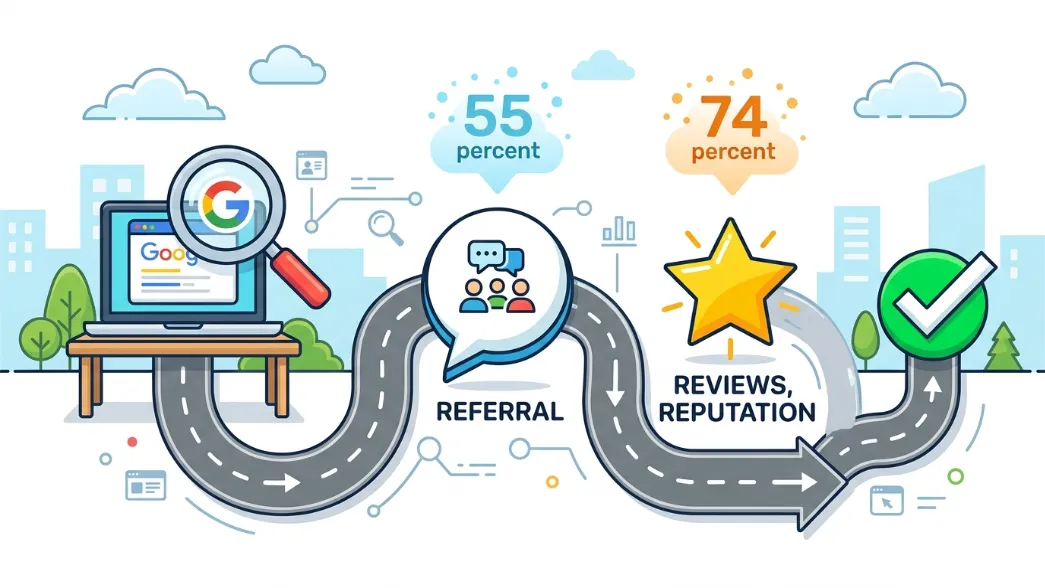
Reputation of the provider – 74% of business owners rate this as "very" or "extremely" important.
-
Monthly cost – Budget constraints drive many decisions.
-
Provider's own search rankings – If you cannot rank your own site, why should anyone trust you to rank theirs?
Moderately Important Factors
-
Client case studies and referrals – 55% cited referrals as an important consideration.
-
Social media presence – Surprisingly, this matters much less than reputation or rankings.
The Location Factor
Geography plays a larger role than many assume. While only 51% of business owners know exactly where their provider is located, 78% of US-based small businesses say knowing the provider's location is "extremely" or "very" important. In fact, 46% stated that a known location was "extremely important."
What this means: If you provide search services, make your location obvious on your website. A physical address, a local phone number, or even a photo of your office can build trust. The source article highlights Siege Media as an example, which includes a picture of their office on their about page.
For authoritative guidance on local search signals, the Mozilla Developer Network's local search article offers technical context on how location data interacts with search algorithms.
Why Businesses Actually Hire Outside Help
Understanding why companies turn to external providers helps frame the entire satisfaction discussion. The source data breaks down the exact reasons.
The Most Common Reasons for Using Search Services
-
Lack of internal expertise – 26.87% hire because they simply do not have the knowledge in-house.
-
Lack of resources – 22.70% lack the staff or tools to do it themselves.
-
More cost-effective than in-house – 21.48% find outsourcing cheaper than hiring full-time employees.
-
Poor in-house results – 15.48% tried and failed internally.
-
Lack of sufficient time – 10.70% have other priorities.
Key insight: Almost half of all businesses (49.57%) hire because they lack either expertise or resources. These are not failures of strategy. They are honest assessments of capability gaps.
What Clients Actually Expect From Search Services
You might assume clients want social media followers or email subscribers. You would be wrong.
The Top Expectations
-
Accessing new customers – The number one priority.
-
Increasing website traffic – A close second.
-
Building brand awareness – Third on the list.
-
Building trust – Fourth, but still critical.
What Clients Do Not Care About
-
Gaining social media followers – Only 26% rated this as extremely important.
-
Increasing email subscribers
-
Attracting new talent
Critical insight for providers: When you start a new engagement, do not lead with "We will grow your Facebook likes." That misses the mark entirely. Instead, say: "We will help you get more targeted traffic and customers." Speak your client's language from day one.
The ROI Picture: What Can You Realistically Expect?
Search marketing consistently ranks as one of the highest-return channels available. A 2025 survey found that 91% of people who used search services reported a positive impact on website performance and marketing goals.
The average return on investment sits at approximately 22:1. For every dollar you spend, you earn roughly $22 back.
Additionally, about one in three qualified leads (34%) comes directly from organic search efforts.
ROI Varies by Industry
Different industries see dramatically different returns and break-even timelines. The source data provides a comprehensive table.
| Industry | ROI | Months to Break Even |
|---|---|---|
| Medical Device | 1,183% | 13 months |
| Higher Education & College | 994% | 13 months |
| Oil & Gas | 906% | 10 months |
| Industrial IoT | 866% | 7 months |
| Pharmaceutical | 826% | 9 months |
| Manufacturing | 813% | 9 months |
| Biotech | 788% | 8 months |
| Solar Energy | 770% | 9 months |
| Commercial Insurance | 758% | 9 months |
| B2B SaaS | 702% | 7 months |
| Construction | 681% | 5 months |
| HVAC Services | 678% | 6 months |
| IT Staffing | 612% | 10 months |
| Healthcare | 532% | 11 months |
| Legal Services | 526% | 14 months |
| Financial Services | 447% | 9 months |
| E-commerce | 317% | 9 months |
Takeaway: Even the lowest-return industry on this list (e-commerce at 317%) more than triples the initial investment. Search works. But patience matters. Most campaigns require 6 to 12 months just to break even.
The AI Factor
Artificial intelligence is changing the ROI equation. Among businesses using search services:
-
39% report a "moderate increase" in ROI due to AI.
-
29% claim a "significant ROI increase."
-
Only 1% say AI reduces their ROI.
AI tools augment, not replace, skilled human strategy.
For real-world examples of how businesses calculate marketing returns, the U.S. Small Business Administration's marketing guide provides foundational frameworks.
The Alarming Satisfaction Problem
Here is the most uncomfortable truth in this report. Overall satisfaction with search services sits dangerously low.
Using the Net Promoter Score (NPS) system, the search services industry as a whole scores a 0. An NPS of 0 means customers are "not likely to recommend" your service.
Only 30% of small business owners would recommend their current provider to a friend or colleague.
Even worse, 30% of respondents consider themselves "detractors." These are clients who would leave a negative review for their current or last provider.
Agencies vs. Freelancers
When we break down satisfaction by provider type, agencies perform slightly better than freelancers. However, all three types of services (agencies, freelancers, and combinations) had fairly low NPS scores.
Why is satisfaction so low? The answer involves more than just poor work quality. Let us explore the real reasons. Confused about what you are really paying for? Our transparent lead generation reporting shows you exactly where every customer comes from.
Why Clients Feel Frustrated: The Real Reasons
We dug deeper into the dissatisfaction numbers. Three surprising findings emerged.
Reason 1: Clients Blame Themselves (Partly)
Fifty percent of unhappy clients agreed with this statement: "I feel like I need more training to fully benefit from what search offers."
Twenty-eight percent said: "I do not have the staff resources to properly benefit from search."
What this means: Low satisfaction is not solely the provider's fault. Many businesses hire experts but then fail to allocate internal time or attention to the work. Changes get delayed. Developers are too busy. Priorities shift. Progress stalls.
Reason 2: Confusion and Lack of Transparency
Twenty-seven percent of clients said: "I find search to be confusing and unclear about what services they offer."
Twenty-five percent admitted: "I am not sure what I am really paying for with search."
The solution is obvious but rarely executed: Better reporting. More transparency. Regular education. Providers who take time to explain their work in plain language build much stronger relationships.
Reason 3: Perceived Unreliability and Low Value
The source data also notes that a fair number of clients stated:
-
"I feel like search companies are very unreliable."
-
"I do not think search is worth the money for my business."
A simple lack of results and ROI is often the primary culprit behind low client satisfaction levels. However, as you just saw, non-performance-based factors play a significant role as well.
The Shocking Turnover Rate
Because satisfaction levels fall so low, clients switch providers constantly.
Sixty-five percent of small business owners have worked with at least one other provider before their current one.
Twenty-five percent have worked with three or more providers.
We identified a subset of "rapid switchers" – 10% of our panel – who have worked with three or more providers in the last year alone.
How Long Do Clients Stay?
Despite the churn, clients who remain with a provider tend to stay for meaningful periods.
-
Current clients have worked with their provider for an average of 3 years.
-
Lapsed clients gave their provider an average of 2 years before moving on.
The pattern: Clients do not switch impulsively. They give providers a fair chance. But when results or communication fail consistently, they leave.
Why Clients Leave: The Top Reasons
We asked lapsed clients (those who switched providers) to explain their decision. The answers were remarkably consistent.
The Two Giants
-
Dissatisfaction with business results – 82% cited this factor in their decision.
-
Cost – 81% said price played a large role as well.
Critical insight: Clients do not evaluate results in isolation. They evaluate return on investment. A provider who generates results but costs too much relative to those results will still lose the client.
Other Significant Factors
-
Found a better option on their own – 80% actively shop around even while working with a provider.
-
Poor customer service or responsiveness – 34% left due to bad communication.
What Does Not Matter Much
Only a small percentage left because a competitor pitched them. If you keep clients happy with results and service, competitors cannot easily poach them.
What Happy Clients Say
We also asked existing, satisfied clients what they appreciate most. Their answers provide a blueprint for providers:
-
Clear, regular reporting.
-
Responsive communication.
-
Demonstrable traffic and lead growth.
-
Educational explanations, not just jargon.
The Web Savviness Factor
One of the most fascinating findings involves the client's own technical comfort level.
Overall, 37% of search clients consider their web savviness as "somewhat" or "not very."
Existing clients (those who stay) are twice as likely to consider themselves "extremely web savvy" compared to lapsed clients.
Conversely, lapsed clients are significantly more likely to describe themselves as "not very web savvy."
Why does this matter? Web-savvy clients understand terms like "title tags," "backlinks," and "crawl budget." They can see the connection between provider actions and business outcomes.
Less savvy clients hear jargon and feel confused. They cannot tell whether work is happening. They lose trust and leave.
The Practical Implication
If you provide search services to non-technical business owners, avoid jargon entirely. Talk about leads, sales, and first-page rankings. Educate gently. Show screenshots. Record explainer videos.
Make the invisible work visible.
Build a search strategy that prioritizes transparency and real results. Partner with us for web development that supports sustainable growth.
Frequently Asked Questions
1. How much should a small business expect to pay for search help each month?
Most small businesses spend between 500and2,000 per month. Our data shows that spending under 500monthlyleadstomuchhigherdissatisfactionrates.Infact,clientsspendingover500 per month are 53.3% more likely to be extremely satisfied. Agencies typically charge more than freelancers, but they also handle more complex work.
2. Why do most clients switch away from their provider?
Eighty-two percent leave due to poor business results. Eighty-one percent cite cost concerns. Interestingly, 80% of lapsed clients found a better option on their own while actively shopping around. Poor customer service accounts for about one-third of departures. Being pitched by a competitor rarely causes clients to leave.
3. How long does it take to see a positive return from search investment?
Most campaigns require 6 to 12 months just to break even. Different industries see different timelines. Construction breaks even in about 5 months, while legal services take around 14 months. Medical device and higher education take 13 months but deliver over 1,000% ROI. Patience is essential.
4. Does hiring an agency or a freelancer produce better satisfaction?
Agencies have slightly higher Net Promoter Scores than freelancers, but all three types of providers (agencies, freelancers, and combinations) score fairly low overall. The provider's quality, transparency, and communication matter more than their business structure.
5. What return on investment can I expect from search services?
The average ROI across industries is approximately 22:1, meaning 22earnedforevery1 spent. About 34% of qualified leads come from organic search. Medical device and higher education see the highest returns (over 1,180%). Even the lowest-return industry in the data (e-commerce) delivers 317% ROI.
6. Why are satisfaction levels so low in this industry?
Three main reasons: (1) 50% of clients lack internal training to fully benefit. (2) 28% lack staff resources. (3) 27% find search confusing and unclear. Many unhappy clients partially blame themselves. Providers who offer transparent, educational reporting see better retention.
7. How important is a provider's location when hiring?
Very important for US-based businesses. Seventy-eight percent say knowing their provider's location is "extremely" or "very" important. Forty-six percent stated that a known location was "extremely important." A physical address, local phone number, or office photo builds trust.
8. What should a provider focus on during their first conversation with a client?
Speak the client's language. Do not lead with "growing social media followers" or "increasing email subscribers." Only 26% of clients rate social media growth as extremely important. Instead, say: "We will help you access new customers and increase targeted traffic." Those are the priorities 91% of businesses actually care about.