

The landscape of search engine optimization is undergoing its most radical transformation since the introduction of RankBrain. Traditional search engines no longer simply index web pages and match keyword strings; they parse concepts, construct knowledge graphs, and deploy artificial intelligence to synthesize direct answers. Modern searchers rely on AI Overviews, SearchGPT, Perplexity, and conversational search engines to extract immediate information.
To maintain market leadership and capture qualified organic traffic, digital marketers must evolve beyond basic keyword research and standard link-building tactics. Success requires adopting Generative Engine Optimization (GEO) a framework designed to make content authoritative, semantically clear, and machine-extractable for both classical crawler algorithms and Large Language Models (LLMs).
This comprehensive guide breaks down the most effective, battle-tested advanced SEO techniques you can deploy right now to dominate organic search, build domain authority, and secure top placement across traditional and AI-driven search interfaces.
Ready to scale your organic search traffic? Explore our full-suite digital marketing and SEO services tailored for high-growth businesses today.
1. Generative Engine Optimization (GEO): Structuring Content for AI Engines

Generative Engine Optimization (GEO) focuses on optimizing digital content for Retrieval-Augmented Generation (RAG) systems and LLM-powered search engines. While standard SEO focuses on securing top positions in organic blue links, GEO ensures that AI engines select, synthesize, and cite your content inside AI-generated response cards.
+-----------------------------------------------------------------------+
|                   Traditional SEO vs. GEO Framework                   |
+------------------------------------+----------------------------------+
| Traditional SEO                    | Generative Engine Optimization   |
+------------------------------------+----------------------------------+
| Target: Crawler Search Algorithms  | Target: LLMs & RAG Pipelines     |
| Goal: Rank in Top 10 Blue Links    | Goal: Cited as Source in AI Cards|
| Focus: Keywords & Backlink Density | Focus: Entity Triples & Density  |
| Structure: Headings & Paragraphs   | Structure: Self-Contained Blocks |
+------------------------------------+----------------------------------+
Understanding the RAG Pipeline in AI Search
To optimize for generative search engines, you must understand how RAG pipelines extract data:
- Retrieval Phase: The search engine converts user queries into vector embeddings and retrieves relevant web documents from its index based on semantic similarity.
- Chunking & Scoring: The system breaks retrieved web pages into smaller text chunks, scoring each chunk for information density, authoritativeness, and clarity.
- Synthesis & Citation: The LLM reads the top-scored chunks, synthesizes a direct response, and embeds inline hyperlinked citations referencing the source documents.
Actionable GEO Optimization Tactics
To maximize your citation rate in generative search engines, execute these specific structural refinements across your key pages:
- Implement Subject-Predicate-Object Triples: Write direct sentences that clearly establish entity relationships. For example: “Interaction to Next Paint (INP) measures web page responsiveness.” This clear structure allows AI algorithms to index semantic facts without ambiguity.
- Increase Information Density: Eliminate conversational filler, redundant introductions, and generic commentary. Modern search platforms prioritize content that delivers unique data points, concrete statistics, and direct definitions.
- Structure Clear Answer Blocks: Position a concise, 40-to-60-word definition directly beneath every main heading. Follow this summary block with detailed lists, data tables, or procedural steps.
- Incorporate Authoritative Citations: Quote peer-reviewed studies, official documentation, industry benchmarks, and recognized subject matter experts. AI models rely on established domain sources to evaluate factual accuracy.
2. Advanced Technical SEO: Interaction to Next Paint (INP) & Core Web Vitals

Technical performance directly impacts search engine crawling efficiency and conversion rates. In March 2024, Google officially replaced First Input Delay (FID) with Interaction to Next Paint (INP) as a Core Web Vitals metric. INP measures user interface responsiveness by tracking the latency of every user interaction such as clicks, taps, and keypresses throughout the entire lifespan of a page visit.
+-----------------------------------------------------------------------+
|                       INP Performance Thresholds                      |
+------------------------+-----------------------+----------------------+
| Good                   | Needs Improvement     | Poor                 |
| <= 200 Milliseconds    | 201 - 500 Milliseconds| > 500 Milliseconds   |
+------------------------+-----------------------+----------------------+
Diagnosing and Resolving High INP Latency
A poor INP score usually stems from heavy JavaScript execution that blocks the browser’s main thread, delaying visual feedback to the user.
+-----------------------------------------------------------------------+
|                    Execution Phase Breakdown for INP                  |
+-----------------------------------------------------------------------+
| [ Input Delay ] ----> [ Processing Time ] ----> [ Presentation Delay ]|
|  (Event Queue)         (JS Event Handlers)     (Rendering/Compositing)|
+-----------------------------------------------------------------------+
Step 1: Identify Long Tasks
Use Chrome DevTools Performance Panel to record user interactions. Look for tasks marked with red flags exceeding 50 milliseconds on the main thread.
Step 2: Break Up Long Execution Tasks
Refactor monolithic JavaScript functions into smaller asynchronous tasks using requestIdleCallback() or setTimeout(). This releases the main thread, allowing the browser to render visual updates faster.
JavaScript
// Example: Yielding to the main thread during heavy processing
function processLargeDataset(items) {
  let index = 0;

  function yieldAndProcess() {
    while (index < items.length) {
      // Process individual data batch
      processItem(items[index]);
      index++;

      // Yield control after every 50ms of execution
      if (performance.now() - executionStart > 50) {
        setTimeout(yieldAndProcess, 0);
        return;
      }
    }
  }

  const executionStart = performance.now();
  yieldAndProcess();
}
Step 3: Optimize Event Listeners
Avoid firing expensive style calculations or DOM updates inside high-frequency event listeners like scroll or input handlers. Implement debouncing or throttling techniques to minimize layout thrashing.
3. Entity-Based SEO & Knowledge Graph Integration
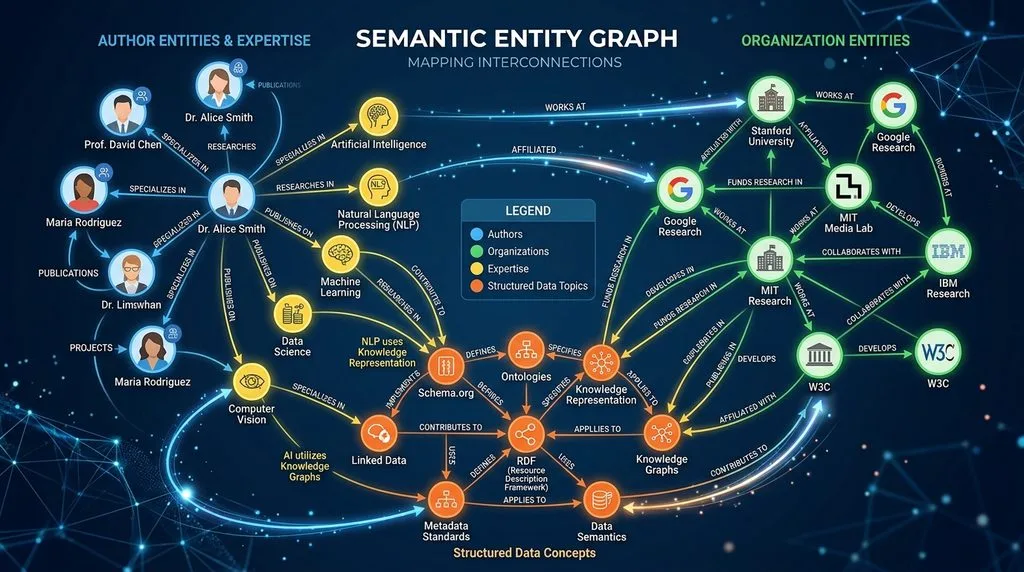
Modern search engines evaluate content using an entity-first paradigm rather than simple string matching. An entity is a uniquely identifiable concept, person, place, organization, or object defined within a Knowledge Graph.
                       +-------------------+
                       |    Organization   |
                       |    (Your Brand)   |
                       +---------+---------+
                                 |
           +---------------------+---------------------+
           |                                           |
           v                                           v
+--------------------+                       +--------------------+
|   Author / Expert  |                       |    Product / SEO   |
|  (SameAs Profiles) |                       |     Services       |
+----------+---------+                       +---------+----------+
           |                                           |
           +---------------------+---------------------+
                                 |
                                 v
                       +-------------------+
                       |  Target Keyword   |
                       |  Topic / Industry |
                       +-------------------+
Building Semantic Entity Depth
To establish entity authority, you must connect your website assets to broader industry knowledge graphs using standardized schema markup formats.
- Leverage Structured Schema Markup: Deploy advanced JSON-LD scripts that explicitly link your content entities to authoritative repositories like Wikidata, Wikipedia, and DBpedia.
- Maintain Brand Entity Consistency: Align your business name, address, phone number (NAP), executive profiles, and service offerings across every external directory and digital press release.
- Establish Strong Author Entities: Attribute articles to real industry experts. Build dedicated author biography pages complete with links to published papers, social profiles, and speaking engagements.
Implementing Nested JSON-LD Schema
Deploy comprehensive schema markup that defines your organization, the article content, and the verified author entity simultaneously:
JSON
{
  "@context": "https://schema.org",
  "@graph": [
    {
      "@type": "Organization",
      "@id": "https://example.com/#organization",
      "name": "Advanced SEO Enterprise",
      "url": "https://example.com",
      "logo": "https://example.com/assets/logo.png",
      "sameAs": [
        "https://www.wikidata.org/wiki/Q00000000",
        "https://twitter.com/example"
      ]
    },
    {
      "@type": "TechArticle",
      "@id": "https://example.com/advanced-seo/#article",
      "isPartOf": {
        "@type": "WebPage",
        "@id": "https://example.com/advanced-seo/"
      },
      "headline": "Advanced SEO Techniques to Try Now",
      "description": "A deep-dive guide covering Generative Engine Optimization, entity SEO, and Core Web Vitals.",
      "inLanguage": "en-US",
      "mainEntityOfPage": "https://example.com/advanced-seo/",
      "author": {
        "@type": "Person",
        "name": "Dr. Sarah Jenkins",
        "jobTitle": "Chief Search Strategist",
        "sameAs": [
          "https://www.linkedin.com/in/drsarahjenkins",
          "https://scholar.google.com/citations?user=example"
        ]
      },
      "publisher": {
        "@id": "https://example.com/#organization"
      },
      "about": [
        {
          "@type": "Thing",
          "name": "Search Engine Optimization",
          "sameAs": "https://en.wikipedia.org/wiki/Search_engine_optimization"
        },
        {
          "@type": "Thing",
          "name": "Artificial Intelligence",
          "sameAs": "https://en.wikipedia.org/wiki/Artificial_intelligence"
        }
      ]
    }
  ]
}
Refer to the official Schema.org documentation to select appropriate types and properties for your specific industry vertical.
4. Programmatic SEO Architecture Without Thin Content Penalties
Programmatic SEO involves automatically generating hundreds or thousands of landing pages designed to capture long-tail, high-intent transactional search queries. However, creating programmatic pages without strict quality controls can lead to search engine penalties for thin or duplicate content.
                      +----------------------+
                      |  Database / Dataset  |
                      +----------+-----------+
                                 |
                                 v
                      +----------------------+
                      | Programmatic Engine  |
                      | (Inject Unique Data) |
                      +----------+-----------+
                                 |
      +--------------------------+--------------------------+
      |                          |                          |
      v                          v                          v
+-----------+              +-----------+              +-----------+
| Page 1    |              | Page 2    |              | Page 3    |
| (Unique   |              | (Unique   |              | (Unique   |
| Metrics)  |              | Metrics)  |              | Metrics)  |
+-----------+              +-----------+              +-----------+
High-Impact Safeguards for Programmatic Scaling
To successfully scale programmatic landing pages while preserving high search quality standards, follow these implementation rules:
- Inject Unique Proprietary Datasets: Ensure every dynamically generated page features proprietary data points, user metrics, real-time pricing, or custom calculations that exist nowhere else on the web.
- Enforce Dynamic Template Variations: Vary page layouts, heading structures, visual modular components, and internal linking structures across dynamic categories to prevent structural footprint duplication.
- Implement Aggressive Indexation Rules: Use canonical tags to consolidate parameter variants. Keep low-value programmatic iterations out of Google’s index by applying
noindex, followdirectives until they meet established traffic and quality benchmarks.
Review Google’s official stance on programmatic scaling in the Google Search Central documentation to ensure full compliance with algorithmic search quality guidelines.
5. Information Architecture & Semantic PageRank Sculpting

Internal linking remains one of the most effective levers for distributing link equity (PageRank) and signaling topical context to search engines. Rather than linking arbitrarily across pages, enterprise sites use a structured Hub-and-Spoke (Topical Cluster) topology.
                        +--------------------+
                        |    Pillar Page     |
                        |   (Central Hub)    |
                        +---------+----------+
                                  |
           +----------------------+----------------------+
           |                      |                      |
           v                      v                      v
  +------------------+   +------------------+   +------------------+
  | Cluster Page A   |<->| Cluster Page B   |<->| Cluster Page C   |
  | (Subtopic Depth) |   | (Subtopic Depth) |   | (Subtopic Depth) |
  +------------------+   +------------------+   +------------------+
Strategic PageRank Allocation Rules
- Pillar Pages (Hubs): Broad, comprehensive resources covering core industry topics. These pages target high-volume, highly competitive search keywords.
- Cluster Pages (Spokes): Detailed articles addressing specific long-tail subtopics. These pages link directly back to the main Pillar page using optimized descriptive anchor text.
- Cross-Cluster Interlinking: Link cluster pages horizontally only when they share direct semantic relevance. This keeps topical context clear and prevents link equity from dissipating into unrelated categories.
+-----------------------------------------------------------------------+
|                    Internal Anchor Text Best Practices                 |
+-----------------------------------+-----------------------------------+
| Anti-Pattern (Avoid)              | Recommended Pattern               |
+-----------------------------------+-----------------------------------+
| "Click here to read more."        | "Review our advanced SEO strategies|
| "Check out our blog post."        |  to fix technical crawl errors."  |
| "Learn more."                     | "Explore entity schema techniques."|
+-----------------------------------+-----------------------------------+
By systematically directing internal links toward high-priority conversion targets, you reinforce topical authority across your entire domain.
Elevate your search engine presence and drive sustained growth by implementing our custom SEO strategy framework today.
6. Content Decay Audit & Algorithmic Refresh Strategy
Published content naturally loses search visibility over time as competitor pages update, user search intent evolves, and search engine algorithms recalibrate ranking criteria. Executing systematic content decay audits prevents organic traffic loss across legacy assets.
+-----------------------------------------------------------------------+
|                       Content Audit Decision Tree                     |
+-----------------------------------------------------------------------+
| Traffic Loss Status -> Is Page Relevant & High Potential?             |
|  |-- YES -> Update Statistics, Expand Sections, Fix Schema (Refresh)  |
|  |-- NO  -> Does Page Have Valued External Backlinks?                 |
|       |-- YES -> Redirect 301 to Relevant Category Page (Consolidate) |
|       |-- NO  -> Apply 410 Gone / Remove Page (Prune)                 |
+-----------------------------------------------------------------------+
The Content Refresh Workflow
Follow this step-by-step remediation framework to identify decaying pages and restore lost organic traffic:
Step 1: Isolate Decaying Pages
Export 12 months of Search Console performance data. Compare the last 90 days against the previous period to flag pages suffering a continuous drop in clicks or impressions exceeding 15%.
Step 2: Analyze Search Intent Changes
Perform live search queries for target keywords. Evaluate whether search engines now prefer different content formats such as interactive calculators, short video clips, or direct comparison tables over traditional long-form text.
Step 3: Upgrade Content Real Estate
Update out-of-date statistics, replace dead links, add new expert commentary, and insert missing subtopics flagged during competitive content gap analysis.
Step 4: Re-Optimize Heading Structures
Ensure headings answer common “People Also Ask” questions cleanly and concisely to reclaim lost SERP feature placements.
Discover deeper insights on algorithmic shifts and search ranking frameworks in our comprehensive guide on advanced SEO tactics now.
7. SERP Feature Hijacking & Target Answer Block Optimization
Winning traditional position #1 organic rankings is no longer enough to maximize search traffic. Search engines regularly place Featured Snippets, People Also Ask (PAA) expandable boxes, and AI Overviews above standard search results. Capturing these prominent visual features allows you to dominate valuable screen space on mobile and desktop devices.
+-----------------------------------------------------------------------+
|               SERP Answer Block Extraction Patterns                   |
+----------------------+------------------------------------------------+
| Snippet Type         | Formatting Requirements                        |
+----------------------+------------------------------------------------+
| Paragraph Snippet    | 40-60 word definitive text directly under H2/H3|
| List Snippet         | Ordered <ol> or unordered <ul> html tags       |
| Table Snippet        | Structured HTML <table> tag with header rows   |
+----------------------+------------------------------------------------+
Exact-Match Target Answer Formatting
To capture Featured Snippets and PAA cards consistently, structure your HTML code to match the exact patterns target search algorithms look for:
HTML
<!-- Example of a Snippet-Optimized HTML Structure -->
<h2>What is Interaction to Next Paint (INP)?</h2>

<p><strong>Interaction to Next Paint (INP)</strong> is a Core Web Vitals metric that assesses a web page's overall responsiveness to user interactions. INP measures the time it takes from when a user interacts with a page—such as clicking a button—until the browser visually updates the screen pixels.</p>

<ul>
  <li><strong>Good INP:</strong> Under 200 milliseconds</li>
  <li><strong>Needs Improvement:</strong> Between 200 and 500 milliseconds</li>
  <li><strong>Poor INP:</strong> Over 500 milliseconds</li>
</ul>
Placing crisp, well-formatted definitions immediately beneath target heading elements dramatically improves your odds of securing top SERP features.
8. Authority Building 2.0: Digital PR & Entity Link Acquisition
Traditional guest posting and low-tier directory link building no longer yield strong search authority gains. Search algorithms evaluate backlinks through the lens of entity relevance, domain authority, traffic metrics, and editorial context.
                               +---------------------+
                               |  Original Research  |
                               |  or Proprietary Data|
                               +----------+----------+
                                          |
                                          v
                               +---------------------+
                               | Digital PR Campaign |
                               |  & Publisher Outreach|
                               +----------+----------+
                                          |
         +--------------------------------+--------------------------------+
         |                                |                                |
         v                                v                                v
+------------------+             +------------------+             +------------------+
| Top Tier Media   |             | Industry Trade   |             | Brand Mentions   |
| Backlink & Quote |             | Publication Link |             | & Entity Signals |
+------------------+             +------------------+             +------------------+
Tactical Methods for Acquiring High-Tier Backlinks
- Publish Primary Industry Research: Conduct original surveys, analyze proprietary product data, or release industry statistical reports. Media outlets and journalists regularly link back to original data sources when covering stories.
- Execute Unlinked Brand Mention Reclamation: Use brand monitoring tools to identify online articles that mention your brand, products, or key executives without including an active hyperlink. Reach out to editors with a helpful request to convert the plain-text reference into a live link.
- Leverage Expert Source Platforms: Respond to daily journalist requests on platforms like Connectively (formerly HARO), Qwoted, and Featured. Provide concise, expert commentary to secure high-authority backlinks from major news publications.
+-----------------------------------------------------------------------+
|                    Evaluating Backlink Quality Metrics                |
+--------------------------+--------------------------------------------+
| High-Value Link Signal   | Low-Value / Risky Signal                  |
+--------------------------+--------------------------------------------+
| Editorial context        | Paid / Sponsored without rel="sponsored"  |
| Real organic traffic     | Zero organic traffic / PBN network sites   |
| Topically aligned domain | Irrelevant geographic or niche origin      |
+--------------------------+--------------------------------------------+
Strengthen your domain authority and command higher search rankings with our high-impact, manual link building services designed for growth.
9. Server Log File Analysis for Enterprise Crawl Budget Management
Search engines assign every domain a specific crawl budget the total number of pages search bots will crawl within a given timeframe. On large-scale websites, inefficient crawl budget allocation can prevent newly published or updated content from getting indexed quickly.
                      +----------------------+
                      | Raw Server Log Files |
                      +----------+-----------+
                                 |
                                 v
                      +----------------------+
                      | Log File Parser / AI |
                      +----------+-----------+
                                 |
      +--------------------------+--------------------------+
      |                          |                          |
      v                          v                          v
+-----------+              +-----------+              +-----------+
| Crawl     |              | Wasted    |              | 400 / 500 |
| Frequency |              | Budget    |              | Response  |
| Analysis  |              | Parameters|              | Errors    |
+-----------+              +-----------+              +-----------+
Uncovering Hidden Technical Issues with Log Audits
Analyzing raw web server logs (Nginx, Apache, IIS) lets you view search engine spider activity directly, bypassing reliance on estimated crawling metrics.
- Eliminate Crawl Traps: Identify faceted navigation URLs, tracking parameters, and infinite pagination loops that consume valuable spider resources.
- Fix Broken Redirection Chains: Find redirect chains (Page A -> Page B -> Page C) and update them to point directly to the final target URL.
- Locate Neglected Content Assets: Spot high-priority pages that search engine bots rarely visit. Improve their visibility by boosting their internal link count across popular pages.
Bash
# Example shell script command to extract Googlebot entries from Nginx logs
grep "Googlebot" /var/log/nginx/access.log | awk '{print $7}' | sort | uniq -c | sort -nr | head -n 20
Systematically reviewing log file data ensures search engines spend their crawl budget indexing your highest-value revenue pages.
10. Multi-Modal SEO: Optimizing for Visual, Voice & Video Search
Search engines increasingly process multi-modal queries that combine text, voice clips, images, and video files. Optimizing content across multiple formats increases your touchpoints in modern search environments.
                               +---------------------+
                               | Multi-Modal Assets  |
                               +----------+----------+
                                          |
         +--------------------------------+--------------------------------+
         |                                |                                |
         v                                v                                v
+------------------+             +------------------+             +------------------+
| Visual Search    |             | Video Search     |             | Voice Search     |
| (Exif, Alt-Text) |             | (VideoObject)    |             | (Speakable)      |
+------------------+             +------------------+             +------------------+
Multi-Modal Optimization Tactics
- Video Schema Integration: Add detailed
VideoObjectschema markup to embedded video content, including explicit transcriptions, thumbnail assets, upload dates, and target time-stamps (hasPart). - Voice Search Optimization: Write natural conversational phrasing that mirrors real voice queries. Integrate
Speakableschema properties to highlight content blocks ideal for voice assistant playback. - Visual Search Optimization: Upgrade image metadata by deploying descriptive file names (e.g.,
advanced-seo-workflow.webp), comprehensive ALT text descriptions, and modern, highly compressed image formats (WebP, AVIF).
11. Python-Driven Predictive SEO & Semantic Clustering
Leading search operations leverage Python scripts and natural language processing (NLP) models to automate keyword clustering, monitor SERP layout changes, and analyze content gaps at scale.
+-----------------------------------------------------------------------+
|                    Python Natural Language Workflow                   |
+-----------------------------------------------------------------------+
| Raw Keyword List -> TF-IDF / Vectorization -> Cosine Similarity ->    |
| Intent Clusters -> Automated Site Structure Assignment                |
+-----------------------------------------------------------------------+
Automating Intent Clustering with Python
Group thousands of keywords by semantic similarity using Python and vector libraries, avoiding manual spreadsheet categorization:
Python
# Conceptual Python snippet for semantic keyword clustering
from sklearn.feature_extraction.text import TfidfVectorizer
from sklearn.cluster import KMeans

keywords = [
    "advanced seo techniques", "technical seo audit",
    "how to improve INP", "generative engine optimization",
    "schema markup implementation", "core web vitals guide"
]

# Convert keyword strings into numeric TF-IDF vectors
vectorizer = TfidfVectorizer(stop_words='english')
X = vectorizer.fit_transform(keywords)

# Cluster keywords into distinct semantic intent groups
num_clusters = 2
model = KMeans(n_clusters=num_clusters, random_state=42)
model.fit(X)

for i in range(num_clusters):
    cluster_words = [keywords[j] for j in range(len(keywords)) if model.labels_[j] == i]
    print(f"Cluster {i+1}: {cluster_words}")
Running automated script workflows allows enterprise strategy teams to map out content creation pipelines backed by objective data science.
Comprehensive Implementation Roadmap
To put these advanced SEO techniques into action effectively, follow this structured, 4-phase execution timeline:
+-----------------------------------------------------------------------+
|                  Enterprise SEO Implementation Roadmap                |
+-----------------------------------------------------------------------+
| Phase 1: Technical & Performance Core (Weeks 1 - 4)                   |
|  * Audit Core Web Vitals (INP) & optimize JS payload execution        |
|  * Analyze server log files; clear crawl traps and 4xx/5xx errors     |
|                                                                       |
| Phase 2: Entity & Semantic Architecture (Weeks 5 - 8)                 |
|  * Deploy nested JSON-LD schema (TechArticle, Person, Organization)   |
|  * Restructure internal linking into clear Hub-and-Spoke clusters     |
|                                                                       |
| Phase 3: GEO & Content Optimization (Weeks 9 - 12)                    |
|  * Re-format key pages with direct answer blocks for RAG extraction   |
|  * Execute content decay audits and refresh declining assets          |
|                                                                       |
| Phase 4: Multi-Modal Expansion & Authority Building (Ongoing)         |
|  * Launch data-backed Digital PR campaigns for editorial backlinks    |
|  * Implement multi-modal schema (VideoObject, Speakable)              |
+-----------------------------------------------------------------------+
Final Thoughts: The Future-Proof Search Strategy
Search engine optimization is no longer a isolated practice centered around keyword insertion and basic link counts. Winning in today’s search market requires a holistic strategy that combines advanced technical site performance, entity-based knowledge architecture, and Generative Engine Optimization principles.
By auditing your technical foundation, adopting structured schema markup, refactoring content for RAG extraction, and expanding domain authority through high-impact Digital PR, you build a resilient search presence designed to thrive across both traditional blue links and emergent AI search engine cards.
Transform your organic search visibility and outpace your competitors by scheduling a consultation with our top-tier SEO optimization experts today.
Frequently Asked Questions (FAQ)
What is Generative Engine Optimization (GEO)?
Generative Engine Optimization (GEO) is the practice of optimizing digital content for AI-driven search engines, Retrieval-Augmented Generation (RAG) pipelines, and Large Language Models. GEO focuses on increasing direct citations inside AI-generated search summaries like SearchGPT, Perplexity, and Google AI Overviews.
How does Interaction to Next Paint (INP) affect SEO?
INP is an official Google Core Web Vitals metric evaluating user interface responsiveness. Pages with high INP latency (exceeding 200 milliseconds) deliver poor user experiences, which can negatively impact search ranking performance and conversion rates.
What is the difference between keywords and entities in SEO?
Keywords are specific words or phrases users type into a search bar. Entities are uniquely defined concepts, places, organizations, or objects stored in a search engine’s Knowledge Graph. Entity-based SEO focuses on context and concept relationships rather than simple keyword string matching.
Why is schema markup crucial for advanced SEO?
Schema markup provides structured data that explicitly tells search engine crawlers what your content means. Using schema helps search platforms connect your content to established entities, display rich snippets, and interpret your information accurately for generative AI responses.
How often should I audit for content decay?
High-traffic enterprise websites should perform content decay audits quarterly. Auditing every 90 to 180 days allows strategy teams to catch declining organic traffic early, update outdated information, and protect valuable top-tier search rankings.
What is PageRank Sculpting in modern search engine optimization?
PageRank Sculpting is the strategic arrangement of internal hyperlinks to pass authority (link equity) efficiently to high-priority business pages. Using structured hub-and-spoke content models helps optimize search crawl paths and reinforce topical relevance.
How can I make my content visible in Google AI Overviews?
To maximize placement inside Google AI Overviews, format content with crisp answer blocks, implement structured JSON-LD schema, maintain high technical performance metrics, include verified expert authorship signals, and provide distinct, authoritative data points.
Keep reading
All articles
Mobile SEO Best Practices for Higher Rankings & Better User Experience
Smartphone screens generate over 60% of all global web traffic. Desktop search experience no longer dictates digital visibility. Google enforces mobile-first indexing…
Read article
How to Find and Choose the Right Keywords for SEO (A Complete GEO & SEO Guide)
Mastering search visibility requires more than just guessing what your target audience types into a search bar. You must engineer a precise,…
Read article
How to Use Web Marketing: The Ultimate Beginner’s Guide
Learn the definition of web marketing and see how to leverage digital channels like email, search, and social media to reach more…
Read article