
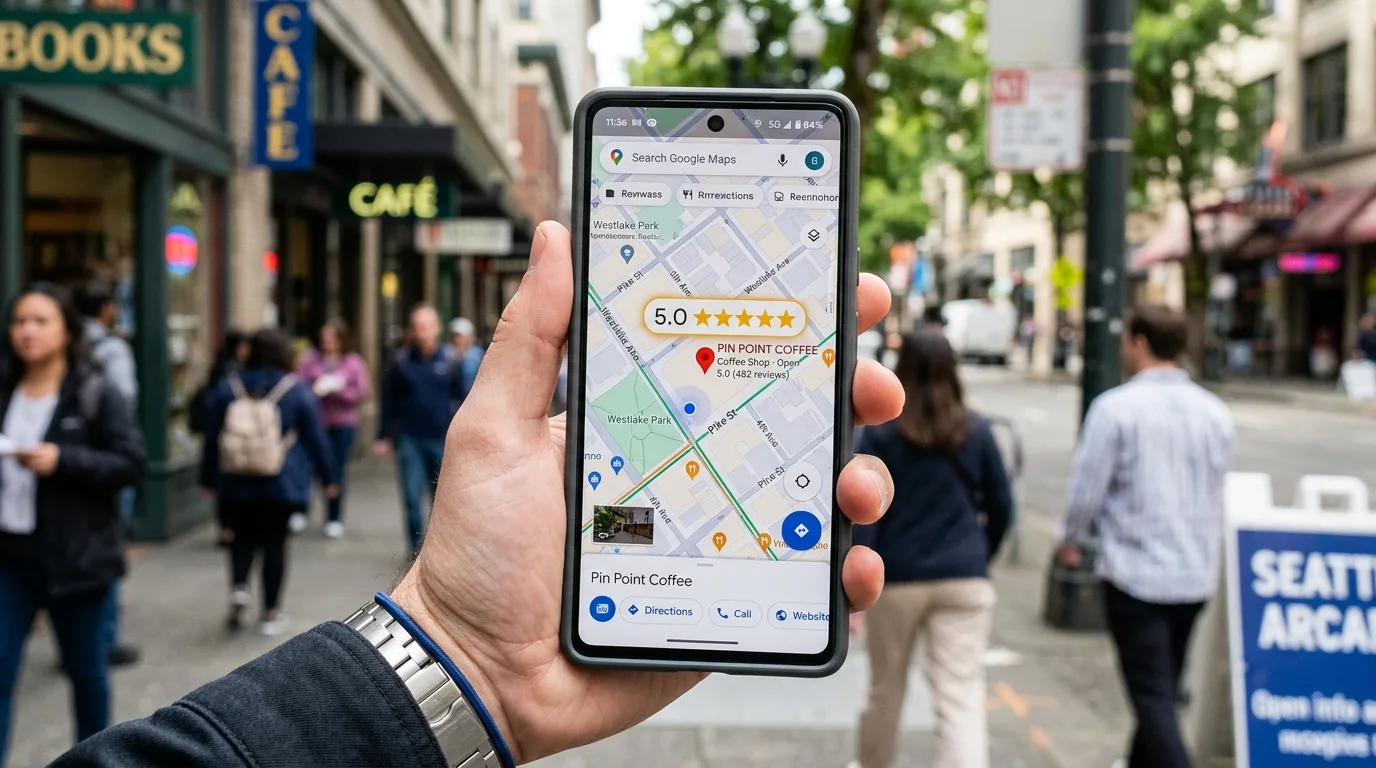
Local businesses face fiercer competition today than ever before. You no longer compete just with the shop across the street; you compete with every business vying for attention on digital platforms. When potential customers pull out their smartphones to find a nearby service, search engines act as the ultimate matchmakers. Securing a top spot in those localized search results requires a highly specialized approach.
This comprehensive guide explores the multifaceted world of local search engine optimization. We will break down exactly how modern search algorithms evaluate regional relevance and provide actionable strategies to elevate your digital footprint. Furthermore, we will examine how the rise of artificial intelligence changes the way you must format your digital presence. By understanding and applying these advanced techniques, you can effectively turn online searches into real-world foot traffic.
Want a broader perspective? Discover what top-tier SEO services include and how they transform your digital presence today.Explore our comprehensive guide
Understanding Local SEO Services in the AI Era
Search engines continuously evolve to provide users with the most accurate, contextually relevant information possible. Traditional optimization tactics still hold value, but local search demands a specialized strategy tailored to geographic proximity.
What Exactly Is Local Search Engine Optimization?
Local search engine optimization focuses entirely on improving a business’s visibility for geographically related searches. When users type phrases like “plumbers near me” or “best coffee shop in downtown,” search algorithms trigger a localized response. Optimizing for these specific queries ensures your business appears prominently when high-intent customers look for immediate solutions in your vicinity.
Professionals who offer local optimization services handle everything from claiming directory listings to generating community-focused content. They structure your digital assets so search algorithms clearly understand your exact physical location and the specific areas you serve. This targeted approach bypasses global competition and connects you directly with the community right outside your door.
Traditional SEO vs. Local SEO
While both disciplines share foundational principles, they target fundamentally different objectives. Traditional search optimization aims to capture a national or global audience. It relies heavily on broad keywords, massive backlink profiles, and extensive content libraries designed to answer universal questions.
Conversely, local optimization zeroes in on geographic relevance. It prioritizes localized intent, proximity to the searcher, and physical prominence within a community. Instead of competing with multinational corporations for broad industry terms, you compete strictly with local rivals for neighborhood dominance. If you want a deep dive into the broader aspects of search marketing, exploring comprehensive SEO
strategies will help you build a solid foundation before narrowing your focus geographically.
The Core Pillars of a Winning Local Strategy
Search engines use distinct ranking factors when evaluating local queries. They want to ensure they send users to legitimate, open, and highly rated establishments nearby. Understanding these core pillars allows you to align your strategy with algorithmic expectations.
The Anatomy of the Local Pack
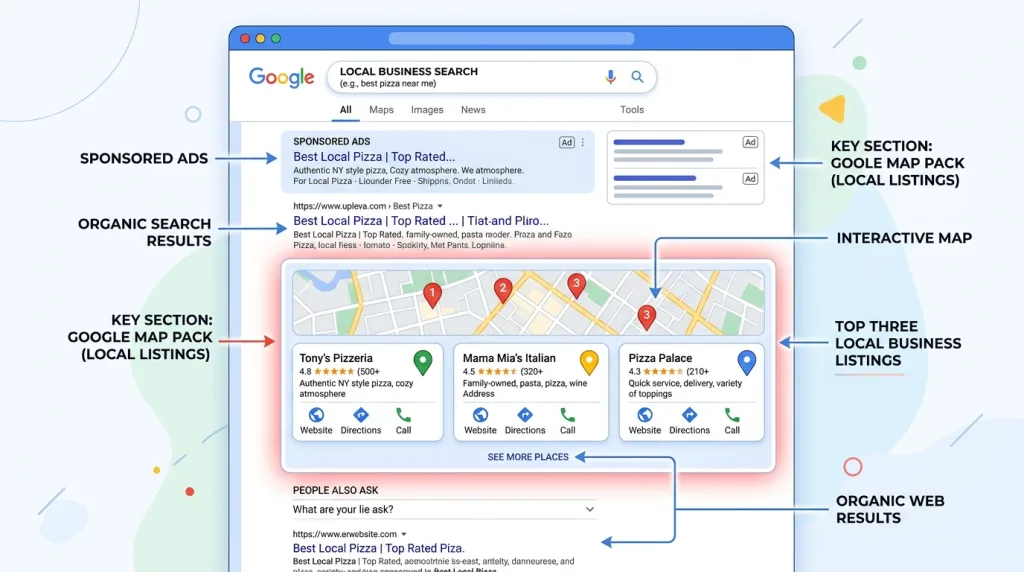
When you perform a local search, Google typically displays the “Local Pack” (or Map Pack) at the top of the results page. This distinct section features a map alongside three highly relevant business listings. Securing a spot in this three-pack represents the ultimate goal of local optimization because it drives the vast majority of user clicks.
The Local Pack bypasses standard organic results by providing immediate, actionable data. Users see your business name, aggregate star rating, physical address, operating hours, and quick links to call your office or request directions. Earning this prime real estate requires flawless execution across multiple local ranking signals.
How Search Engines Determine Local Ranking
Google explicitly states that its local algorithm relies on three primary factors to determine ranking order. You must master all three to consistently appear in the Local Pack:
- Relevance: Search algorithms evaluate how well a local business profile matches what someone searches for. Providing detailed, comprehensive business information helps engines better understand your services and match your profile to highly specific user queries.
- Distance: The algorithm calculates how far each potential search result sits from the location term used in a search. If a user does not specify a location, the engine calculates distance based on their current geographic data.
- Prominence: This factor measures how well-known a business is in the real world. Search engines evaluate prominence based on information aggregated from across the web, including links, articles, and directories. Review count and review score heavily factor into local search prominence.
The Rise of Generative Engine Optimization (GEO)
Artificial intelligence now fundamentally alters how users discover local businesses. Generative Engine Optimization (GEO) represents the practice of optimizing content specifically for AI-driven search experiences. AI overviews synthesize information from multiple sources to provide direct, conversational answers.
To succeed with GEO, you must provide clear, factual, and highly structured data. AI models look for consensus across the web. If your business hours vary between your website and Yelp, the AI model loses confidence in your data and may exclude your business from its generated response. Therefore, maintaining absolute accuracy across all digital touchpoints now carries unprecedented importance.
Mastering Google Business Profile Optimization
Your Google Business Profile serves as the crown jewel of your local search strategy. This free tool allows you to manage how your business appears across Google Search and Maps. A poorly optimized profile severely limits your local visibility, while a fully optimized one acts as a powerful lead-generation engine.
Claiming and Verifying Your Listing
Before you can optimize your profile, you must claim ownership and verify your business identity. Search engines require verification to prevent fraudulent listings and protect users. You typically complete this process via a postcard sent to your physical address, a phone call, or a live video verification session.
Once you receive your verification code, enter it promptly into your dashboard. Do not make any major changes to your core business information (like your business name or address) while waiting for verification, as this often resets the process and delays your live status.
Ensuring Complete NAP Consistency
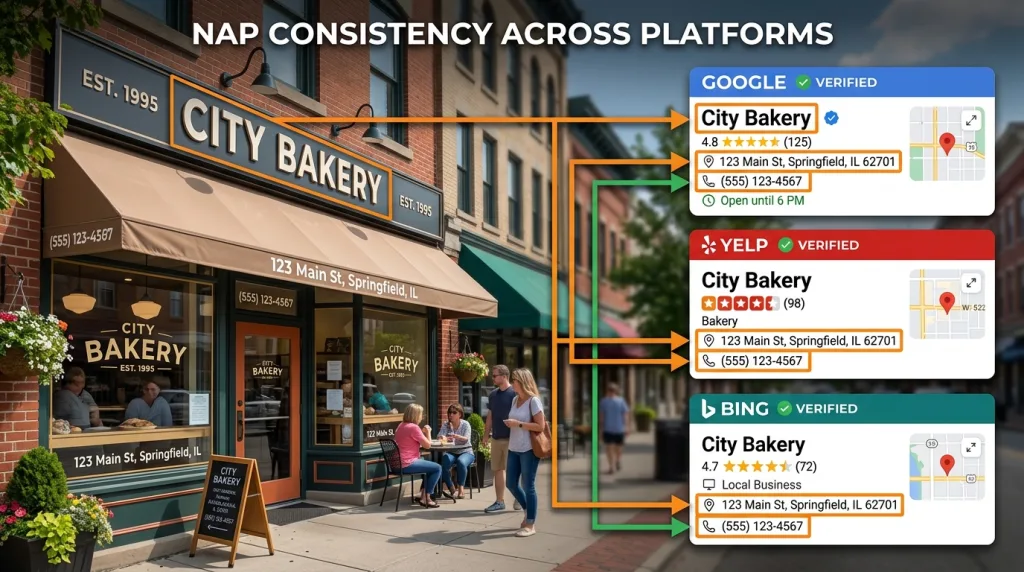
NAP stands for Name, Address, and Phone number. Search algorithms use your NAP data as a foundational trust signal. You must maintain perfect consistency with this information across the entire internet.
If your website lists your address as “123 Main Street, Suite 4” but your Google profile says “123 Main St, Ste 4,” algorithms might interpret these as two different locations. You should create a master document containing your exact, standardized NAP information. Use this exact formatting every time you create a new local listing or update your website contact page.
Struggling to find the right local search terms? Learn what SEO keywords are and capture your target market effectively.Learn about SEO Keywords
Selecting the Right Categories and Attributes
Categories help search engines determine which searches your local listing belongs in. You must select one primary category that best describes your overall business. Choose this carefully, as it heavily influences your ranking potential.
After selecting a primary category, you can add up to nine secondary categories to highlight additional services. Furthermore, you should aggressively utilize attributes. Attributes allow you to highlight specific features like “wheelchair accessible,” “veteran-led,” or “free Wi-Fi.” These details help generative AI engines provide highly specific recommendations to users with unique requirements.
Leveraging GBP Posts and Q&A Sections
Google Business Profile offers dynamic features that many businesses ignore. GBP Posts allow you to share updates, offers, events, and new products directly in the search results. You should publish new posts weekly to show search engines that your business remains active and engaged.
Additionally, you must monitor the Q&A section of your profile. Anyone can ask a question, and more importantly, anyone can answer it. You should proactively populate this section by posting common questions yourself and providing thorough, helpful answers. This prevents random internet users from providing inaccurate information to your potential customers.
Precision Local Keyword Research Strategies
Keyword research forms the foundation of all content marketing efforts. However, local keyword research requires a nuanced approach that prioritizes geographic modifiers and hyper-local search intent.
Uncovering Hyper-Local Search Terms
General keywords hold little value for a neighborhood business. Instead of targeting “emergency plumber,” you must target “emergency plumber in [City Name]” or “24/7 plumbing repair [Neighborhood Name].” You need to identify the exact phrasing your local community uses when discussing your industry.
Start by listing your core services and appending your city, county, and surrounding neighborhood names. You should also consider colloquial terms or nicknames that locals use for your area. If residents commonly refer to a specific district by an abbreviation, incorporate that abbreviation into your keyword strategy to capture highly qualified local traffic.
Analyzing User Intent for Local Queries
Search intent describes the primary goal a user has when typing a query into a search engine. Local search intent usually falls into two categories: informational (“how much does a roof repair cost in Miami”) and transactional (“roof repair company near me”).
You must map your keywords to the correct stages of the customer journey. Create detailed blog posts to capture informational intent early in the research phase. Conversely, optimize your core service pages and your Google Business Profile to capture transactional intent when users are ready to make a purchase. Providing the right type of content at the right time significantly improves your conversion rates.
Utilizing Competitor Keyword Analysis
Your local competitors often leave digital footprints that reveal their most successful keyword strategies. You should analyze the websites of businesses that currently dominate the Local Pack in your area. Look closely at the title tags on their service pages, the headings in their blog posts, and the categories they select on their business profiles.
Advanced professionals often utilize premium tools to run gap analyses. A gap analysis reveals the keywords your competitors rank for that your website currently ignores. By identifying these gaps, you can create targeted content to systematically steal market share from rival businesses.
On-Page Optimization for Local Businesses
On-page optimization refers to the strategic adjustments you make directly on your website to improve its visibility. For local businesses, on-page optimization requires seamlessly blending industry expertise with geographic relevance.
Crafting Dedicated Location Pages
If your business operates multiple physical locations, you must create a dedicated webpage for each specific branch. Never group all your locations onto a single generic contact page. Search engines struggle to rank a single page for multiple different cities simultaneously.
Each dedicated location page should feature unique content tailored to that specific branch. Include the exact NAP information for that location, an embedded interactive Google Map, localized testimonials, and descriptions of the specific services offered at that branch. Ensure you write completely unique copy for every location page to avoid duplicate content penalties.
Optimizing Meta Tags and Headers
Your title tags and meta descriptions serve as your first impression in organic search results. You must optimize these elements to clearly communicate both your service and your location. A strong title tag places the most important keywords at the beginning, followed by the geographic modifier, and ends with your brand name.
Additionally, you should structure your page content using descriptive header tags (H1, H2, H3). Your H1 tag should clearly state the main topic of the page, incorporating your primary local keyword. Use H2 and H3 tags to break down complex topics into scannable sections. This structured format heavily benefits Generative Engine Optimization, as AI models easily parse well-organized content to extract factual answers.
Ready to dominate your neighborhood search results? Explore expert local SEO services on Fiverr to accelerate your regional growth.View Fiverr Services
Implementing LocalBusiness Schema Markup
Schema markup acts as a universal language that helps search engines understand the context of your website data. By implementing LocalBusiness schema on your website, you feed explicit, structured data directly to search algorithms.
This code sits invisibly in the backend of your website. It highlights vital information like your business hours, accepted payment methods, geographic coordinates, and aggregate review scores. When you provide data in this format, you dramatically increase your chances of appearing in rich snippets and AI-generated overviews. For detailed implementation guidelines, developers should regularly consult the official documentation provided on Schema.org to ensure compliance with the latest structured data standards.
Building Authority with Local Link Building and Citations
Search engines view backlinks as digital votes of confidence. However, local search algorithms value relevance over sheer authority. A link from a prominent neighborhood blog often carries more weight for local rankings than a link from a massive international news publication.
The Role of Online Directories and Aggregators
A local citation represents any online mention of your business’s NAP data. Search engines use these citations to verify your existence and evaluate your prominence. You must ensure your business appears accurately in major data aggregators, as these platforms distribute your information to hundreds of smaller directories.
Beyond aggregators, you should manually submit your business to top-tier directories like Yelp, Bing Places, Apple Maps, and the Better Business Bureau. Furthermore, seek out industry-specific directories and local chamber of commerce websites. Maintain absolute consistency with your NAP data across every single submission to build a rock-solid foundation of algorithmic trust.
Earning High-Quality Local Backlinks
Earning backlinks from local organizations requires active community involvement. You should sponsor local youth sports teams, charity events, or community festivals. In exchange for your sponsorship, these organizations typically link back to your website from their event pages.
Additionally, you can host educational workshops or offer exclusive discounts to local university students or government employees. When these institutions publish information about your discounts or events on their official websites, you earn highly authoritative, locally relevant backlinks that significantly boost your geographic prominence.
Reclaiming Unlinked Brand Mentions
Sometimes, local news outlets or community bloggers mention your business in an article without actually linking to your website. These unlinked brand mentions represent missed opportunities for valuable link equity.
You should set up automated alerts for your business name. Whenever an alert notifies you of a new mention, review the article to see if it includes a backlink. If it does not, you can politely email the author or editor, thank them for the coverage, and gently request that they turn the mention into a clickable link. This simple outreach strategy often yields high-converting local backlinks with minimal effort.
Reputation Management and Review Strategies
Online reviews serve as the modern equivalent of word-of-mouth marketing. They profoundly influence consumer behavior and directly impact your local search rankings. You must implement a proactive system for managing your online reputation.
Developing a Proactive Review Generation Plan
You cannot simply hope that happy customers leave reviews; you must actively request them. Implement a systematic review generation strategy that asks for feedback at the peak moment of customer satisfaction.
Train your staff to request reviews verbally upon completing a successful service. Follow up with automated email or SMS campaigns containing a direct link to your Google review portal. Make the process as frictionless as possible. However, you must adhere strictly to platform guidelines. Never offer financial incentives or discounts in exchange for positive reviews, as this violates Google’s terms of service and can lead to severe penalties.
Responding to Positive and Negative Customer Feedback
Search engines monitor how actively you manage your business profile. You should respond promptly and professionally to every single review you receive, regardless of the star rating.
When responding to positive reviews, thank the customer by name, mention the specific service they received, and naturally weave in a localized keyword if appropriate. When handling negative reviews, remain objective and professional. Acknowledge their frustration, apologize for the negative experience, and immediately offer to resolve the issue offline by providing a direct contact number. Your response to a negative review often influences future prospects more heavily than the negative review itself.
How Reviews Influence AI Search Overviews
Generative AI models synthesize customer sentiment from across the web when answering user queries. If a user asks an AI search engine, “What is the most reliable HVAC company in Chicago?”, the AI model will analyze thousands of reviews to formulate a consensus.
If your reviews consistently mention terms like “punctual,” “honest pricing,” and “knowledgeable,” the AI model will extract these descriptive entities and associate them with your brand. Therefore, providing exceptional service that inspires detailed, narrative-driven reviews acts as a direct catalyst for Generative Engine Optimization success.
Localized Content Marketing Strategies
Content marketing establishes your authority and signals geographic relevance to search engines. You must transition away from generic blog posts and focus entirely on creating highly localized, community-centric content.
Developing Highly Relevant Service Pages
Your core service pages must thoroughly explain what you do while highlighting your connection to the community. Avoid thin content. You should write comprehensive pages detailing your processes, the specific materials you use, and the unique challenges your local climate or geography presents.
Incorporate local case studies directly onto your service pages. If you completed a major landscaping project in a prominent neighborhood, detail the specific challenges you overcame and feature localized imagery. This highly specific content proves your local expertise to both search engines and potential clients.
Is your website structure hurting local rankings? Explore our comprehensive SEO technical audit guide to fix hidden errors immediately.Perform a Technical Audit
Blogging About Community Events and News
Your blog provides an excellent platform to demonstrate community involvement. Instead of writing generic industry tips, you should write about local events, community partnerships, or neighborhood news that relates to your business.
For example, a local real estate agent could publish detailed monthly market reports specific to individual school districts. A local hardware store could write a guide on preparing homes for the specific weather patterns native to their county. This localized content naturally attracts regional backlinks and engages the exact demographic you want to reach.
Engaging Local Audiences on Social Media
While social media signals do not directly impact traditional search rankings, they heavily influence local prominence and brand awareness. You must maintain active profiles on platforms where your community congregates.
Share behind-the-scenes photos of your team working on local projects. Utilize geotags on every single post to reinforce your geographic location. Engage directly with other local businesses, neighborhood associations, and community leaders by commenting on their content. This active participation builds a digital web of local associations that search algorithms recognize and reward.
Mobile Optimization and Voice Search Readiness
Local search happens on the go. The vast majority of localized queries originate from mobile devices. If your digital presence fails to deliver a flawless mobile experience, you will lose a massive percentage of potential local revenue.
Capturing “Near Me” Micro-Moments
Consumers frequently use “near me” modifiers when they need an immediate solution. These searches represent high-intent micro-moments. A user searching for “tire repair near me” does not want to read a comprehensive history of rubber manufacturing; they want a phone number, an address, and immediate confirmation that your shop remains open.
To capture these micro-moments, you must ensure your critical business information sits front and center on mobile screens. Users should never have to scroll or zoom to find your phone number. Implement clickable call buttons and integrated map functions to streamline the conversion process.
Designing a Flawless Mobile Experience

Search engines utilize mobile-first indexing, meaning they evaluate the mobile version of your website before the desktop version. Your website must utilize a responsive design that seamlessly adapts to any screen size.
According to extensive research published on Think with Google
, even a one-second delay in mobile load times can severely impact conversion rates. You must compress heavy images, minify excessive code, and leverage browser caching to ensure your mobile site loads instantaneously. A fast, fluid mobile experience keeps users engaged and signals high quality to search engine algorithms.
Preparing for Voice-Activated Local Queries
Voice search fundamentally changes the way users phrase their queries. When typing, a user might enter “best pizza Brooklyn.” When speaking to a digital assistant, that same user will likely ask, “Where is the best pizza place open right now near me?”
Voice queries feature longer, more conversational phrasing centered around question words (who, what, where, when, why, how). You must optimize your content to answer these direct questions clearly and concisely. Structuring your content with clear FAQs and utilizing conversational language drastically improves your chances of being featured as a voice search result.
Technical SEO Essentials for Local Websites
Technical optimization ensures that search engine crawlers can efficiently access, read, and index your website content. Without a solid technical foundation, even the best local content strategy will fail to generate results.
Structuring Your Site Architecture
Your website architecture dictates how easily search engines understand the hierarchy and relationship between your pages. You should organize your site using a logical, flat structure. A user should be able to reach any local service page or location page within three clicks from your homepage.
Utilize clear, descriptive URL structures. Instead of using a random string of numbers, format your URLs to include your target keywords and locations (e.g., [yourwebsite.com/plumbing-services/austin-tx](https://yourwebsite.com/plumbing-services/austin-tx)). Create a comprehensive XML sitemap and submit it directly to search engines to ensure they discover every localized page on your domain.
Improving Core Web Vitals and Page Speed
Google uses Core Web Vitals to measure the overall user experience of a webpage. These metrics evaluate loading speed, visual stability, and interactivity. You must ensure your website passes the Core Web Vitals assessment to maintain competitive rankings.
Focus on optimizing your Largest Contentful Paint (LCP) by upgrading your server response times and preloading critical assets. Minimize Cumulative Layout Shift (CLS) by assigning explicit dimensions to all images and video elements on your site. A technically sound website provides a frictionless experience that keeps local users on your page longer.
Securing Your Website with HTTPS
Security remains a mandatory ranking factor across all search engines. If your website does not utilize an SSL certificate (HTTPS), browsers will display a prominent “Not Secure” warning to users. This warning instantly destroys consumer trust, particularly for local businesses asking users to submit contact forms or request quotes online.
You must ensure that every single page, image, and script on your website loads securely over HTTPS. Regularly monitor your SSL certificate status to prevent expiration and maintain the encrypted connection that modern search engines demand.
Need specialized help managing your local map pack presence? Hire top-rated local SEO professionals on Upwork to boost visibility.Hire Professionals on Upwork
Tracking Analytics and Measuring Local Success
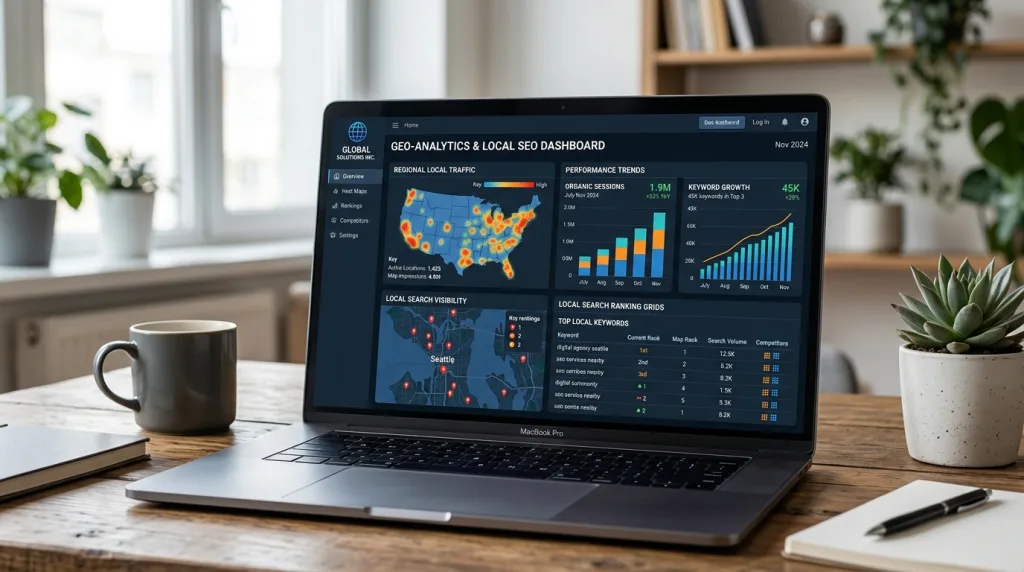
You cannot improve what you do not measure. Implementing a rigorous tracking and analytics protocol allows you to evaluate the return on investment for your local optimization campaigns and make data-driven adjustments.
Monitoring Key Performance Indicators
Local SEO requires tracking specific Key Performance Indicators (KPIs) that differ slightly from global campaigns. While tracking organic traffic remains important, you must prioritize metrics that indicate real-world intent.
Monitor your Google Business Profile dashboard heavily. Track the number of direct calls generated from the listing, the volume of “request directions” clicks, and the number of times users visit your website directly from the Local Pack. These specific actions represent high-intent users actively moving down the local conversion funnel.
Utilizing Advanced SEO Tracking Tools
Standard analytics platforms often struggle to track localized search visibility accurately because rankings fluctuate wildly based on the exact physical location of the searcher. You must utilize specialized local rank tracking software to gain an accurate picture of your visibility.
These advanced tools deploy localized search grids. A localized grid simulates searches from various points across a specific city or neighborhood, showing you exactly where you rank well and where your competitors dominate. By analyzing these geographic heat maps, you can identify specific neighborhoods that require more aggressive citation building or localized content.
Interpreting Monthly Performance Reports
Data collection holds no value without accurate interpretation. You should compile your KPIs into comprehensive monthly reports. Compare your current data against previous months and year-over-year metrics to identify long-term seasonal trends.
Do not just look at the numbers; analyze the story they tell. If your profile views increase but your phone calls decrease, you might need to adjust the primary call-to-action on your listing or improve your review score. Use these insights to continually refine your strategy and adapt to shifting market conditions.
Future-Proofing with Generative Engine Optimization (GEO)
As artificial intelligence continues to integrate directly into the search ecosystem, businesses must proactively adapt their content strategies to satisfy Large Language Models (LLMs). Generative Engine Optimization ensures your brand survives the transition from traditional search links to AI-generated answers.
Adapting to AI-Driven Search Results
AI overviews attempt to provide zero-click solutions. The engine reads multiple websites, synthesizes the facts, and presents a comprehensive answer directly on the results page. To remain visible in this environment, you must establish absolute factual authority.
You should ensure your business details, service menus, and pricing models remain consistent everywhere they appear online. If an AI model detects conflicting information across different directories, it will exclude your business from its generated response to maintain its own accuracy standards. Trust and consistency form the bedrock of GEO success.
Structuring Content for Large Language Models
Language models parse information differently than human readers. They rely heavily on semantic relationships, clear formatting, and structured data. You must format your local content in a highly logical manner.
Use precise, definitive language. Instead of writing, “We offer some of the best plumbing services around,” write, “Our company provides emergency plumbing services in downtown Austin, Texas.” Utilize bulleted lists, comparative tables, and bolded entity names. The more structured and digestible you make your data, the more effectively generative AI models can extract and feature your business in local queries.
Frequently Asked Questions About Local SEO Services
How long does it take to see results from local SEO?
Local search optimization represents a long-term investment. While updating your Google Business Profile might yield minor improvements within a few weeks, building significant local authority takes time. Most businesses begin to see noticeable increases in local traffic, map pack visibility, and phone calls between three to six months of consistent optimization efforts.
Do I need a physical address to do local SEO?
You do not strictly need a storefront where customers visit you, but you must have a physical address to verify a Google Business Profile. If you run a Service Area Business (SAB) like a mobile detailing service or a plumbing company, you can hide your physical address from the public listing while still designating the specific geographic areas you travel to serve. PO Boxes and virtual offices violate Google’s guidelines and will result in a suspended listing.
Why did my business disappear from the Map Pack?
Listings typically drop out of the Map Pack due to a few common issues. Search engines heavily penalize businesses for NAP inconsistency, keyword stuffing in the business name, or acquiring fake reviews. Additionally, a new, highly optimized competitor might have simply outranked you, or an algorithmic update may have shifted the primary ranking factors. You must conduct a comprehensive audit to identify and resolve the specific drop cause.
Can I do local SEO on my own, or do I need an agency?
Business owners can execute many foundational tactics such as claiming profiles, requesting reviews, and updating basic NAP data—independently. However, competitive markets often require advanced strategies like technical schema implementation, local link building, and comprehensive gap analyses. If you lack the time or technical expertise, hiring dedicated professionals typically yields a much higher return on investment.
How do online reviews directly impact my local rankings?
Reviews heavily influence the “Prominence” factor in the local search algorithm. Search engines evaluate the total volume of your reviews, your aggregate star rating, the frequency of new reviews, and the specific keywords customers use in their feedback. A steady stream of positive, narrative-rich reviews signals to algorithms that your business remains active, trustworthy, and highly relevant to local consumers.
What is the most important factor for local SEO?
No single tactic guarantees success, but claiming and completely optimizing your Google Business Profile remains the most impactful foundational step. Without an accurate, verified, and active profile, appearing in the highly coveted Local Map Pack becomes virtually impossible.
Final Thoughts on Elevating Your Local Presence
Mastering local search visibility requires a commitment to consistency, technical accuracy, and community engagement. You must view your digital presence as an exact mirror of your physical business. By perfectly aligning your Google Business Profile, managing your online reputation, executing targeted keyword strategies, and embracing the structural demands of Generative Engine Optimization, you position your brand as the undeniable local authority.
Search algorithms and AI models ultimately want to recommend the best, most reliable businesses to their users. Prove that you are that business through meticulous optimization, and you will transform local searches into a consistent, scalable stream of real-world revenue.
Thinking about optimizing your local presence independently? Read our guide to discover if you can handle SEO yourself effectively.Find out if DIY SEO is for you
Keep reading
All articles
Best GPU for Video Editing in 2026 – Top 10 Graphics Cards Ranked
Choosing the best GPU for video editing in 2026 comes down to more than raw speed. You need the right mix of VRAM,…
Read article
How to Make Backlinks: A Complete Guideline for Building Authority
Want more traffic? This complete backlink guide shows you exactly how to earn links from authoritative websites in your niche.
Read article
Page Views vs. Visits: What’s the Difference?
Learn the difference between page views and visits. Discover how each metric impacts your SEO and business decisions. Complete guide with examples.
Read article