

Every modern website or web application you interact with whether it’s a bustling ecommerce store, a real-time dashboard, or a content‑rich blog rests on thousands of lines of carefully organized code. Writing all that code from scratch would slow any team to a crawl. Web development frameworks solve this exact problem. They give developers a structured starting point, reusable components, and proven patterns that tame complexity and accelerate delivery. In this guide, you’ll explore what web development frameworks really are, the key concepts that power them, the different types that dominate the industry, and the measurable benefits they bring to projects of any size. You’ll also learn how to choose the right one for your next initiative and glimpse the trends that are reshaping the framework landscape.
Ready to turn framework concepts into real-world applications? Partner with Vastcope’s expert web development team to build scalable, high‑performance solutions tailored to your business. Explore our web development services.
What Exactly Is a Web Development Framework?
A web development framework is a pre‑built collection of libraries, tools, and best practices that provides a foundation for building websites, web applications, and APIs. Think of it as a well‑organized toolbox and a blueprint combined. Instead of reinventing user authentication, database connections, or URL handling for every new project, you reach for the framework’s built‑in capabilities. This approach dramatically reduces repetitive work and lets teams focus on what makes their application unique.
MDN Web Docs defines a web framework as a tool that “aims to alleviate the overhead associated with common activities performed in web development.” These common activities include routing requests to the correct code, interacting with databases, rendering HTML templates, and managing sessions securely. When you adopt a framework, you agree to work within its conventions, and in return you gain speed, security, and a structure that other developers instantly recognize.
Library vs. Framework: Understanding Inversion of Control

People often use the words “library” and “framework” interchangeably, but a critical distinction exists. A library is a collection of functions that you call whenever you need them. You remain in control of the application flow. A framework, on the other hand, inverts that control. The framework calls your code at specific points; it dictates the overall architecture, and you fill in the details. This concept, known as inversion of control, is what makes frameworks so powerful they enforce consistency and handle the plumbing while you concentrate on business logic.
- You import a library and use its functions at will; the library never dictates the structure of your entire project.
- A framework provides the skeleton of your application. You plug your components into the skeleton, and the framework manages the lifecycle, from receiving an HTTP request to sending a response.
Understanding this difference clarifies why frameworks accelerate development so dramatically. They eliminate thousands of small decisions about file structure, naming conventions, and error handling, letting your team align quickly.
Key Concepts Behind Web Development Frameworks

All mature web development frameworks share a set of foundational concepts. Grasping these concepts helps you compare frameworks and decide which one fits your mindset and your project’s needs.
Model-View-Controller (MVC) Pattern
MVC separates an application into three interconnected layers. The model handles data and business logic. The view presents information to the user. The controller processes incoming requests, manipulates data through the model, and selects the appropriate view. Wikipedia’s explanation of model–view–controller traces its origins back to graphical user interfaces, but it has become the backbone of countless web frameworks such as Ruby on Rails, Laravel, and ASP.NET Core. MVC keeps your code organized, makes it easier to test individual components, and allows multiple developers to work on separate layers without stepping on each other’s toes.
Routing and URL Mapping
Every web framework needs a way to translate a user‑friendly URL into a specific piece of code. Routing systems let you define patterns like /products/123 and map them to a controller action that fetches the product with ID 123. Modern routers support route parameters, optional segments, and even regular expressions. Frameworks like Express.js use a minimal, chainable routing syntax, while Django’s URL dispatcher leans on a centralized configuration file. Clear routing keeps your API intuitive and your application easy to navigate.
Templating Engines
Templating engines enable you to write HTML with dynamic placeholders for data. Instead of concatenating strings or constructing entire pages with server‑side code, you write templates that blend markup with simple logic. For example, you might loop through an array of blog posts and render each one inside an <article> tag. Popular engines include EJS, Handlebars, Jinja2 (Python), and Blade (Laravel). These engines protect against cross‑site scripting (XSS) by escaping output automatically and allow you to create reusable layout components like headers and footers.
Object‑Relational Mapping (ORM)
Most web applications rely on a database. An ORM bridges the gap between object‑oriented code and relational databases. Instead of writing raw SQL queries, you define models as classes and interact with records through methods. Django’s ORM, Sequelize for Node.js, and Eloquent for Laravel each provide an expressive syntax that generates optimized queries behind the scenes. ORMs also handle connection pooling, migrations, and schema management, which significantly reduces boilerplate code and the risk of SQL injection.
Middleware and Request Pipeline
Middleware functions sit between the raw incoming request and the application logic. They inspect, modify, or short‑circuit requests before they reach the controller. Common middleware handles authentication, logging, compression, and CORS headers. Frameworks like Express.js and ASP.NET Core build their entire request pipeline around middleware, giving you a clean way to layer cross‑cutting concerns without tangling them into business logic.
- Middleware can authenticate users before any controller code runs.
- It can compress responses to reduce bandwidth.
- It can log request details for monitoring and debugging.
- It can parse JSON or form data so that you work with convenient objects.
Types of Web Development Frameworks

Web development frameworks fall into three broad categories based on where they operate: frontend (client‑side), backend (server‑side), and full‑stack. Each type tackles a distinct portion of the technology stack, and many projects combine one frontend and one backend framework to achieve the best of both worlds.
Frontend Frameworks
Frontend frameworks run in the browser and manage what users see and interact with. They provide components, state management, and tools for building responsive, interactive interfaces. Developers choose a frontend framework when they need to create single‑page applications (SPAs), dynamic dashboards, or progressive web apps that feel as fluid as native software.
- React: Created and maintained by Meta, React focuses on a component‑based architecture and a virtual DOM for efficient updates. React’s component‑based architecture lets you compose complex UIs from isolated, reusable pieces. Its massive ecosystem includes state management libraries like Redux and Next.js for server‑side rendering.
- Angular: Google’s Angular delivers a complete, opinionated platform with two‑way data binding, dependency injection, and a powerful CLI. Teams often favor Angular for enterprise‑scale applications because it enforces a consistent structure and comes with built‑in solutions for forms, HTTP communication, and routing.
- Vue.js: Vue combines a gentle learning curve with reactive data binding and a flexible component system. You can use it as a library to enhance parts of a page or as a full‑blown framework with Vue Router and Pinia for state management. Its single‑file components keep HTML, CSS, and JavaScript co‑located, which many developers find intuitive.
- Svelte: Svelte shifts the heavy lifting from the browser to a compile step, producing highly optimized vanilla JavaScript. It eliminates the virtual DOM entirely and writes code that directly updates the DOM. This approach results in smaller bundle sizes and excellent runtime performance.
Backend Frameworks
Backend frameworks run on the server and handle business logic, database interactions, authentication, and API endpoints. They receive requests, process data, and send responses back to the client. Choosing the right backend framework often depends on your preferred programming language and the scale of your application.
- Express.js (Node.js): Minimalist and unopinionated, Express forms the backbone of countless Node.js applications. Its middleware‑driven design makes it easy to plug in functionality. The vast npm ecosystem ensures you never start from scratch.
- Django (Python): Django follows the “batteries‑included” philosophy, shipping with an ORM, an admin interface, authentication, and a templating engine out of the box. It enforces a clean project structure and promotes rapid development while keeping security top‑of‑mind. Django powers sites like Instagram and Pinterest.
- Ruby on Rails: Rails popularized convention over configuration and the MVC pattern. It generates a working application with just a few commands and encourages best practices like database migrations and RESTful design. Many startups credit Rails for their ability to launch an MVP in days.
- Laravel (PHP): Laravel brings expressive syntax and a rich set of tools to PHP development. Features like Eloquent ORM, Blade templating, and Artisan CLI streamline common tasks. Laravel’s ecosystem also offers official packages for billing, social authentication, and server management.
- Spring Boot (Java): Spring Boot simplifies enterprise Java development by auto‑configuring the Spring framework. It excels at building large, secure, transactional systems and integrates seamlessly with the broader Java ecosystem. Many financial and healthcare applications rely on Spring Boot for its maturity and stability.
Full‑Stack Frameworks
Full‑stack frameworks blur the line between frontend and backend, providing a unified way to build an entire application from a single codebase. They handle server‑side rendering, API routes, and client‑side interactivity in one cohesive developer experience.
- Next.js: Built on React, Next.js adds file‑based routing, server‑side rendering, static site generation, and API routes. It lets you choose the best rendering strategy for each page static generation for a blog, server‑side rendering for a personalized dashboard without juggling separate projects.
- Nuxt.js: Nuxt does for Vue what Next does for React. It offers a smooth developer experience with automatic code splitting, a powerful module system, and excellent defaults for SEO and performance.
- Meteor: Meteor provides a real‑time, isomorphic platform where the same JavaScript code runs on both the client and the server. It manages data synchronization automatically, making it a strong choice for collaborative applications like live‑editing tools.
Interested in launching a powerful online store? Discover how Vastcope’s ecommerce web development services leverage leading frameworks to create fast, secure shopping experiences. Read our ecommerce guide.
Benefits of Using Web Development Frameworks
Frameworks inject speed, quality, and predictability into the development process. Teams that embrace them ship faster, maintain code more easily, and build applications that stand up to real‑world demands.
Faster Development and Time‑to‑Market
Frameworks eliminate the monotony of scaffolding. When you start a new Django or Laravel project, you gain authentication, database connectivity, and an admin panel in minutes, not weeks. Stack Overflow’s 2024 Developer Survey confirms that professional developers overwhelmingly rely on frameworks, precisely because they shrink repetitive coding tasks. Faster development means you can respond to market changes, test ideas through MVPs, and deliver value to users sooner.
- Ready‑made components handle user registration, password reset, and permission checks.
- Command‑line tools generate models, controllers, and migrations with a single line.
- Established patterns reduce the time spent debating architecture.
Consistent Architecture and Maintainability
A framework imposes a well‑defined project structure. When a new developer joins your team, they recognize the folder layout and the flow of an HTTP request because those conventions appear across thousands of codebases. This consistency makes code reviews faster, onboarding smoother, and long‑term maintenance far less painful. Instead of untying spaghetti code, you enhance features within a predictable architecture.
Enhanced Security
Web frameworks ship with defenses against the most common vulnerabilities. They escape output to prevent cross‑site scripting (XSS), use parameterized queries or ORMs to block SQL injection, and include built‑in protection against cross‑site request forgery (CSRF). These protections don’t require you to be a security expert; you simply use the framework’s APIs, and it handles the rest. Regular updates from active maintainer communities patch newly discovered threats, keeping your application hardened over time.
Scalability and Performance Optimization
Modern frameworks optimize performance through caching strategies, lazy loading, efficient database querying, and support for asynchronous processing. Node.js frameworks like Express and Fastify excel at handling thousands of concurrent connections. Django and Rails offer robust caching backends that store rendered pages, query results, or session data in memory. Full‑stack frameworks such as Next.js let you pre‑render pages at build time and serve them via a CDN, reducing server load and latency. This built‑in scalability means your application can grow from a handful of users to millions without a complete rewrite.
Rich Ecosystem and Community Support
Choosing a widely adopted framework plugs you into a global community. You gain access to countless open‑source packages, detailed documentation, tutorials, and forums. When you encounter a bug, chances are someone else already solved it and shared the answer. For example, React’s npm ecosystem contains thousands of pre‑built components, while Laravel’s ecosystem offers official packages for everything from real‑time notifications to cashier integration. This network effect dramatically reduces the risk of building on a framework and accelerates troubleshooting.
- You can add complex features like payment gateways with a single package.
- Active communities drive continuous improvement and security patches.
- Extensive testing tools and libraries integrate seamlessly with the framework.
Streamlined Testing and Debugging
Frameworks encourage, and often enforce, testable code. The separation of concerns in MVC architectures lets you unit‑test models in isolation, simulate HTTP requests for controllers, and write end‑to‑end tests that mimic user behavior. Laravel’s built‑in testing helpers, Django’s test client, and React’s Testing Library all make it straightforward to maintain high test coverage. Built‑in debugging tools such as Laravel’s debug bar or Django’s error pages surface issues instantly during development, cutting down the time you spend hunting for bugs.
How to Choose the Right Web Development Framework
Selecting a framework can feel overwhelming because the options all sound impressive on paper. Ground your decision in the specific needs of your project and team. Use the following questions as a compass.
What Are Your Project Requirements?
Define what your application must do. A content‑heavy marketing site with relatively static pages thrives with a static site generator or a full‑stack framework like Next.js that supports incremental static regeneration. A real‑time chat application needs persistent connections and might gravitate toward Node.js with Socket.io and Express. An ecommerce platform with complex inventory management and secure payment processing benefits from a mature, batteries‑included framework such as Django or Laravel. Match the framework’s strengths to your domain, not just its popularity.
What Does Your Team Already Know?
Your developers’ existing skills heavily influence productivity and morale. If your team lives and breathes JavaScript, adopting Express or Next.js keeps everyone in a familiar language. A Python‑savvy team naturally picks Django or Flask. Forcing a new language and framework at the same time often delays delivery and introduces subtle bugs. Sometimes the “best” technical choice is the one your team can wield effectively today.
How Steep Is the Learning Curve?
Frameworks like Vue and Express pride themselves on gentle learning curves, while Angular and Spring Boot come with more upfront complexity but offer powerful tools for large projects. Assess the timeline and the complexity of your application. If you need to launch an MVP in two weeks, a lightweight, intuitive framework reduces the risk of missed deadlines. If you’re building a long‑lived enterprise system, investing in a more structured framework pays dividends in maintainability.
How Large and Active Is the Community?
A thriving community answers questions, writes tutorials, contributes packages, and fixes bugs. Check the framework’s GitHub stars, the number of questions on Stack Overflow, and the frequency of releases. React, Vue, Django, and Laravel each have vibrant communities that ensure you’ll never be stuck for long. A smaller community can still be healthy, but you should verify that the core maintainers actively merge pull requests and publish security updates.
What Performance and Scalability Demands Do You Anticipate?
If you expect a high volume of concurrent connections, event‑driven frameworks like Express.js or Fastify handle concurrency elegantly. If you need to serve millions of pages with minimal server resources, a statically generated Next.js site hosted on a CDN drastically reduces costs. Benchmarks exist for every framework, but real‑world performance depends heavily on your architecture, database queries, and caching strategy. Prototype a small piece of your application in a candidate framework to see how it behaves under load before committing fully.
Future Trends in Web Development Frameworks
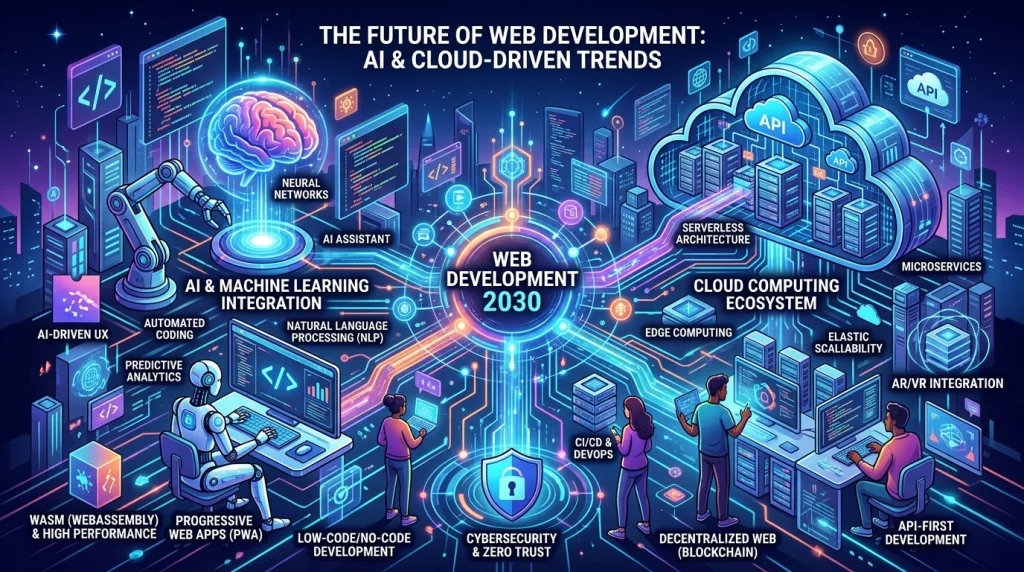
The framework ecosystem never stands still. Several trends are reshaping how we build for the web, and staying aware of them helps you future‑proof your skills and your codebase.
Jamstack and Decoupled Architectures
Jamstack (JavaScript, APIs, Markup) decouples the frontend from the backend, serving pre‑built static files from a CDN while dynamic functionality comes from APIs. Frameworks like Next.js, Nuxt, and Gatsby excel in this model. Jamstack sites are inherently fast, secure, and easy to scale. As headless CMS platforms and API‑first services multiply, Jamstack will continue gaining traction for content sites, ecommerce storefronts, and marketing pages.
Serverless and Edge Computing
Serverless platforms such as Vercel, Netlify Functions, and AWS Lambda allow you to run backend logic without provisioning servers. Full‑stack frameworks now integrate deeply with serverless, enabling you to write API routes that automatically scale. Edge computing takes this further, running code close to users at the network edge for near‑instant responses. Next.js Middleware and Cloudflare Workers bring framework‑like routing and logic directly to the edge, blurring the lines between CDN and application server.
Micro‑Frontends and Module Federation
Large organizations often struggle with monolithic frontend codebases. Micro‑frontends apply the same principles as backend microservices to the UI: independent teams build, test, and deploy self‑contained pieces of a frontend. Webpack 5’s Module Federation and frameworks like single‑SPA enable multiple frameworks to coexist on the same page. This approach allows gradual migration and parallel development, which is especially valuable for massive enterprise portals.
AI‑Driven Development and Low‑Code Integration
Framework tooling increasingly bakes in AI assistance. Code generators, intelligent autocomplete, and automated refactoring tools learn from your project’s patterns to suggest entire components. Low‑code platforms are also beginning to output framework‑compatible code, letting business stakeholders prototype interfaces that developers later refine within a standard React or Vue project. While AI won’t replace a developer’s judgment, it will continue to accelerate the routine parts of framework‑based development.
Enhanced Developer Experience (DX)
Framework teams compete fiercely on developer experience. Hot module replacement, zero‑config setups, instant previews, and tight TypeScript integration all reduce friction. Nuxt 3 and SvelteKit, for example, embrace convention over configuration while offering escape hatches for complex scenarios. Future frameworks will continue to prioritize fast feedback loops, streamlined deployment, and built‑in observability so that developers spend more time creating and less time fighting tooling.
Frequently Asked Questions
What is the main purpose of a web development framework?
A framework provides a structured, reusable foundation that handles common web development tasks such as routing, database interaction, and templating so developers can focus on building unique features instead of reinventing the wheel.
How do frontend frameworks differ from backend frameworks?
Frontend frameworks run in the browser and manage user interfaces, interactivity, and state. Backend frameworks run on the server, handling business logic, data storage, authentication, and API responses. Many modern applications pair one frontend framework with one backend framework.
Is React a framework or a library?
React officially calls itself a library because it focuses on the view layer and does not enforce a project structure. However, when combined with complementary tools for routing, state management, and server‑side rendering, the ecosystem forms a de facto framework.
Can I use multiple frameworks in the same project?
Yes. It’s common to use a frontend framework like Vue or React with a backend framework like Express or Django. Some architectures even run multiple micro‑frontends on the same page using module federation.
Which framework is best for beginners?
Vue.js and Express.js are often praised for their gentle learning curves. Django’s “batteries‑included” approach also helps beginners because it handles many decisions automatically, letting you focus on learning web fundamentals.
Do I need a framework for a simple website?
Not always. A static HTML site with minimal interactivity may not benefit from a full framework. But even for modest projects, a lightweight framework like Astro or a static site generator can speed up development and make the site easier to maintain as it grows.
How often do web development frameworks change?
Major versions tend to release every one to two years, with smaller updates more frequently. Most frameworks provide clear migration guides, and staying current ensures you receive performance improvements and security patches.
What role does TypeScript play in modern frameworks?
TypeScript adds static type checking to JavaScript, catching errors early and improving code editor tooling. Many frameworks, including Angular, Next.js, and Nuxt, offer first‑class TypeScript support, and its adoption continues to rise across the entire ecosystem.
Conclusion
Web development frameworks transform the way you build for the internet. They condense decades of collective engineering experience into repeatable patterns, secure defaults, and powerful abstractions. Whether you craft immersive user interfaces with React or Vue, ship robust APIs with Django or Express, or unify the entire stack with Next.js or Nuxt, a well‑chosen framework eliminates guesswork and lets your team deliver value faster. The framework landscape will keep evolving embracing serverless, Jamstack, AI, and ever‑better developer experiences but the core promise remains unchanged: do more, with less boilerplate, and build applications that are secure, scalable, and maintainable from day one.
Take the first step toward mastering web development foundations. Dive into Vastcope’s comprehensive introduction to web development and start building smarter today. Read the introduction.
Keep reading
All articles
The Ultimate Guide to the Top Mobile App Development Platforms in 2026
Businesses across the globe recognize the undeniable power of mobile applications. A well-designed mobile app connects you directly with your target audience,…
Read article
Make Your Website Secure in 2026: 14 Critical Steps
Website security in 2026 demands more than basic firewalls. Discover how to defend against AI threats, secure APIs, and maintain compliance.
Read article
What Are Core Web Vitals & Why Do They Still Matter?
The digital landscape is ruthless when it comes to performance. Users expect websites to load instantaneously, respond to taps without hesitation, and…
Read article